

Notice of Site Closure
Thank you very much for using Panasonic Kids School.
This website will be discontinued as of March 31, 2026.We sincerely appreciate your support and loyalty over the years.


-
You can’t hear sounds without air

-
Does sound slow down on chilly days?
-
Why can you hear through a string telephone?
-
Why does your voice echo in a shower room or a tunnel?
-
Are there sounds we can’t hear?
-
How does a microphone make sounds bigger?
-
How do our voices work?
-
Did you know you can touch sound?
-
Everyone likes the sound of a river
-
How come can we hear the sound of the wind?
-
Why do dogs make odd sounds when they hear a police car’s siren?
-
Music changes people’s moods
-
Why do rattlesnakes make a rattling sound?
-
Why does the sound of an ambulance siren change as it passes by me?
-
What kind of sound is noise?

You can’t hear sounds without air
There are so many sounds all around us. The sounds of cars, footsteps, bouncing balls, and so on. We hear sounds with our ears. But the air is what actually carries sounds to our ears so we can hear them. Deep in the ear is the eardrum. The eardrum is necessary to hear sounds. Sounds make the air vibrate like waves on an ocean. The air vibrations in turn vibrate the eardrum, which we sense as sound. We hear all kinds of different sounds — high-pitched sounds, low-pitched sounds, noisy sounds, quiet sounds — because each sound creates air vibrations of different sizes and intensities.
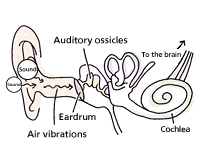
Sounds can’t be heard in space. That’s because there’s no air to carry sounds.
Does sound slow down on chilly days?
Sound reaches our ears by vibrating the air like waves. So if the temperature of the air, which carries sound, changes, then the speed at which it carries sound will also change.
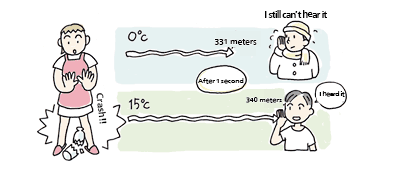
First of all, sound is not instant. It has a speed, which is called the speed of sound. Sound travels in air at a speed of around 331 meters per second. This speed is called Mach 1. This is the speed of sound at 0 degrees Celsius. But for each degree of Celsius increase in temperature, the speed of sound speeds up by 0.6 meters per second. So the warmer it is, the faster sound travels. And the colder it is, the slower sound goes. This effect is caused by the movement of air. The warmer the air, the livelier it moves. The colder the air, the more sluggish it moves. So on chilly days, it’s harder for sound to travel.
Why can you hear through a string telephone?
Connect the bottoms of two paper cups with a string, and, ta-da, you have built a string telephone! If you talk into one of the paper cups, your voice will reach the other paper cup. How does this work?
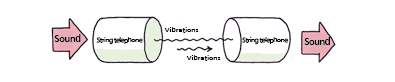
We saw before that sound is carried, or transmitted, by air to your ears. But, in fact, many materials other than air can transmit sound. With a string telephone, it’s the string that transmits the sound. What’s interesting is that string, being a solid, transmits sound better than air, which is a gas. The reason is sound travelling through air gets weaker and weaker. But sound travelling through a solid material is transmitted without getting weaker. One tip for a better string telephone is to keep the string taut. With the string tight between the cups, the transmitted sound will be stronger. But if you pinch the string in the middle, it will stop transmitting sound.
Why does your voice echo in a shower room or a tunnel?
When you sing in the shower, your voice will echo a lot and sound beautiful. If you shout loudly in a tunnel, after a moment or two, you will hear your voice echo back to you. Why does this happen?
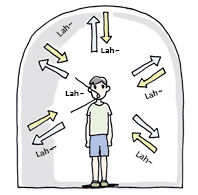
This happens because the sound of your voice hits the walls and bounces back to you. These sound echoes are called reverberations. As sound tries to spread out farther and farther, it runs into walls. The sound hits the walls and comes back to your position. The harder the wall, the stronger the reverberations. This is especially true in narrow spaces with hard walls like a shower room or tunnel. Sounds echo a lot and reach your ears one after another. The reflected sounds gradually weaken and fade away. But when a new sound echoes together with a fading sound, the combination is pleasing to our ears.
Are there sounds we can’t hear?
You might be surprised to learn that there are sounds that human ears can’t hear. These sounds are called ultrasonic and infrasonic sounds. These are sounds that are either too high or too low for human ears to hear. There’s a limit to how high a pitch humans can hear. We can’t hear sounds higher than that limit. But what are these sounds that we can’t hear? Infrasonic sounds are less like sounds and more like gusts or billows of air. People don’t even recognize these as sounds. Ultrasonic sounds include the sounds dolphins make to talk to each other and the sounds bats use to find food. Another example are the ultrasonic sounds boats use to find fish. Wouldn’t it be cool if we humans could listen in on dolphins’ conversations?
How does a microphone make sounds bigger?
When you speak into a microphone, you voice gets bigger. But how does it work? A microphone, or mic, is a device that changes sound waves that are carried by air into electric signals. Air inside the microphone transfers the incoming sound waves into electricity. This is how sound waves are transformed into electric signals. Once sound waves are made into electric signals, the sound can be made louder by changing the strength of the electric signals. The electric signals can also be passed along electric wires to places far away. The device that does this is a power amplifier, or power amp.
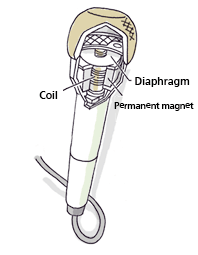
TVs, radios, and telephones also change sounds into electric signals. This is why you can listen to voices and sounds from very far away.
How do our voices work?
Try touching your throat as you say “Aaah”. You will feel that your throat vibrates a little. That vibration is the starting point of your voice. Each time we breathe out, air passes through our throat. There are folds in the tissue of your throat called vocal cords. When air from your breath hits the vibrating vocal cords, the air also vibrates. But your voice is not formed just by air hitting your vocal cords. Your voice is also made by the shape of your tongue, the shape of your lips, how open your jaw is, and the air passing through your nose. These things combine to change the sound of the air that comes out of your mouth. This creates different kinds of voices.
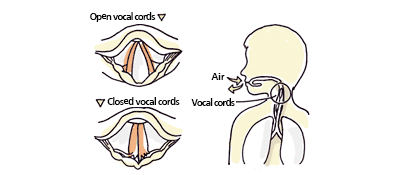
As you know, men have lower voices than women. Men have larger vocal cords and air passageways than women. This is why there are many different kinds of voices. This is also why men’s voices can make lower tones.
Did you know you can touch sound?
Have you ever felt a thumping feeling, like gusts of wind, when standing near percussion instruments? Those are vibrations in the air carrying the sound. You can’t see the vibrations, but you can definitely touch them and feel them. If you want to feel a lot of sound, try hitting a large drum as hard as you can. The bigger the surface you hit, the more air you can make vibrate. And the harder you hit the surface, the stronger the vibrations.

But life would be difficult if we could feel every sound. Think about all the sounds around you all the time. If you could feel them all, your body would be constantly trembling. But you don’t have to worry. Sounds spread out in all different directions. And the farther they go, the smaller they get.
Everyone likes the sound of a river
Try listening closely to the gentle flowing sounds of a stream. You will soon get sleepy. It’s said that the murmuring sounds of a river relaxes a tired person’s mind. How does this happen? Listening to hushed sounds like a flowing river creates alpha waves. Alpha waves are brain waves that make people feel comfortable and at ease. Sounds travel from the ears to the brain and create waves in the brain. People also feel relaxed when they hear the chirping of small birds or the sound of gentle ocean waves. That’s because these sounds also create alpha waves, just like the sounds of a stream do. All of these sounds come from nature. That’s why if you go into the hills, a forest, or other natural place when you are tired and listen to lots of natural sounds, you will feel refreshed.
How come can we hear the sound of the wind?
No doubt you have heard howling sounds on days when the wind is blowing hard. Those must be the sounds of the wind, but where exactly do they come from? You can hear the wind because it makes swirls of air. Strong winds split into different air streams whenever they run into a wall or power line. These air streams curl around the object they hit and spin. This spinning makes swirls of air. These swirls keep forming and disappearing as long as the wind blows. The swirls that form and disappear in this way create air vibrations that make the howling sounds.
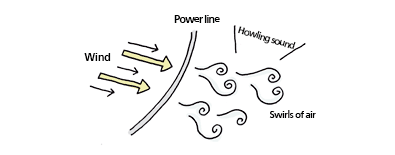
You can also hear a whirring sound when jumping rope. You hear this sound because the rope cuts through the air creating swirls.
Why do dogs make odd sounds when they hear a police car’s siren?
Here’s a little quiz for you. Dogs make odd sounds when they hear a police car’s siren. What’s the reason for that? A: Because the siren is similar to a dog’s howl. B: Because dogs know some incident has happened. C: Because dogs get excited by the red flashing lights.
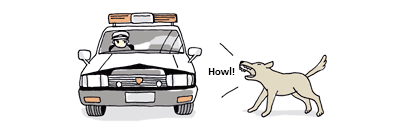
The right answer is A. But you are probably thinking a siren and a dog’s howl don’t sound much alike. So what’s going on? The reason is not the sound you hear, but how the air that carries the sound vibrates. Sounds reach our ears through vibrations in the air. The vibrations of air made by a siren are similar to the air vibrations when a dog howls. Long ago, when dogs still lived in the wild, they used to howl to each other to say things like: “This is my territory” or “Here I am”. So when dogs hear a police car’s siren, they mistake the siren for another dog howling and they can’t help but reply. Of course, it can get annoying when they howl at nighttime.
Music changes people’s moods
Listening to music can make us feel sleepy or comfortable. Other times, it can make us feel sad or excited. This happens because the kind of music we listen to changes how we feel. All our brains have brain waves. These waves are the root of many kinds of feelings and moods. And music can change brain waves. Music is amazing, isn’t it.
Why do rattlesnakes make a rattling sound?
Wild animals live in harsh natural environments. Weaker animals lose out to stronger animals and are eaten. But all animals have a will to live and try to protect themselves in some way. This is why animals have developed clever ways to protect themselves. The reason a rattlesnake makes a rattling sound is to frighten other animals, as if saying: “You can’t eat me because I have poison”. Porcupines, which are covered in quills, rub inverted quills together to make a sound alerting other animals: “Don’t eat me”.
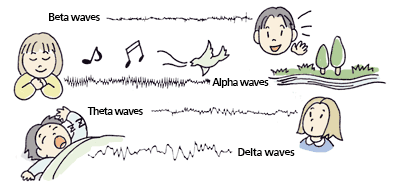
During normal activities, your brain waves are beta waves. But when you listen to gentle music, the chirping of birds, or the murmuring of a stream, these waves change to alpha waves, which can make you feel very relaxed. Two other kinds of brain waves are theta waves when you daydream and delta waves when you are sleeping.
Why does the sound of an ambulance siren change as it passes by me?
A siren wails! An ambulance is coming. Have you ever noticed that the sound of a siren changes as soon as it passes by you? It’s not your imagination. There’s a good reason for this effect.
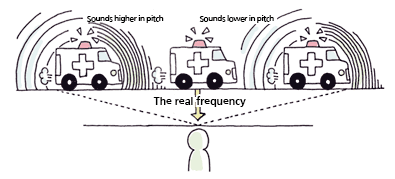
The pitch of a sound — whether it sounds high or low — is decided by the number of vibrations per second of the air transmitting the sound. The more vibrations per second, the higher the pitch. The fewer the vibrations, the lower the pitch. When an ambulance’s siren approaches you, the air waves get pushed together by the speed of the ambulance and the number of vibrations per second that reach your ear steadily goes up. This makes the siren sound louder and higher in pitch. Once the ambulance passes you by, the air waves get further apart and the number of vibrations per second goes down. This makes the siren sound quieter and lower in pitch. So the sound changes from a higher pitch to a lower pitch based on where you are standing. This change in pitch is called the Doppler effect.
What kind of sound is noise?
The sound of cars or airplanes flying overhead can be quite noisy when you start to notice it. So are all noisy sounds noise? People normally think of noise to be sounds you wish went away, like sounds so loud that you can’t hold a conversation or sleep. Of course, each person has different ideas of what noise is. You might think even a tiny sound is noise if you dislike it. Noise levels are measured in a unit called decibels. Noise that you can’t hear unless you listen very carefully is 0 decibels, while noise in a subway, for example, may reach 100 decibels. There isn’t a rule that says noise is sounds louder than some number of decibels. Still, various clever ideas are used to make trains, airplanes, and other things less noisy. If clever ideas were used everywhere, noise just might disappear.
