


Policy
The mission of the Panasonic Group is realization of an ideal society where people enjoy their lives both materially and spiritually, which is the philosophy of our founder, Konosuke Matsushita: "Happiness through both material and spiritual affluence." We aim to solve issues in people's lives and society through our business. In 1932, Konosuke Matsushita proclaimed that we would achieve our ideals over the coming 250 years, which is known as "Meichi," the revelation of our corporate mission. Since then, we have been proactively working to address a variety of environmental issues, including the pollution problems of the 1970s, under this management philosophy of contributing to the sound development of society.
To share our approach to environmental issues, which are spreading on a global scale, we announced our Environmental Control Policy (Matsushita Environmental Charter) in 1991, and our Environmental Statement in 1993. Since then, the Panasonic Group has been demonstrating its commitment to serving society as a public entity and leading environmental activities through united group efforts across the world.
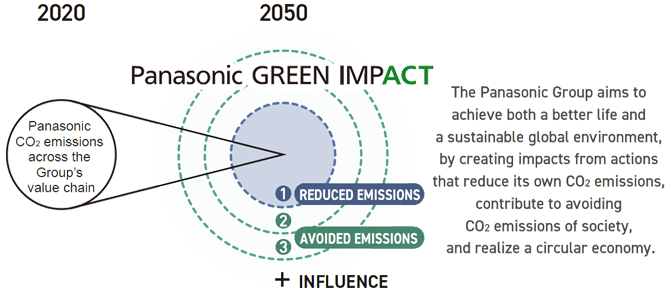
Our current work is based on Panasonic GREEN IMPACT, the long-term environmental vision announced in 2022, towards achieving our 2050 goals through improving our environmental management over the medium- to long-term.
We also established our Circular Economy Group Policy in 2023, in addition to our decarbonization efforts, as the principle of our priority activities that aim at the most efficient use of material resources.

Environmental Control Policy
(1991)
- Applied by all business sites worldwide
- Original text in English
(Japanese text is a translated version) - There are punitive clauses
Environmental Policy
Environmental Statement (1993)
Fully aware that humankind has a special responsibility to respect and preserve the delicate balance of nature, we at Panasonic acknowledge our obligation to maintain and nurture the ecology of this planet. Accordingly, we pledge ourselves to the prudent, sustainable use of the earth's resources and the protection of the natural environment while we strive to fulfill our corporate mission of contributing to enhanced prosperity for all.

Environmental Action Guideline (2013)
Toward achieving a sustainable society, we will strive to develop our business through the creation of environmental value.
For this purpose, we will address environmental challenges through our business activities and will expand our environmental initiatives based on collaboration with stakeholders.
(1) Initiatives to address environmental challenges
- - We will reduce CO2 emissions through production activities and products/services.
- - We will work to efficiently use resources by pursuing recycling-oriented manufacturing.
- - We will conserve water resources through efficient use of water and prevention of contamination.
- - We will reduce the impact of chemical substances on human health and the environment.
- - We will consider and conserve biodiversity.
(2) Initiatives based on collaboration with stakeholders
- - We will provide products and services that create environmental value for customers with our technological strengths.
- - We will expand our environmental contributions with our partner companies.
- - We will deepen communications with local communities and work as a team to address environmental challenges.
Environmental Action Plan

Long-term Environmental Vision "Panasonic GREEN IMPACT (2022)"
Circular Economy Group Policy (2023)
Acknowledging the contribution of resource efficiency to decarbonization as well as a necessity for decreasing resource consumption due to the earth's limited natural resources,
we establish this Panasonic Group-wide Circular Economy Policy as a contribution to achieving a sustainable society.
Circular Economy describes an economic system aiming for the most efficient use of material resources along the product lifecycle. Within the frame of this policy,
Panasonic Group Companies define their dedicated approaches, targets, and individual action plans based on the following circularity principles:
- (1) Maximize the product lifetime and maintain the material value with a focus on circular business models and product design, extended servicing, as well as through further enhancing recycling activities.
- (2) Minimize the use of materials and extend the usage of recycled and renewable materials.
- (3) Make a joint approach with customers and partners for establishing circularity-oriented business operations, information sharing, and product usage options.
By establishing this circular economy policy, we will promote the transition of our business from linear to circular as part of our green transformation (GX) activities inside and outside Panasonic.
Towards achieving Panasonic GREEN IMPACT, the Panasonic Group establishes the GREEN IMPACT PLAN, a medium- to long-term environmental action plan. This plan specifies the KPIs for priority environmental issues and their targets, and also includes business materiality indices. Together with targets for decarbonization by fiscal 2031, we are currently working under GREEN IMPACT PLAN 2028, which covers the fiscal 2027 to 2029 KPIs in coordination with our business strategy.
(https://holdings.panasonic/global/corporate/sustainability/environment/vision.html#greenimpactplan)
