

Promoting Groupwide Environmental Sustainability Management Centering on PDCA*1
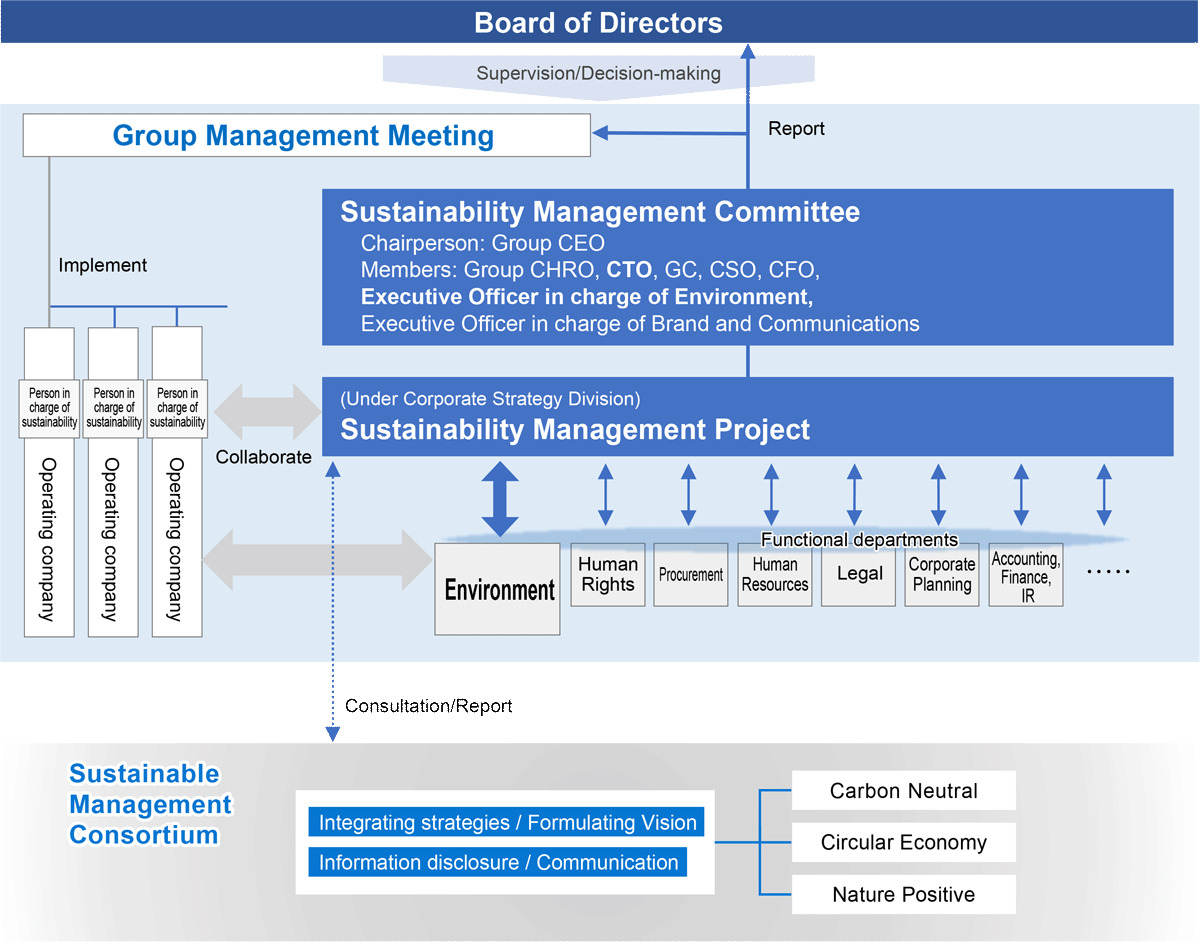
The Board of Directors holds the oversight function for sustainability, including environmental matters. Since January 2022, Panasonic Holdings Corporation (hereinafter "PHD") has generally convened monthly meetings of the Sustainability Management Committee, which was established under the supervision of the Board of Directors to discuss, direct, and manage policies, strategies, indicators, targets, and other matters concerning important sustainability-related themes.
Furthermore, in 2024, PHD established the cross-functional Sustainability Management Project, while each operating company developed its own sustainability promotion structure, thereby building a collaboration system for the entire Group.
Starting from fiscal 2027, the Group will integrate Group strategy and sustainability management in order to further promote the resolution of social issues through business activities. Discussions and direction-setting for sustainability-related policies, strategies, indicators, and targets will continue at management meetings such as the Group Transformation Round Table, in which Business CEOs also participate. Accordingly, the former Sustainability Management Committee was dissolved at the end of March 2026 as part of the transition to this enhanced structure.
Environmental sustainability management initiatives are implemented in accordance with the following PDCA*1 cycle under the Group CTO (Tatsuo Ogawa, Executive Officer as of June 2026).
Based on the Environmental Policy, the Group sets key environmental KPIs and targets linked to its annual business plans, under the autonomous and responsible management of each operating company, with the aim of fulfilling the Group's environmental responsibilities and strengthening its competitiveness. These constitute GREEN IMPACT PLAN (GIP), the Group's medium- to long-term environmental action plan. (Plan)
For activities aimed at achieving these KPIs and targets, performance data is collected as environmental performance data on a monthly, quarterly, or annual basis, depending on the theme. The data is shared with the relevant departments as appropriate, and additional measures are implemented as necessary. (Do)
Annual performance data undergoes independent assurance following third-party reviews and on-site audits, after which it is fed back internally and disclosed externally. Opinions and suggestions from stakeholders are applied to subsequent measures to achieve continuous improvement. (Check)
Progress made toward the KPIs established under GIP, along with related issues and other matters, is discussed at meetings such as the Group Transformation Round Table. Matters deliberated and decided at these meetings are reported, depending on their content, to the Board of Directors, which holds the oversight function for sustainability, thereby leading to swift decision-making and subsequent action. (Action)
*1 A framework aimed at improving business operations and quality by repeatedly carrying out the four steps of Plan (develop a plan), Do (take action), Check (evaluate), and Action (make improvements) to achieve continuous improvement.
The Sustainable Management Consortium is a voluntary, cross-Group community initiative launched in 2020 to address sustainability issues, particularly environmental challenges such as carbon neutrality and the circular economy (1,100 participants as of June 2026). With the expectation that each participant will apply the outcomes to their primary responsibilities, the Consortium works to define issues common to the Group, incubate activities, shift gears on important issues, and accelerate problem-solving by pooling collective wisdom. Through these activities, functions and resources are coordinated across organizational boundaries, enabling participants to utilize their respective expertise to act more swiftly and improve productivity.
Structure for Promoting Groupwide Environmental Sustainability Management*2