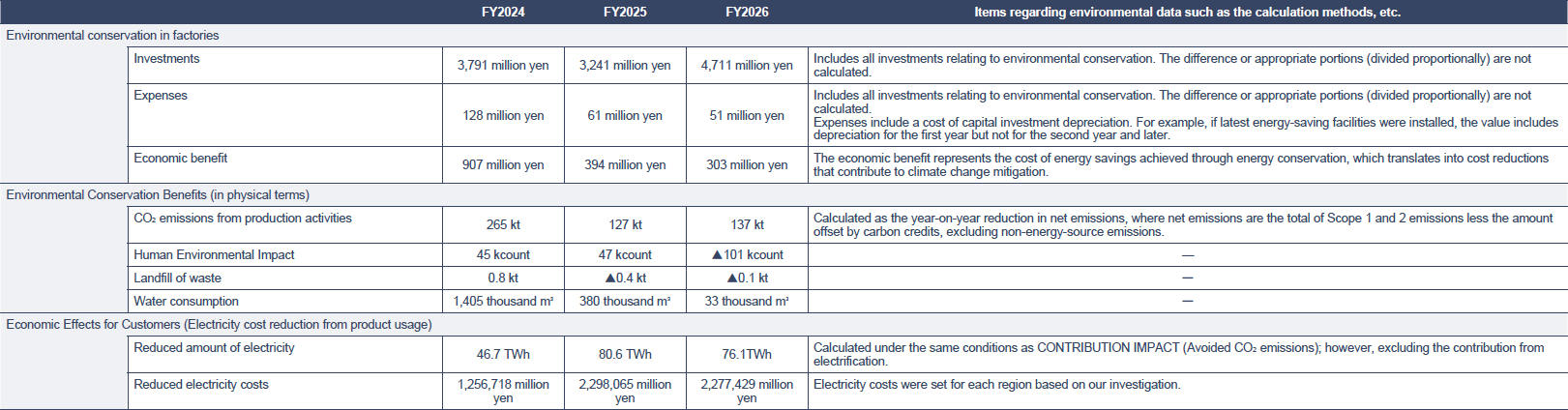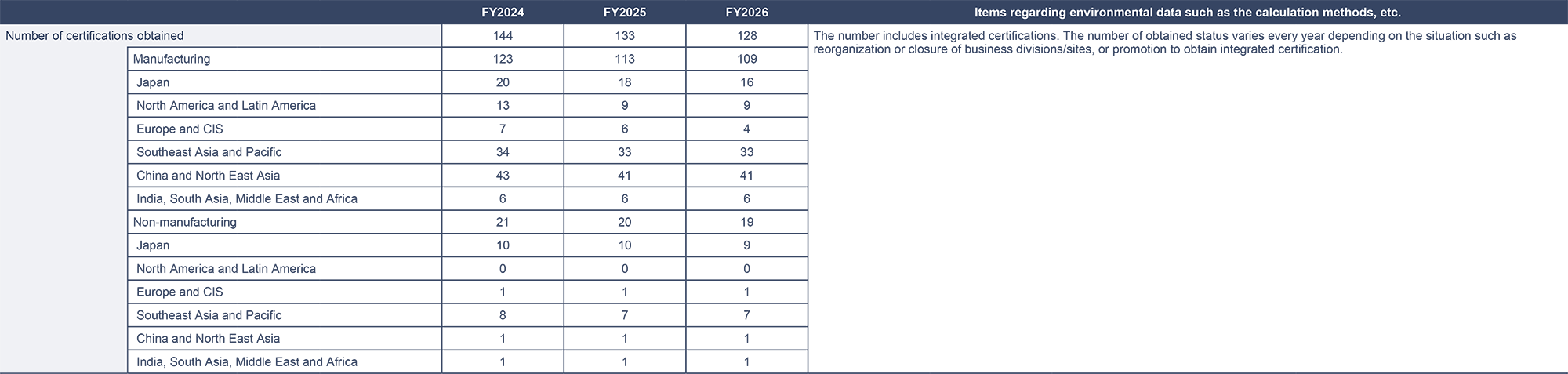


The scope of calculation is the same as the scope of reporting as described in■Data.
Where the two scopes do not match is indicated with a note.
■Breakdown of Energy Consumption (D1)
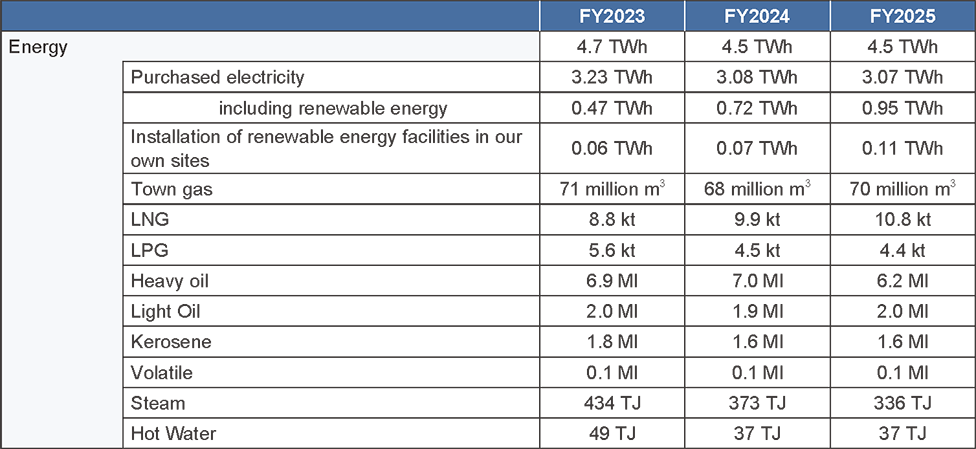
*D1-1: Electricity is calculated in kWh. Fuel is converted to a unit of electrical energy, which is 1 kWh = 3.6 MJ. The figures are then combined.
*D1-2: The calculation includes all electricity service plans.
*D1-3: The calculation includes offsite renewable PPA (solar, onshore wind, geothermal) procurement.
*D1-4: 100% renewable energy-sourced electricity includes deemed 100% renewable energy contracts that use a renewable energy certificate.
*D1-5: Electricity certificates such as Non-Fossil Certificates (NFC), International RECs (I-REC) and Green Electricity Certificates (GEC) are used.
■Breakdown of GHG Emissions (Scopes 1 and 2): From Energy Sources, From Non-Energy Sources, and Carbon Offset by Credits (D2)
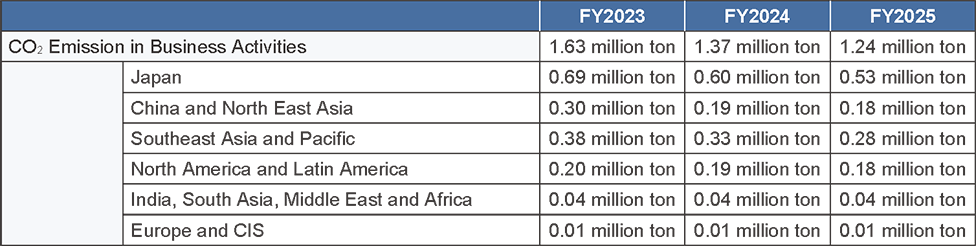
*D2-1: (Respective energy consumption) x (CO2 emission factor per energy)
*D2-2: For all global regions we used emission factors based on GHG Emissions Accounting and Reporting Manual (Ver. 5.0) by MOE.
For city gas, we used emission factors published by gas suppliers. Where necessary, we used replacement figures based on Emission Factors per Gas Supplier - FY2026 Supply Results by MOE. In China, we used a steam emission factor based on GB/T 32150-2025 General Guidelines of the Greenhouse Gas Emissions Accounting and Reporting for Industrial Enterprises.
*D2-3: Scope of GHGs and Global Warming Potentials (GWPs) used to determine CO2 emissions were based on the Order for Partial Revision of the Order for Enforcement of the Act on Promotion of Global Warming Countermeasures (Cabinet Order No. 20 of 2026).
*D2-4: GHG emissions other than CO2 emissions from energy sources were calculated for manuracturing sites only (non-manufacturing sites were excluded), excluding results from 10 manufacturing sites under Panasonic HVAC & CC.
*D2-5: A unit of electrical energy was used for electricity. Emission factors for each country were set by the Panasonic Group based on factors listed in CO2 Emissions from Fuel Combustion published by the International Energy Agency (IEA). For fiscal 2026, IEA Emissions Factors 2025 was used. For purchased electricity in Japan in fiscal 2026, we used Emission Factors per Electric Utility - FY2026 Supply Results by MOE.
*D2-6: Heat includes steam and hot water.
*D2-7: Carbon credit based on the certification system such as J-Credits, Verified Carbon Standard (VCS), and Clean Development Mechanism (CDM) are used.
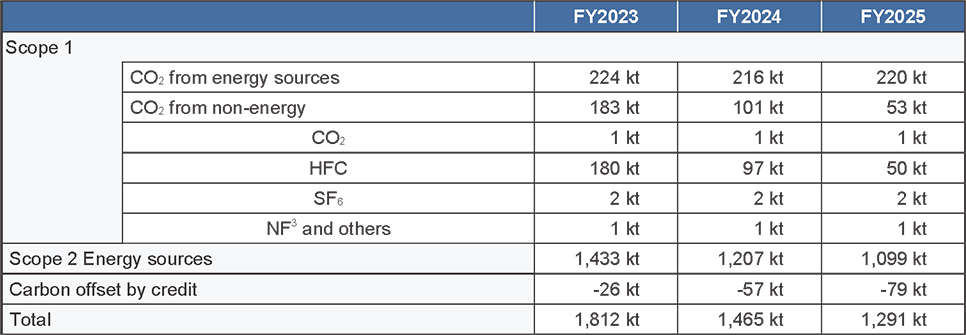
■Breakdown of GHG Emissions (Scopes 1 and 2): By Global Regions (D3)
■CO2 Emissions Intensity (Compared to Fiscal 2014) (D4)

*D4-1: CO2 emissions in the numerator of emissions intensity was changed to calculate by e) in fiscal 2026.
*D4-2: Sales in the denominator of emissions intensity is the figure reported in the Annual Securities Report.

*D5-1: Emissions Intensity Database for Calculating Greenhouse Gas Emissions of Organizations through Supply Chains (Ver. 3.6) by MOE
*D5-2: Emissions Intensity Database for Calculating Greenhouse Gas Emissions of Organizations through Supply Chains (Ver. 3.5) by MOE
*D5-3: Major product groups with high energy consumption or high refrigerant leakage: Lighting equipment and lamps, Household air conditioners, commercial air conditioners, household refrigerators, washing and drying machines, ventilation fans, bathroom ventilation dryers, electric water heaters, electric fans, A2W (Hot-Water and Heating Systems with Heat Pump), EcoCute, electronic rice cookers, dish washer and dryers, LCD TVs, Organic EL TVs, microwave ovens, heat exchange systems, blowers, chip mounters, refrigerated display cases for stores, hair dryers, IH cooking heaters, dehumidifiers, range hoods, vacuum cleaners, irons, electric thermos pots, projectors, digital signage, welding machine, welding robot, insertion equipment, printing equipment, mobile computer, electric bidet toilet seats, freezers, commercial refrigerators and freezers, absorption freezers, well water pumps, telephones, air purifiers, humidifiers, electrically-assisted bicycle, motors for air conditioning, motors for refrigerator, motors for FA application, etc. 60 products.
*D5-4: Spare parts warranty period and design lifetime, etc.
*D5-5: Electric power CO2 emission factor: 0.449 (Japan); 0.254 (Europe); 0.331 (North America); 0.59 (China and Northeast Asia); 0.748 (India); 0.378 (Southeast Asia and Pacific); 0.244 (Latin America); and 0.597 (Middle East and Africa). CO2 emission factor in each region is based on IEA Emissions Factors 2025 published by the International Energy Agency (IEA). Fuel-related CO2 emission factor is based on "Manual for Calculating and Reporting Greenhouse Gas Emissions, Ver. 5.0 by the Ministry of the Environment (MOE)". (Global)
*D5-6: CO2 emissions were calculated using the global warming potential specified in the Order for Partial Revision of the Order for Enforcement of the Act on Promotion of Global Warming Countermeasures (Cabinet Order No. 20 of 2026).
*D5-7: See IDEA Ver.3.5 (IPCC 2021 without LULUCF AR6) by the National Institute of Advanced Industrial Science and Technology (AIST).

*D6-1: Five products such as Cylindrical Lithium-ion Batteries for In-vehicle, Hot-Water and Heating Systems with Heat Pump (A2W), Electrically-assisted Bikes.
*D6-2: 20 products such as DC fan motor for air conditioner, lighting equipment, household air conditioners, commercial air conditioners, household refrigerators, etc.
*D6-3: Six products such as distributed storage battery system for data centers, heat exchange system, BEMS/HEMS, etc.
*D6-4: 12 products such as photovoltaic power generation systems, fuel cells, Genelink absorption chiller system, home delivery smart box, etc.

*D7-1: Progress rate not calculated, as emissions increased due to the expanded scope of calculation.

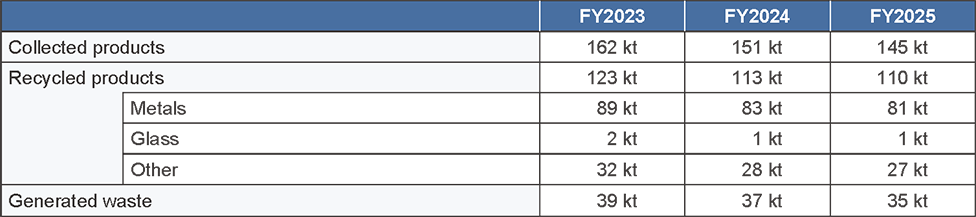
*D9-1: Number of sites assessed under the rules applicable before the change to the application of green electricity certificates in China—a change introduced by the Implementation Rules for the Management of Renewable Energy Green Electricity Certificates (Trial) enforced in November 2025. Reflecting this rule change, the number of sites would be 46.
■Scope 2 GHG Emissions from Energy Sources (Location-based) (D10)
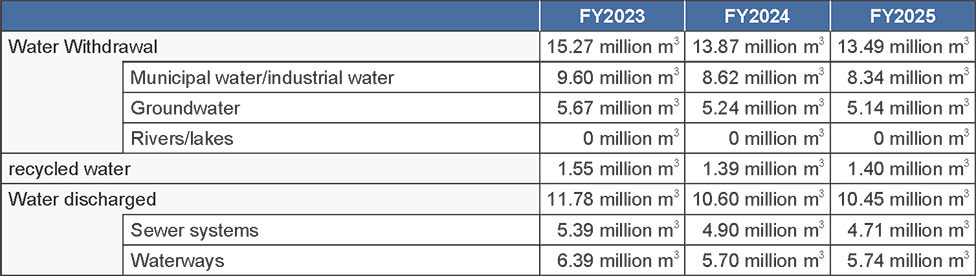
*D10-1: A unit of electrical energy was used for electricity. Emission factors for each country were set by the Group based on factors listed in CO2 Emissions from Fuel Combustion published by the International Energy Agency (IEA). For fiscal 2026, IEA Emissions Factors 2025 was used.
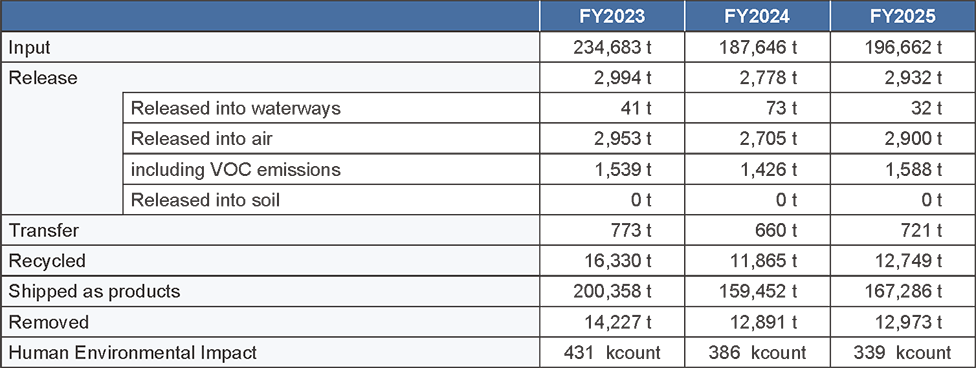
*D11-1: Consignors' Guidelines for the Act on Rationalization of Energy Use and Shift to Non-fossil Energy – 2026 Revised Version
*D11-2: Use of "Global Logistics Emissions Council Framework v3.1" from FY 2026
*D11-3: Emissions Intensity Database for Calculating Greenhouse Gas Emissions of Organizations through Supply Chains (Ver. 3.6) by MOE
*D11-4: Joint Guidelines for CO2 Emissions Calculation Methods in Logistics (Ver. 3.2)
*D11-5: Six of the domestic group companies are excluded as they are not equipped with an emissions calculation system.
*D11-6: The above calculations are for transportation where the Panasonic Group is the consignor, as specified in Energy Saving Law Guidebook for Consigners published by the Agency for Natural Resources and Energy.
■Recycling

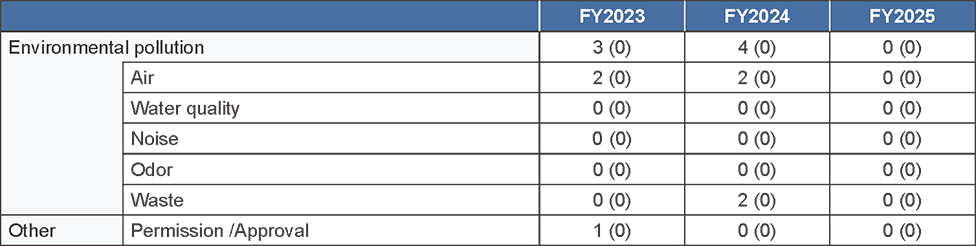

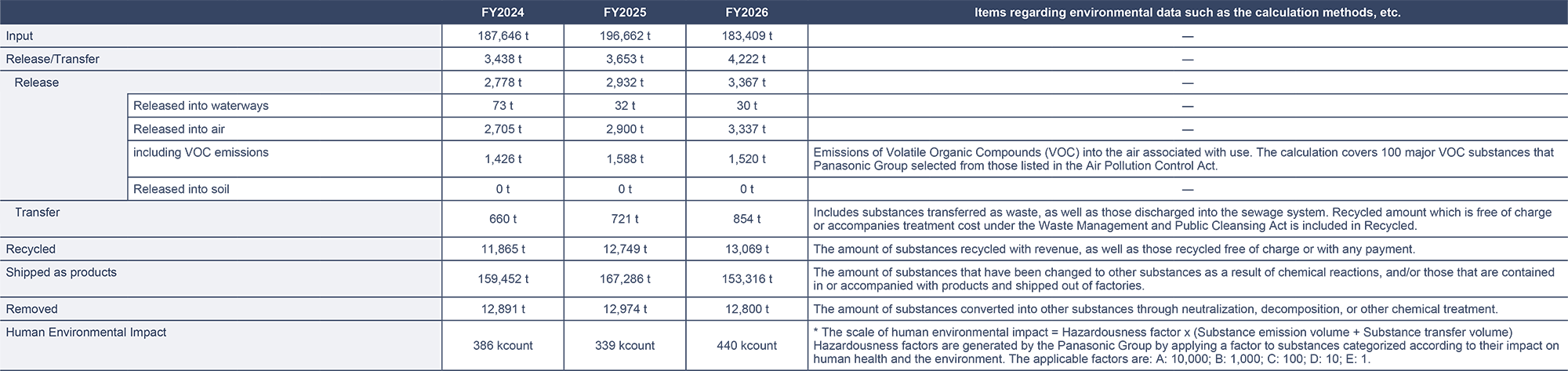
■Chemical Substances
* The scope of chemical substances is as specified in Panasonic Group Chemical Substances Management Rank Guidelines (for Factories).
* Results from 10 production sites under Panasonic HVAC & CC were not included.