

Notice of Site Closure
Thank you very much for using Panasonic Kids School.
This website will be discontinued as of March 31, 2026.We sincerely appreciate your support and loyalty over the years.

-
What is recycling?

-
There are different kinds of recycling
-
What can we recycle?
-
What is important when recycling?
-
Things made from recycling have a recycling mark
-
Depending on the type, cans are completely different
-
What do newspapers become when we recycle them?
-
How do you throw away a refrigerator?
-
Are recycled products clean?
-
We also recycle when we eat
-
How do other countries recycle?
-
PET bottle recycling
-
What is even more important than recycling?

What is recycling?
These days, “recycling” is a word we hear a lot. But what does “recycling” mean?
A Recycling is throwing out garbage.
B Recycling is reusing resources.
C Recycling is burning garbage.
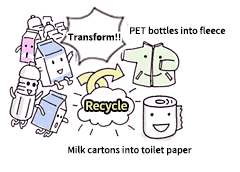
The correct answer is B. Recycling takes things that we no longer need and makes them into new things that we can use once more. Isn’t it amazing that we can transform things we no longer need into something new?
When we take things to recycle from the things that we no longer need and throw away, there is less garbage, and that means we don’t have to use fuel to burn this garbage or to bury it some place near the ocean or mountains. Having less garbage is a good way to conserve nature.
There are different kinds of recycling
Repeatedly reusing limited natural resources to reduce garbage is called recycling, but it is more accurate to call it “reuse” or “recycling” depending on how it is done. So, how are they different?
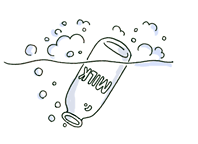
An example of “reuse” is washing a beer bottle or milk bottle after you have finished drinking from it and using the same bottle again. Depending on the type of bottle, it’s possible to reuse it many times in this way. Another important kind of reuse is repairing and then reusing broken furniture and home appliances. In contrast, “recycling” is when we take cans or discarded paper and use them as a resource for remaking them into something new. PET bottles that once contained juices or other drinks are made into clothes, and there are many other cases where things are recycled into something completely different than the original.
What can we recycle?
What kinds of things can we recycle? And when we recycle them what do they become?
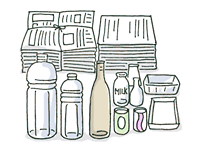
Paper that is newspaper is recycled once again into newspaper. Copy paper is recycled into the notebook paper and toilet paper we all use. What about empty bottles? There are “returnable bottles” that we wash and reuse and “one-way bottles” that we can use only once. But one-way bottles are crushed and then made into new bottles. Finally, there are empty cans. Steel cans are recycled into steel products such as steel plate, and aluminum cans are recycled into automobile parts. The pens that we all use every day are made from recycled food trays and PET bottles. As you can see, we recycle all kinds of things.
What is important when recycling?
A To throw away lots of garbage
B To burn garbage on your own
C To sort garbage when you throw it away
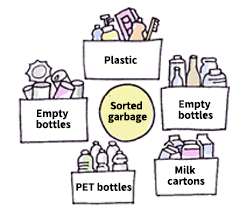
The correct answer is C.
When recycling, the most important thing to do is thoroughly sort your garbage. As they say, “if you mix it together it’s garbage, if you sort it it’s a resource”. So, always be sure to throw away plastics with plastics and empty cans with empty cans. For example, putting used candy wrappers or chewing gum inside an empty can doesn’t count as recycling.
Besides sorting, it’s a good idea to thoroughly wash milk cartons, PET bottles, and empty cans before throwing them away. In other words, it’s important to always remember that these things are going to be used again.
Things made from recycling have a recycling mark
You probably have things in your home that have been recycled. Toilet paper, trash bags, rulers, plant pots, work gloves, and hangers can all be made by recycling. A good idea is to ask someone at home what kind of things they use.
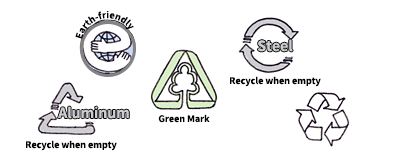
If you have things that are recycled, look for a recycling mark. For example, in Japan things made from recycled paper such as notebooks and sketchbooks have the Green Mark, and other countries also use the same mark. The Green Mark is intended to promote recycled products. Let’s all use resources wisely.
Depending on the type, cans are completely different
Did you know that there are two types of cans? Steel cans are rather hard. Aluminum cans are soft and collapse when you squeeze them. Look closely at a juice can and you will see either an “aluminum” mark or a “steel” mark.
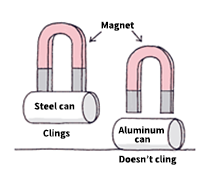
Even though both are cans, they have different recycling methods. A steel can is completely flattened and turned into steel sheet and steel products for constructing buildings. After an aluminum can is flattened and melted, it is once again made into a can or made into automobile parts. Making aluminum cans by recycling uses less fuel than making them from scratch, so it is more economical to recycle them.
What do newspapers become when we recycle them?
Your mom and dad read the newspaper every day. If you take their newspapers to a factory after they are done reading them, they can be made into newspaper again.
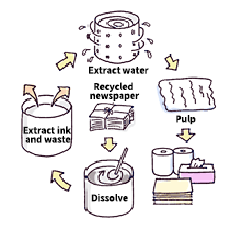
Discarded newspaper is taken to a paper mill. At the mill, the paper is dissolved and then made into new paper. The mill can also recycle paper besides newspaper. Magazines are made into boxes for such things as shoes and detergent. Cardboard is once again made into cardboard, and copy paper becomes tissue and toilet paper.
How do you throw away a refrigerator?
The amount of garbage increases when we don’t recycle electric appliances such as refrigerators and TVs. A refrigerator can be completely recycled. But do you know the rules for recycling a refrigerator?
A Put the refrigerator out on recyclable garbage collection day
B Take the refrigerator to a refrigerator factory
C Have a person from the shop where you bought it take it away
The correct answer is C.
Even if you put the refrigerator in the garbage on the regular garbage day, they will not take it away. When you discard a refrigerator, the rule is that you pay a fee to someone—the shop where you purchased it, for example—to come and take it away. This rule is called the Home Appliance Recycling Law. Besides refrigerators, this law applies to TVs, air conditioners, and washing machines.
The reason there is this rule is to make sure that these things are recycled. At the factory, TVs and refrigerators are split up by their materials—aluminum with aluminum, glass with glass, and so on—and then recycled into something new. So, the rule makes sure that we treat resources wisely.

Are recycled products clean?
The origin of a recycled product is another product that was in use before it was recycled. But recycled products are not dirty in the least.
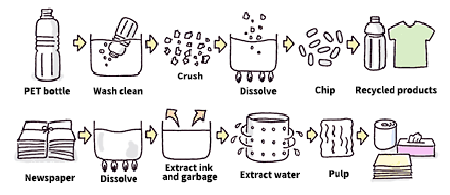
For example, recycled paper notebooks are made from old paper that we throw away. At a paper mill, the old paper is dissolved and ink is extracted, and then it is used as paper once again. The same goes for PET bottles and glass bottles. They are washed clean at the factory and then melted down and hardened into shape. Just like things made from scratch, recycled products cannot be made without cleaning, dissolving, and hardening materials.
But there is something else you need to know. Did you know that a notebook’s whiteness has a “whiteness scale”? A completely white notebook has a whiteness of 100 while a notebook with a bit of yellow has a whiteness of 70.
When washing the paper, the factory uses detergents and chemicals, but the amount used can be reduced when notebook paper has a whiteness scale of 70.
So, notebooks with a bit of yellow are good for the environment. And don’t you think that notebooks with some yellow are gentle on the eyes? From now on, when you choose a notebook, be sure to look for the notebook’s whiteness level.
We also recycle when we eat
Cooking that uses things that we usually throw away like fish tails and vegetable skin is called “eco-cooking”. Here, we will show you two easy-to-make snacks that you can try making at home.
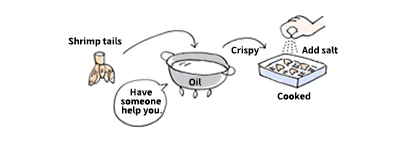
Shrimp crackers
Thoroughly pound and stretch the shrimp tails. Fry in oil until crisp. While still hot, sprinkle with salt and serve.
Japanese persimmon skin dessert
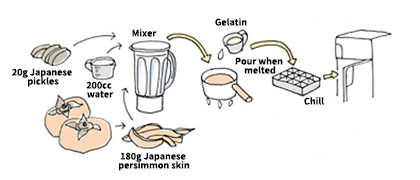
In a mixer, mix 180 grams of Japanese persimmon skin, 200cc of water, and 20 grams of Japanese pickles. Mix with gelatin soaked in water and then heat until the gelatin melts. Pour the gelatin into molds and place it in the refrigerator to chill. Once the gelatin is firm, serve. When preparing food with vegetable skin, it is best to use skin from vegetables grown with as few chemicals as possible.
How do other countries recycle?
Recycling not only reduces garbage, it helps conserve the earth’s limited resources. For this reason, people all over the world come up with ideas and work together to recycle. So, what is recycling like in other countries? To find out, let’s compare the recycling methods for a juice container.
In Germany, most beverages come in returnable bottles that can be washed and reused many times, and bottles are collected at various locations around town. Sweden also mostly uses returnable bottles. When you return bottles at the store, you get money back for the bottles. In Denmark, all bottles are returnable bottles. Since it costs money to make new bottles, they make an effort to use the same bottles over and over.
PET bottle recycling
Everyone regularly uses PET bottles to drink water, tea, juice, and other drinks. When PET bottles are recycled, they are turned into all kinds of things. Let’s take a look at how they are recycled.
First, the PET bottles are transported to a recycling center. At the recycling center, they are checked to make sure there are no non-PET bottle objects mixed in, and then they are slightly crushed to make them easier to transport. If there are leftover liquids in the bottles, crushing them can produce a terrible odor. So, you can make the recycling center people very happy if you wash out your bottles before recycling them.
From the recycling center, the PET bottles are transported to a recycling factory. They are washed clean, sorted by color, and crushed into little pieces. At a factory, the fine shards of thoroughly crushed PET bottles are used as material for making plastic products. The shards are also recycled into plastic files and rulers, carpet and tissue, and shirts and trousers. Some people might be surprised that PET bottles can be recycled into clothes.
What is even more important than recycling?
There are many ways to reduce garbage. We “reuse” empty beer bottles and milk bottles by using the same bottles again, and we “recycle” milk cartons and cans by making them into something else.
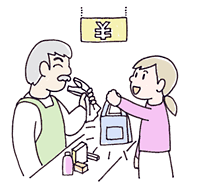
But even more important than recycling is what we do when we go shopping. Do you ever get tired of something right away and just toss it aside? Before buying something, it’s important to consider whether you really want it. And from now on, bring a shopping bag with you when you go shopping so that you won’t need to use a paper or plastic bag from the shop. It’s important to avoid buying or taking things that can become garbage right from the start. If we all come up with different ideas, we can steadily reduce the amount of garbage we produce.
