


Customer Relations
Improving Customer Satisfaction
-
Policy

-
Responsible Executive and Framework
-
Reflecting Voices of Customers in the Products and Services (VOC Activities)
-
Response to the Act for Eliminating Discrimination against Persons with Disabilities
-
Co-creating with Diverse Customers: Promoting Inclusive Design
-
Customer Month Initiatives
-
Addressing Social Issues by Raising Awareness
Responsible Advertising and Promotional Activities
Improving Customer Satisfaction
Since its founding, the Panasonic Group has sought to contribute to society through its products and services, always prioritizing the customer’s needs above all else. The Group aims to enhance customer service (CS) and offers products, solutions, and services that enrich the lives of people worldwide. When providing CS, the Group strives for sincerity, accuracy, and speed, and it acts with humility and appreciation. This finds its basis in the CS principle of “true service” that the Group’s founder described. Our fundamental stance is thus to provide customers with trust, peace of mind, and satisfaction.
Service Philosophy (True Service)
The customer’s satisfaction is our satisfaction.
True service resides in mutual satisfaction.
Service is an integral part of any business. A business that does not provide service is no business at all.
Service, therefore, is the duty and obligation of any business person. But there’s nothing more aggravating than service provided only out of a sense of duty.
Customers can sense it.
Service means satisfying customers, and when we satisfy our customers, we in turn find satisfaction in a job well done. Satisfied customers and satisfied employees: This is what constitutes true service.
Konosuke Matsushita
August 1967 issue of PHP Magazine
▪Policy
We have established a set of Operational Rules for Response to Customers (compliant with ISO 10002 and JIS Q 10002) to provide guidelines to group companies in Japan for responding to inquiries and complaints from customers. We have also stipulated the following provisions as part of our Operational Rules for Response to Customers:
- We strive to deliver the utmost satisfaction to all customers;
- We approach our customers and utilize their opinions in our management decisions
Following the above rules and policies, each business site in Japan has established a Management System for Response to Customers as a mechanism for utilizing information received from customers in its management approach. These sites conduct periodic self-audits and make other efforts to improve the quality of customer relations. Outside Japan we have also implemented ISO-compliant management systems based on the Operational Rules for Response to Customers and tailored to the legal system in each country or region.
▪Responsible Executive and Framework
The Group Chief Technology Officer (Group CTO) is the Executive Officer responsible for the CS of the Group (as of August 2026).
The CS departments at each of the 7 operating companies cooperate to implement the Group’s customer satisfaction initiatives. Outside Japan, the CS departments of the Panasonic Group’s sales companies around the world collect local information concerning services and quality, as well as customer requests and so forth. This information is used to ensure the quality and safety of products and to help develop products that match the needs of customers in each department.
CS staff in Japan and abroad share the knowledge and experience that they have accumulated to endeavor to provide better customer service around the world.
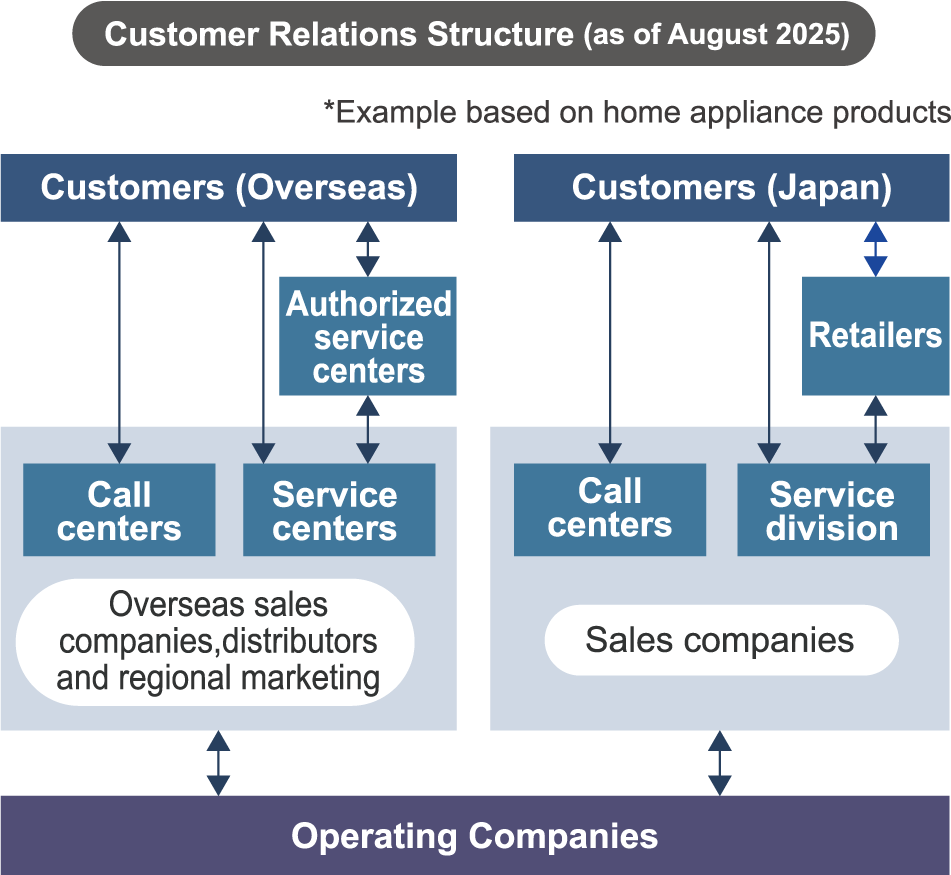
▪Customer Inquiry Response System
In Japan, we deal with inquiries from customers before they purchase products as well as with their concerns about how to use them after purchase through the Customer Care Center. The Customer Care Center is open from 9:00 am to 6:00 pm, Monday through Saturday, excluding Sundays, national holidays, and the first three days of the New Year. There are separate phone numbers for each product. Customers rarely spend a long time on hold; the Customer Care Center is organized to provide accurate and rapid service.
We aim to continuously understand actual circumstances, issues, frustrations, and expectations of customers (consumers) by leveraging a wide range of customer touchpoints. These include not only analog touchpoints such as telephone calls, but also direct digital touchpoints with the Panasonic Group, such as email, websites, FAQs, and social media, as well as indirect digital touchpoints through search AI (generative AI).
For example, when customers make inquiries on the Panasonic website by typing in a question, the site displays multiple relevant FAQs. Thus, the company strives to provide quick responses to questions. Regarding the content of its FAQ pages, the company analyzes the search keywords that bring customers to FAQs, as well as the number of times that the questions are viewed, to increase the precision of the FAQs, so that the information that customers require is accurate and displayed quickly. At the same time, we have introduced an AI-powered voice bot and are working to provide support 24 hours a day, 365 days a year. The company has also been undertaking initiatives to utilize Facebook, X, Instagram and other social media platforms to post various types of helpful information in a timely manner, such as when the seasons change, and to entice customers to visit relevant FAQ pages using LINE’s autoreply service. Because these FAQs are organized so that customer’s problems can be solved without the customer needing to contact the Customer Care Center, the number of inquiries at the center is trending downward. The Panasonic Group’s sales companies and sales agencies operate call centers in each country/region outside of Japan as well, handling all types of inquiries as well as intake for repairs. The website for each country also includes FAQs, and we are working on building ways to allow customers to resolve their own issues as they are able to in Japan.
▪Repair Service Organization
The CS Company (repairs and spare parts department) of Panasonic Marketing Japan Co., Ltd. is in charge of repair services for consumer electronics products in Japan. Panasonic Techno Service Co. is in charge of housing facility products. These service companies constitute a network across Japan and employ full-time customer engineers who have close ties to their local regions as well as advanced technical skills and experience. The network provides swift and reliable on-site repair services in response to customer requests. The repair services system is organized such that repair requests are received 24 hours per day, 365 days per year; the Panasonic Group makes particular efforts to provide repair services as quickly as possible for products that are everyday necessities.
- Number of Service Locations of the CS Company, Panasonic Marketing Japan Co., Ltd. and affiliates:
99 locations throughout Japan (as of April 2026) - Number of Service Locations of Panasonic Techno Service Co., Ltd.:
37 locations (as of April 2026)
▪Initiatives for Improving Repair Service Contact Point
For household appliance repairs in Japan, we have made arrangements for receiving requests via websites and for courier services to pick up customers’ products before repair and to deliver the repaired products when they are ready with the goal of making it more convenient for customers requesting repairs.
Customers can obtain a diagnosis from our website before requesting repairs, allowing them to confidently use our online repair services. To receive a diagnosis, customers enter their product numbers and select the appropriate symptoms, and the system provides useful troubleshooting approaches to solving their problems. If the system determines that repairs are necessary or the issue remains unresolved, customers can review the estimated repair costs and proceed directly with a repair request.
▪Global Repair Service Centers
For customers outside Japan, the Panasonic Group’s sales companies, call centers and service centers operated by distributors, and call centers and certified service providers commissioned by sales companies or distributors offer repair services meeting local needs and business practices. We have been strengthening our initiatives in each country toward improving experiential value through the repair services and responses to inquiries we offer our customers. We are also working to communicate with customers on social media.
We are striving to improve and provide better service by using questionnaires to get customers’ opinions about our response. As measures to contribute to environmental protection in the after-sales field in response to recently heightened environmental awareness, we are focusing on reducing waste through recycling together with cutting down on on-site repairs by providing a more comprehensive FAQ and remote diagnosis. Moreover, we are establishing a system to provide information and other services to our customers in line with the “right to repair” legislation that is being enacted mainly in Europe and the United States.
Number of Repair Service Centers (FY2027)
| Region | Number of Repair Service Centers |
|---|---|
| Japan*1 | 136 |
| North America | 389 |
| Latin America | 600 |
| Europe & CIS | 1,031 |
| Southeast Asia & Pacific | 1,593 |
| India, South Asia, Middle East & Africa | 686 |
| China & Northeast Asia | 3,024 |
*1 Japan: CS Company, Panasonic Marketing Japan Co., Ltd. and affiliates, Panasonic Techno Service Co.
▪CS System for Enterprise Business
Electrical Equipment and Appliances
Through our business customer inquiry desk for lighting fixtures, information systems, electrical facility materials, and energy-related products such as solar power generation and power storage facilities, we accept inquiries from our business partners regarding construction, installation, and setup from 9:00 a.m. to 6:00 p.m., Monday through Saturday, excluding Sundays, national holidays, and the first three days of the New Year, while maintaining a system that enables rapid response.
Commercial Equipment
In the area of commercial equipment—which includes video, security, information communications, and commercial air conditioning equipment—the Panasonic Group’s sales companies in each field provide unified support at every stage, from proposals for devices and systems to their design, construction, customer inquiries, and repair services. By providing total solutions that meet its customers’ needs, the Group strives to improve its CS.
Commercial Solutions
The Panasonic Group sales division in charge of commercial solutions, our sales companies and sales partners of our products understand the diverse needs of individual customers and provide total solutions that optimize operations and improve productivity at our customers’ sites, including everything from system implementation to sales, construction, maintenance, repairs, operations services, and cloud services. These solutions support customers in the implementation of their product strategies and the improvement of their operations. Through its CS-related activities, the Company uses its points of contact with its customers—including support desks, repair services, and maintenance—to build trusting relationships. The Group has created a responsive system that provides quick, continuous support to its customers when they experience difficulties.
▪Reflecting Voices of Customers in the Products and Services (VOC Activities)
The Panasonic Group leverages AI and text-mining tools to analyze the Voice of Customer (VOC), enabling it to promptly identify overall trends and valuable insights, which are then used to improve business activities.
The voices of customers are heard via the opinions received through the Customer Care Center and The Panasonic Group’s sales persons and partners, showrooms, and service companies.
We use the results of these analyses for product development, functionality, quality, updates to instruction manuals and catalogs, and improvement of sales activities through a collaboration between product planning, design, technology, and quality control departments on one hand, and their marketing and sales departments on the other. The Group considers those VOC activities to be practical implementations of its Basic Business Philosophy, which aims to improve customer satisfaction. The company encourages all employees to engage with the voices of the company’s customers throughout various aspects of their work.
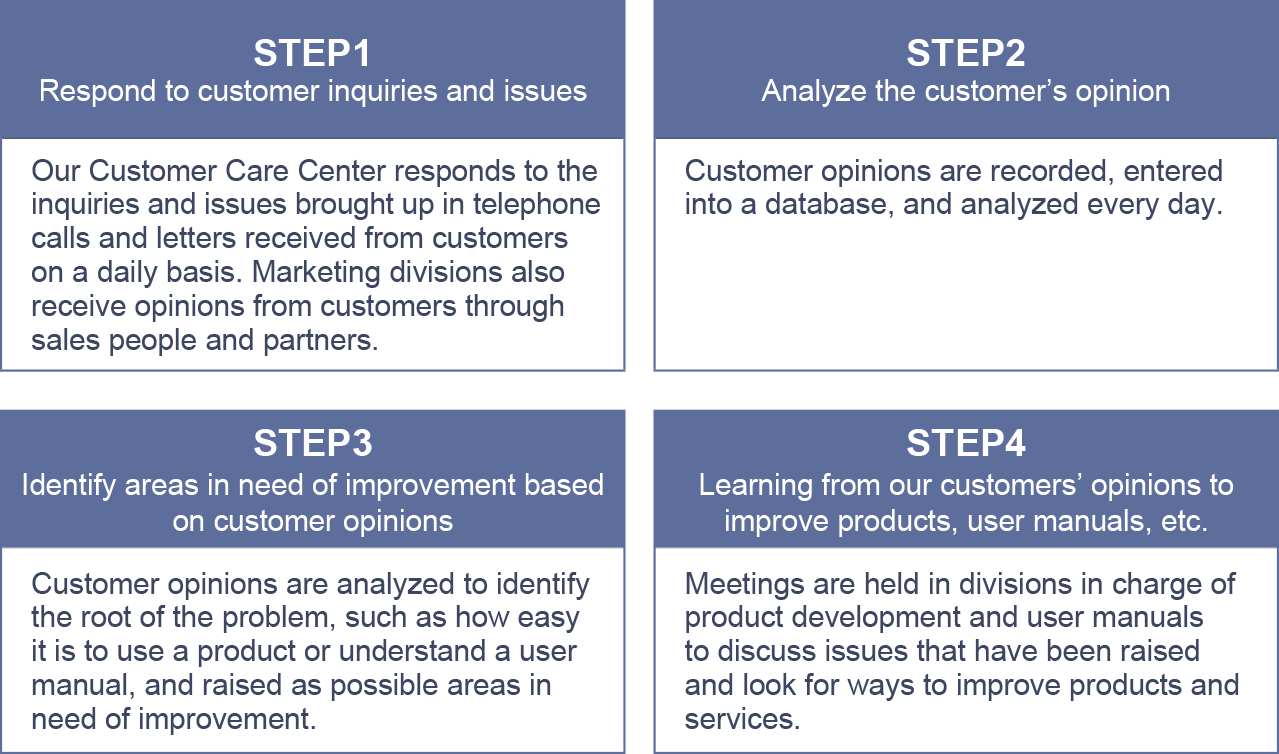
In Japan, we also use Net Promoter Score (NPS) surveys as an indicator of customer service satisfaction and use the results to continuously improve the customer experience.
Outside Japan, we use NPS surveys and post-repair questionnaires to assess customer touchpoints, such as authorized service centers and service engineers, and leverage the results to enhance customer service.
▪Response to the Act for Eliminating Discrimination against Persons with Disabilities
Based on the revised Act for Eliminating Discrimination against Persons with Disabilities, which came into effect on April 1, 2024 and made it mandatory for businesses to provide reasonable accommodation, the Panasonic Group is working to provide appropriate accommodation for people with disabilities. When a request is made by a person with a disability, we engage in careful dialogue tailored to the individual circumstances and consider what support can reasonably be provided and put it into practice.
▪Co-creating with Diverse Customers: Promoting Inclusive Design
As society and lifestyles become more diverse and we are increasingly expected to address issues that have not previously received attention, we are promoting inclusive design—an approach that brings us into ongoing dialogue with people with diverse lived experiences, enables us to learn from voices that have often gone unheard, and enables us to work together to find solutions.
Since its founding, the Panasonic Group has embraced “empathy-driven manufacturing” as part of its corporate DNA. Building on this foundation, we revised our internal rules in February 2025, looking ahead to the future and evolving our initiatives in step with an increasingly diverse society. Originally established in 2003 as the Operational Rules for Universal Design, they were renamed the Operational Rules for Inclusive Design and Universal Design. These rules define the mission and vision of inclusive design, five action guidelines, and achievement requirements, and are being promoted groupwide. For more details, see “Promotion of Inclusive Design and Universal Design” in the chapter “Raising Product Quality Levels and Ensuring Product Safety”
▪Customer Month Initiatives
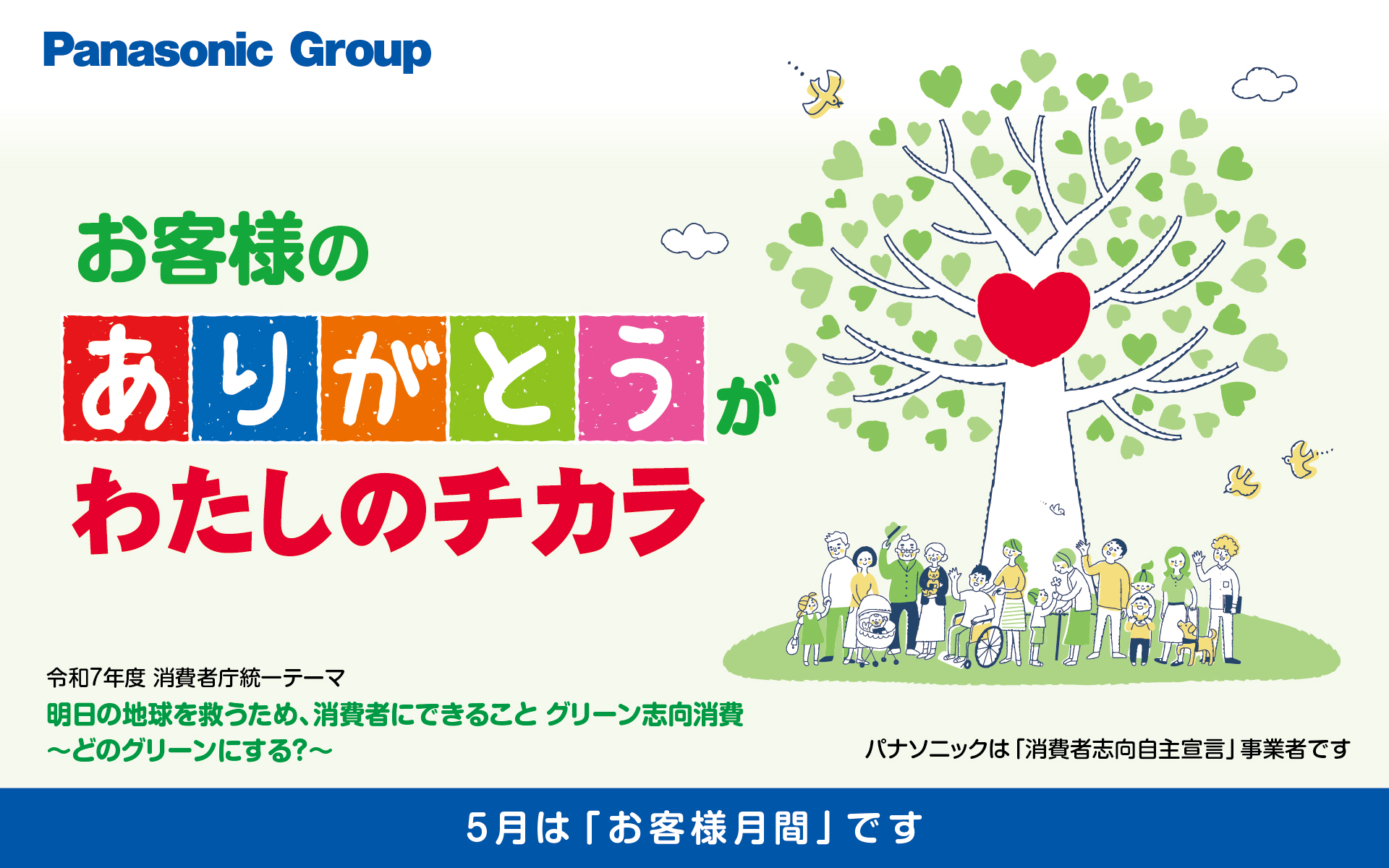
In Japan, we believe it will become ever more important to provide meaningful value to customers. With this in mind, we designate May each year as Customer Month, in line with Consumer Month, which is designated by the Japanese government, and carry out related initiatives throughout the month. Each operating company undertakes initiatives such as disseminating top messages and creating Customer Month posters to ensure that all employees fully understand the significance of Customer Month, raise individual awareness, and encourage behavioral change. The aim is to put into practice the principle of “Customer Focus”.
*2 Consumer Month
Japan’s Consumer Protection Fundamental Act (predecessor to the Consumer Basic Act) was enacted in May 1968. On the 20th anniversary of the creation of this law in 1988, May was designated Consumer Month. Every year during this month, consumers, businesses, and government agencies come together to participate in focused work on education and awareness raising concerning consumer issues.
▪Addressing Social Issues by Raising Awareness
As part of our ESG efforts toward addressing the pressing social issues of countering global warming and promoting carbon-free solutions, we have partnered with local governments, corporations, and companies to provide courses for local communities in Japan, mainly on environmental education.
Our goal is to help participants understand what they can do as members of their communities and raise awareness that drives action on themes that are highly socially relevant and interesting to consumers, such as the environment and energy issues. Recently, we have noticed a marked uptick in the frequency of parent-child study sessions, in which lecturers incorporate complex topics into everyday life situations, and participants learn about energy conservation, using energy from natural sources, and other familiar issues in a fun and easy-to-understand manner.
We also actively participate in government-hosted environmental events as part of our broader engagement in promoting education and raising awareness.
To remain a company trusted by society, we engage in public affairs and external relations activities that place emphasis on constructive dialogue with government agencies, industry associations, and related organizations. Through these activities, we accurately monitor social developments and policy trends, contribute to the realization of a sustainable society through our business activities, and thereby enhance corporate value over the medium to long term.
Our primary initiatives include exchanging views and gathering information with relevant ministries and agencies, local governments, and industry associations in order to understand developments in legal systems and societal demands and reflect them in our business strategies and initiatives. We also reflect regulatory developments related to consumer protection, product safety, labeling, and advertising in our customer satisfaction activities and quality and safety initiatives, thereby helping to ensure our customers’ trust and peace of mind. In addition, through participation in the activities of industry associations, we are also engaged in consumer education.

The Group’s domestic Japanese-language site provides information to customers, including basic knowledge about electricity, laws and regulations concerning home appliances and their disposal (recycling), along with precautions related to protecting home appliances from disasters including warnings on what to do during natural disasters.
The Panasonic Group provides information to give our customers a better understanding of safety, from how to correctly use their household appliances for safety and product longevity, illustrated using practical and realistic examples.
Responsible Advertising and Promotional Activities
Corporate advertising and promotional activities help increase awareness of brands, products and services throughout society. However, there is a risk that such content may have a negative impact on general consumers due to expressions and images that lack diversity and are insensitive to impressionable children. Furthermore, with the development of social media, such effects are likely to spread globally, not only in the country or region where the advertising or promotional campaign activities are carried out. Therefore, companies must maintain high standards of ethics and social responsibility in their communications.
We continue to follow the idea of our founder, Konosuke Matsushita, that "if manufacturers make good products, they have an obligation to communicate that quickly, widely, and accurately to their customers, and that is what advertising does." Furthermore, we recognize the significant social responsibility of disseminating information not only about our products, but also the comprehensive scope of our activities as a corporation. Our efforts to achieve this are informed by the same kind of thinking. The following basic guidelines are based on the philosophy of our founder and reflect our attitude and approach to the day-to-day creation of advertising content (e.g. creating TV commercials, newspaper ads, and digital ads).
- In the context of our business activities, advertising and promotional activities fulfil an important social mission.
- This is an activity that effectively communicates the core values and principles that define our company.
- It is vital that facts are presented truthfully and in a manner that is easily comprehensible to our customers.
- We do not cause any discomfort or annoyance.
- Always use a creative and innovative approach.
- Approach our work with a high level of insight, competence and passion.
▪Policy
Providing accurate and honest information and communications to customers and society is fundamental to earning their trust and is essential to protecting and enhancing brand value.
Based on this recognition, the Panasonic Group has established the following guidelines for communications with society in its Panasonic Group Code of Ethics & Compliance.
- We are committed to enhancing our brand value by communicating fair and accurate information to society. This includes sharing our Basic Business Philosophy, products, services, and technologies through various corporate communication activities, such as public relations, advertising, and promotional activities. Concurrently, we continuously listen to the voices of customers and society, receive their feedback with humility, and reflect it appropriately in our business activities.
- We respect diversity and conduct all corporate communication activities based on factual and accurate representation. We do not engage in or endorse any expression that could lead to discrimination, defame others, or undermine the dignity of individuals.
We have also established various sets of rules and guidelines, including the Panasonic Group Basic Rules for Brand Matters, Operational Rules for Digital Media, Panasonic Group Social Media Guidelines, Basic Rules for Intellectual Property Matters, and Operational Rules on Information Security. Our policies and guidelines require the Group to respect the intellectual property, identities and privacy of third parties when carrying out our corporate communications activities.
▪Responsible Executive and Framework
Advertising and promotional activities are handled by the Group Chief Creative Officer (CCO) (as of April 2026).
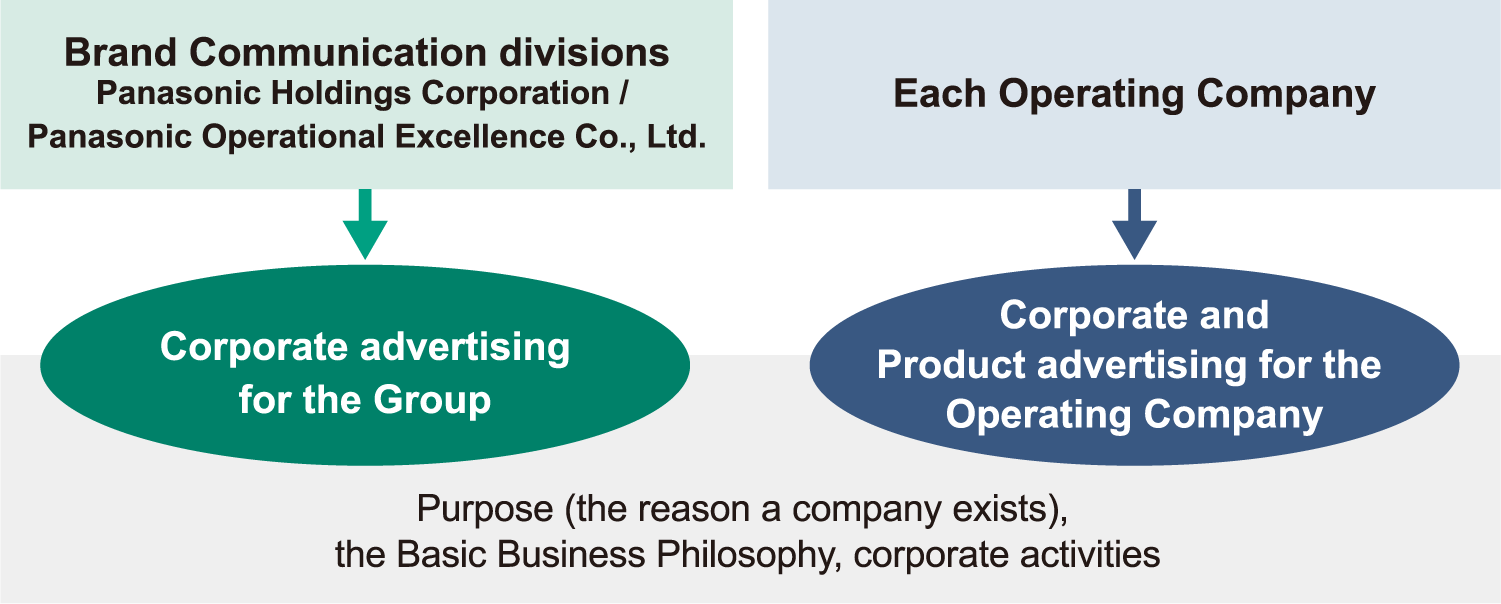
The brand communication divisions of Panasonic Holdings Corporation and Panasonic Operational Excellence Co., Ltd. are responsible for corporate communications for the entire Panasonic Group. Meanwhile, each operating company is responsible for its own corporate communication and product advertising activities. These functions collaborate work closely together across the Group.
▪Promoting Fair and Honest Advertising and Promotional Activities
We have established mechanisms that enable us to verify all the advertising and promotional activities we produce against the relevant laws and industry regulations in each global region.
This helps us to avoid misunderstandings or misconceptions on the part of our customers.
For instance, in Japan, we specialize in training and deploying personnel with expertise in the creation of advertising content, and we also ensure that our personnel accrue experience and expertise in expression and risk avoidance. Furthermore, we screen risks with production partners, review expressions with media and advertising agencies, and conduct preliminary studies. We comply with the Act against Unjustifiable Premiums and Misleading Representations and other legal regulations concerning advertising. This includes various self-imposed media guidelines that companies use to evaluate their advertisements, such as the Japan Advertisers Association Inc.'s ethics code. We also seek review from the Legal Department as necessary.
We also avoid using expressions or performances that could potentially hinder children's sound learning and growth. When employing child actors in advertisements, we comply with all the relevant laws and regulations.
To ensure compliance is maintained, OJT will continue to be conducted on a day-to-day basis. Special training sessions will also be held for major revisions to relevant laws, ensuring that those responsible are fully informed. We will also continue to participate in training and seminars conducted by outside organizations and seek consultations with outside experts when necessary.
Furthermore, we aim to address the recent concern regarding the prevention of fraudulent advertisements on websites and social media. In Japan, we have established a system that will facilitate early detection and response to fraudulent advertisements through continuous monitoring. This system aims to prevent harm from crime by quickly detecting fraudulent advertisements impersonating our company and websites that publish them. It also works to prevent the spread of false information and related comments. We are collaborating with industry associations and relevant government agencies, media companies, as well as the relevant departments within the Group, including Legal, Intellectual Property, Information Systems, and Brand departments, in a joint effort to address these issues.
▪Anti-Counterfeit Activities
The problem of counterfeit products manufactured and sold through the unauthorized use of trademarks continues to grow. As a result, some of our brands have also become targets of counterfeiters, and there have been cases where customers unknowingly purchased such products. To address this issue, we provide information to consumers in China, other parts of Asia, and Japan, through websites and social media regarding the existence and risks of counterfeit electrical products, as well as tips for identifying genuine products. For more information, please refer to “Anti-Counterfeit Activities” section in the “Intellectual Property” chapter.
