


TNFD Recommendations*1
In the same way as the TCFD recommendations, the TNFD recommendations comprise the four thematic areas of Governance, Strategy, Risk and Impact Management, and Indices and Targets, for corporations to voluntarily identify and disclose business risks and opportunities.
The Panasonic Group recognizes risks and opportunities concerning natural capital as a critical management issue. Based on the TNFD recommendations, we are currently identifying these business risks and opportunities, as well as verifying the resilience of our business strategies.
We are also assessing business sustainability using scenario analysis.
*1 In September 2023, the Taskforce on Nature-related Financial Disclosures (TNFD) released a set of disclosure recommendations and guidance for organizations to report and act on evolving nature-related dependencies, impacts, risks, and opportunities.
General Requirements
(1) The approach to materiality
This report assesses and describes "impacts from natural capital on our business activities" and "impacts from our business activities on natural capital" applying a dual materiality approach.
(2) The scope of disclosures
This report adheres to the four pillars of the disclosure recommendations, which are Governance, Strategy, Risk & Impact Management, and Metrics & Targets. The scope of the analysis covers the Panasonic Group's business activities and those of the upstream and downstream of the supply chains. The analysis includes nature-related impact from all manufacturing sites across the group, and then the business-related dependencies and impacts were analyzed under the electronics sector. The risks and opportunities were identified using the LEAP approach,*2 recommended by TNFD, and scenario analysis.
(3) The location specificity of nature-related issues
The analysis used data from the areas where we operate.
(4) Integration with other sustainability-related disclosures
The analysis took into account the relation to environmental issues, such as climate change and resource recycling.
(5) Time span
We use three time spans: Short term—up to three years into the future; Medium term—up to 2030; and Long term—up to 2050.
(6) Stakeholder engagement
We hold dialogues with major media outlets coinciding with the publication of annual sustainability data books. We also hold regular meetings between external experts and our management to deepen understanding of natural capital and gain objective perspectives on the Panasonic Group's efforts.
We are closely engaged with institutional investors to discuss the sustainability strategy that helps to increase our medium- to long-term corporate value. Every company inevitably causes direct and indirect impacts from its business operations. The direct impact is to the company's operating area and surrounding areas, and the indirect impact is to all stakeholders affected by the direct impact. We are watchful for human rights infringements occurring from these direct and indirect impacts and are aware of the importance of managing and correcting any infringements. The Panasonic Group endorses all human rights-related international rules and models, and values the human rights of anyone who may be affected by our business activities. We put the greatest emphasis on our efforts to fulfill this responsibility. We are keen to understand the status of impact from our businesses on indigenous peoples, local communities, and other stakeholders, and are reinforcing our system to protect their human rights. Please refer to the following section, Governance, for more details.
*2 LEAP approach
TNFD adopted the LEAP approach to comprehensively assess nature-related risks and opportunities.
The LEAP approach comprises four phases: Locate the company's interfaces with nature; Evaluate its dependencies and impacts on nature; Assess its nature-related risks and opportunities; and Prepare and report on material nature-related issues.
Governance
Aiming to build a sustainable society, the Panasonic Group regards issues relating to natural capital—such as biodiversity—as a critical management issue. We manage such issues under Groupwide governance using the same system and schemes as we do for TCFD.
We are working to build a society in harmony with nature, contributing to a nature-positive future by supporting the recovery of natural ecosystems. As a part of this effort, we value the human rights of any stakeholders who could be affected indirectly by nature altered by our businesses and supply chain—especially those who are vulnerable to environmental deterioration, such as indigenous peoples and local communities. Such stakeholders have the right to obtain accurate and appropriate information, the right to effectively participate in decision making concerning their environment (including the right of self-determination and to prevent forced relocation of indigenous peoples and local communities), and the right to receive effective remedies. We understand the importance of such rights, as well as of engagement with them to support and exercise their rights. We are aiming to enhance our capability to address these issues.
Strategy
The Panasonic Group provides products and solutions that contribute to people's lives and businesses. Such products and services include home appliances, housing facilities, devices and systems for production and distribution sites, and batteries and electronic components that support transportation systems and social infrastructure. Our businesses largely depend on natural capital, such as water and mineral resources, and biodiversity.
Business management that can bring both business results and natural capital protection is essential to maintaining a sustainable business. With full awareness of this point, we are working to identify and assess nature-related risks in our value chain.
In 2024, we qualitatively evaluated our businesses' relationships with nature and prioritized any issues using the ENCORE*3 and LEAP approaches. The scope of this assessment covered general product life cycles, including procurement, production, usage, and disposal.
The production phase was then analyzed according to the Group companies—Living Appliances and Solutions, Connect, Industry, Energy, and others. Subsequently, these analyses were studied according to the characteristics of major products. We plan to build a more precise assessment system by continuing detailed analysis and improving the assessment procedure.
*3 ENCORE: Exploring Natural Capital Opportunities, Risks and Exposure. A tool developed by the UN Environment Programme World Conservation Monitoring Centre (UNEP-WCMC) to systematically visualize how businesses impact and depend on natural capital, enabling companies to be aware of their exposure to nature through business operations and material procurement in the supply chain. The tool is recommended by the TNFD Guidance and the Ministry of the Environment.
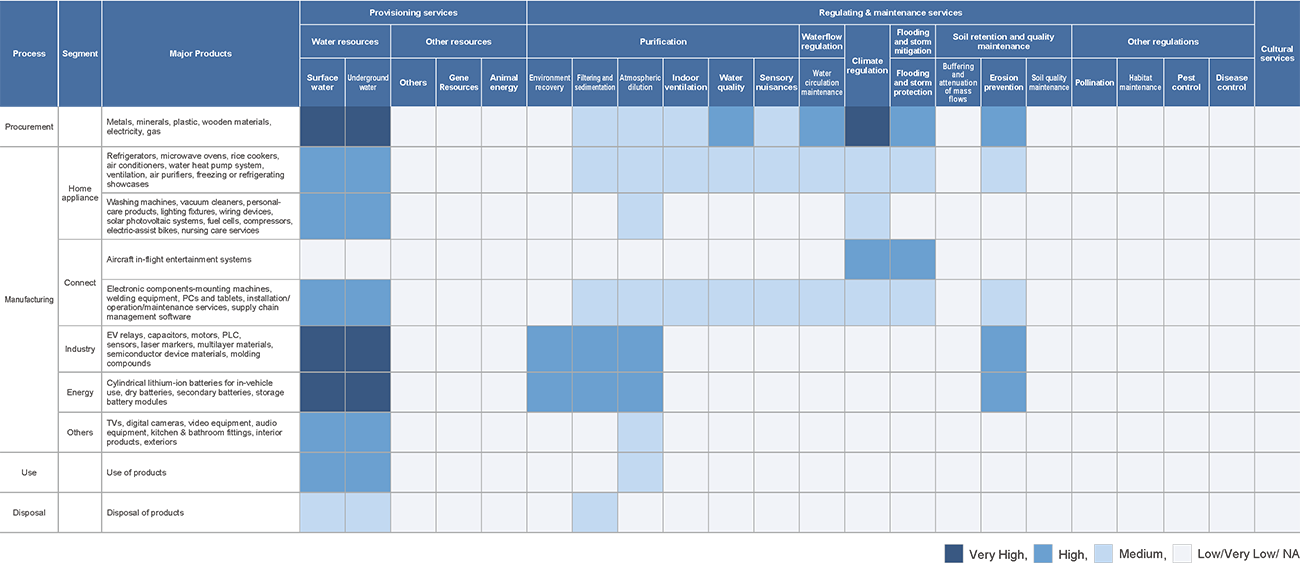
■Dependency Heatmapping
We created a heatmap that shows our value chain's dependencies on ecosystem services, categorized into Very High, High, Medium, and Low (including Very Low and N/A). As a result of ENCORE scoring, many of our business segments showed high dependency on water resources, both surface and underground water.
Ecosystem service dependency heatmap
■Impact Heatmapping
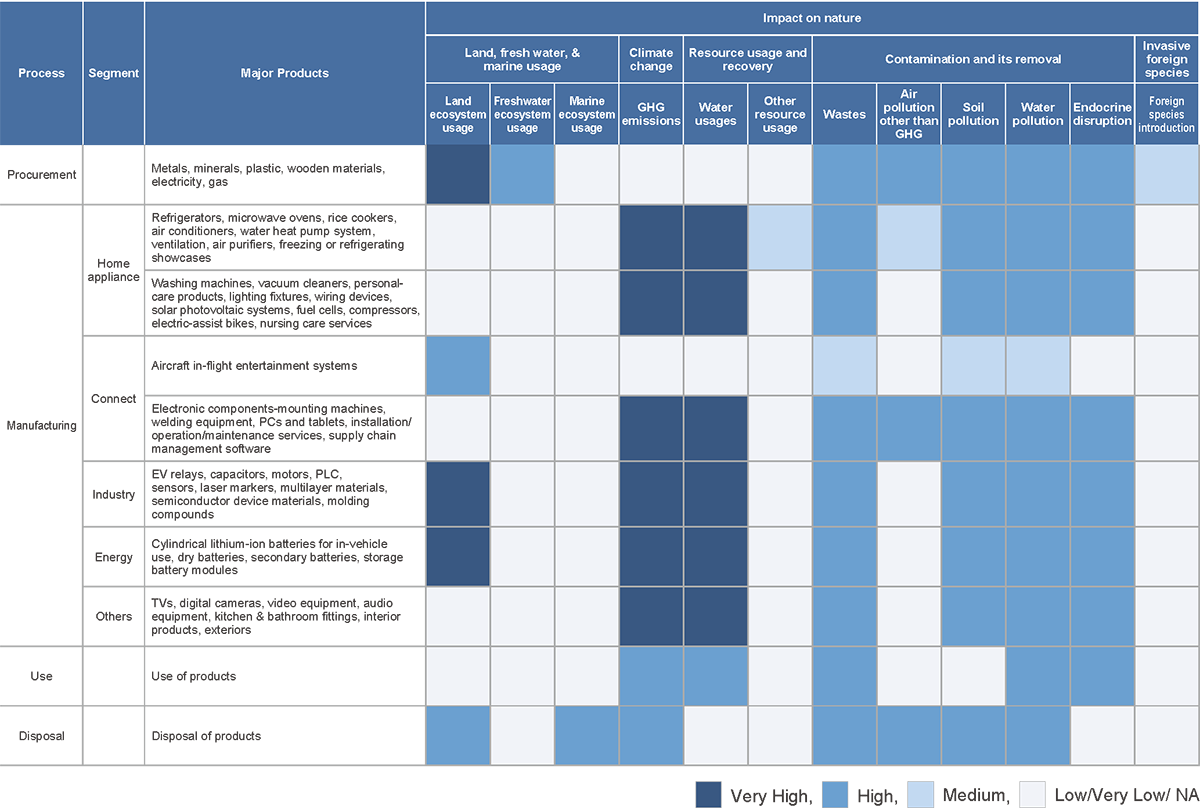
We have also created a heatmap of impacts from our businesses using four categories of Very High, High, Medium and Low (including Very Low and N/A). As a result, many of our business segments showed a high impact for GHG emissions, water usage, land ecosystem usage, waste emissions, soil pollution, and water pollution.
Ecosystem service impact heatmap
■Locating Nature Priority Sites (Locate)
Among all the Panasonic Group's manufacturing sites, we identified Sensitive Locations as defined by TNFD.
Combining the analysis tools and database referred to by TNFD, we identified Sensitive Locations according to the score for each manufacturing site calculated for the following areas: Areas Important for Biodiversity; Areas of High Ecological Integrity; Areas Important for Ecosystem Services Provision; and Areas of Physical Risks for Water. As for the physical risks for water, 54% of our entire sites were found to be in sensitive locations. Taking account of the importance of our group businesses, we will continue to identify the Priority Locations as defined by TNFD.
Sensitive locations among all manufacturing sites
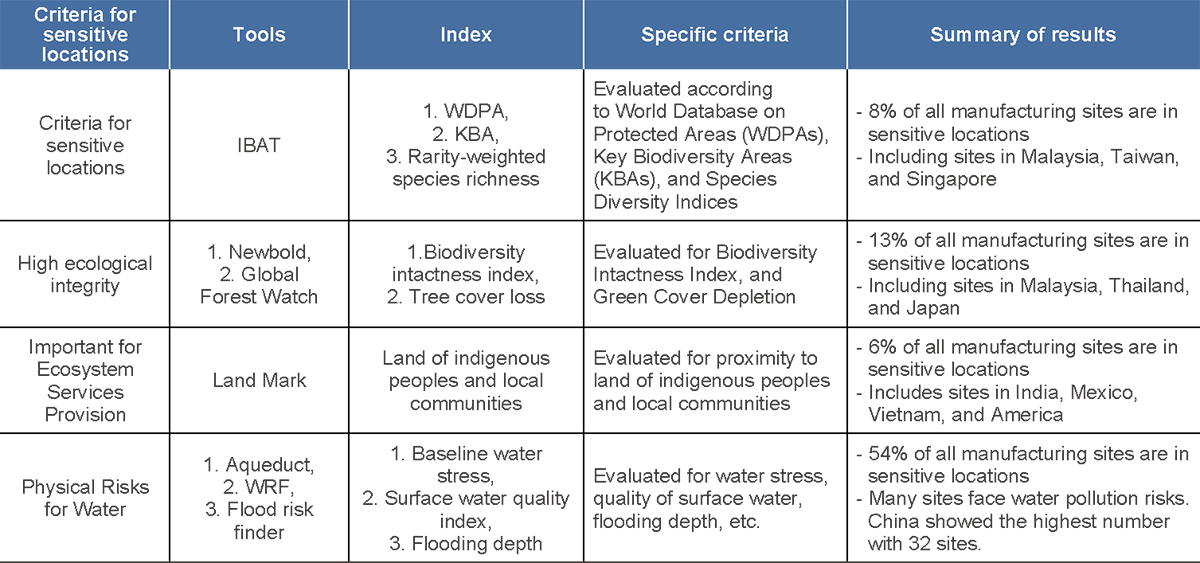
The Locate phase for water resources is described here. The qualitative analysis of the impact on the ecosystem from iron resources is currently being undertaken.
■Identifying Risks and Opportunities Based on Scenario Analysis
Identifying Risks and Opportunities
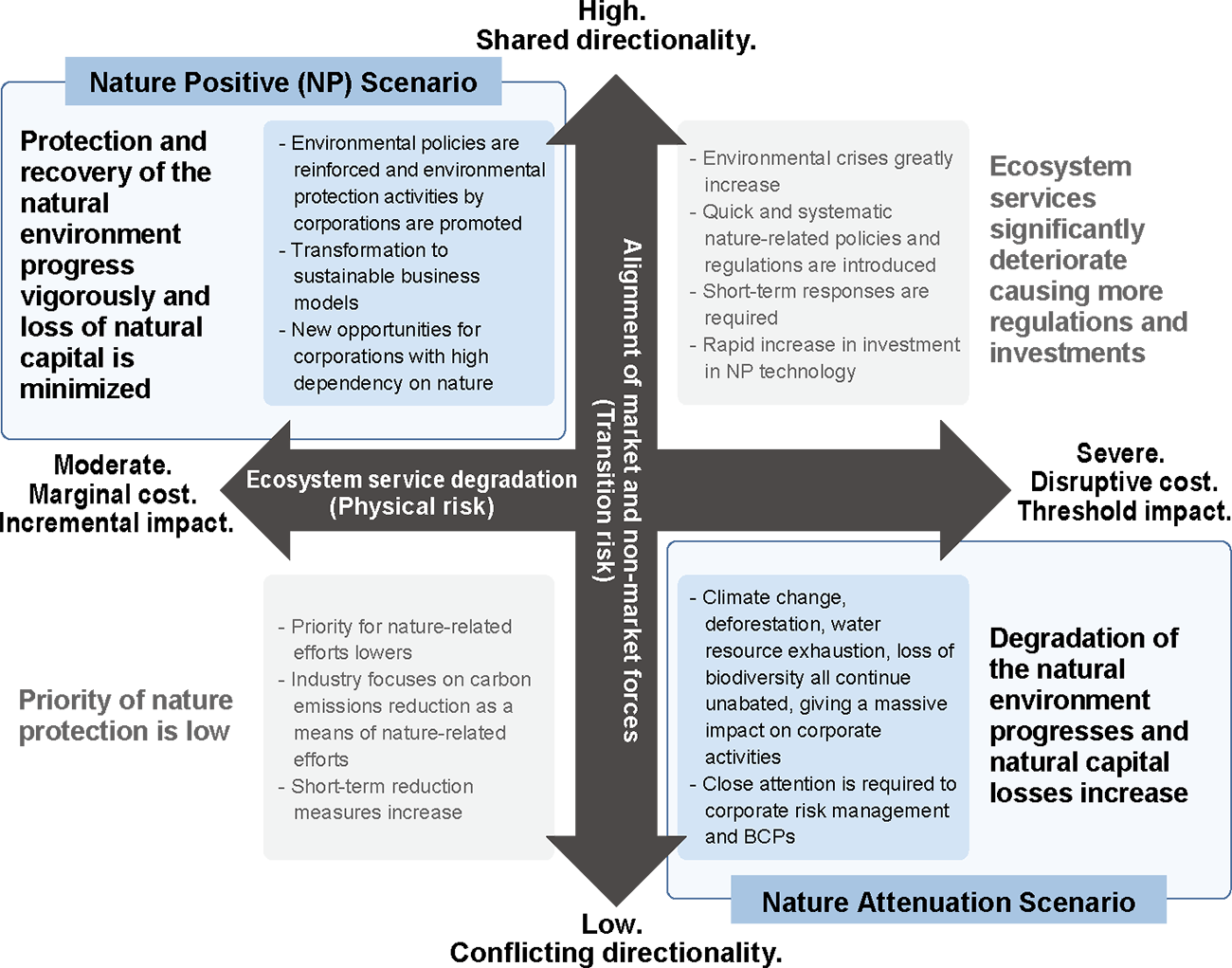
The Panasonic Group is aware of the impact and dependencies of our business activities on natural capital (ecosystem services), and regards our response to related risks and opportunities as priority issues in business management. As a part of such efforts, we ran scenario analyses based on the TNFD recommendations to identify nature-related risks and opportunities. With our eyes set on 2050, we analyzed four scenarios (phases) formed on the two axes of "ecosystem service degradation" and "alignment of market and non-market forces," as recommended by TNFD. As a result, we adopted the following two scenarios for detailed analysis based on their perceived likelihood and potential scale of impact.
- Nature Positive (NP) Scenario
This scenario assumes vigorous progress in nature protection and recovery whereby natural capital would be recovered in the future. This is a scenario based on Vision 2050 of the Kunming-Montreal Global Biodiversity Framework (GBF), which aims at a world living in harmony with nature, or equivalent to a +1.5°C climate change scenario.
- Nature Attenuation Scenario
This scenario assumes a world where natural capital and biodiversity are largely lost due to lack of international cooperation towards nature positive. This is equivalent to a +4°C climate change scenario that describes the accelerated degradation of the natural environment.
Based on these two scenarios, we identified potential issues in the upstream, direct operations, and downstream of the value chain, as well as in the business areas of each operating company.
We then assumed the impact from such issues (risks and opportunities) on our finances and businesses. Taking account of the scale of the impacts and their possible frequency, as well as their time span, we made a relative evaluation between the risks and opportunities. Based on the evaluation results, we then devised countermeasures to minimize the risks and maximize the opportunities. These countermeasures were developed from the standpoint of measures already enforced, other measures currently being discussed, and future plans.
Four Scenarios and Assumed Worlds
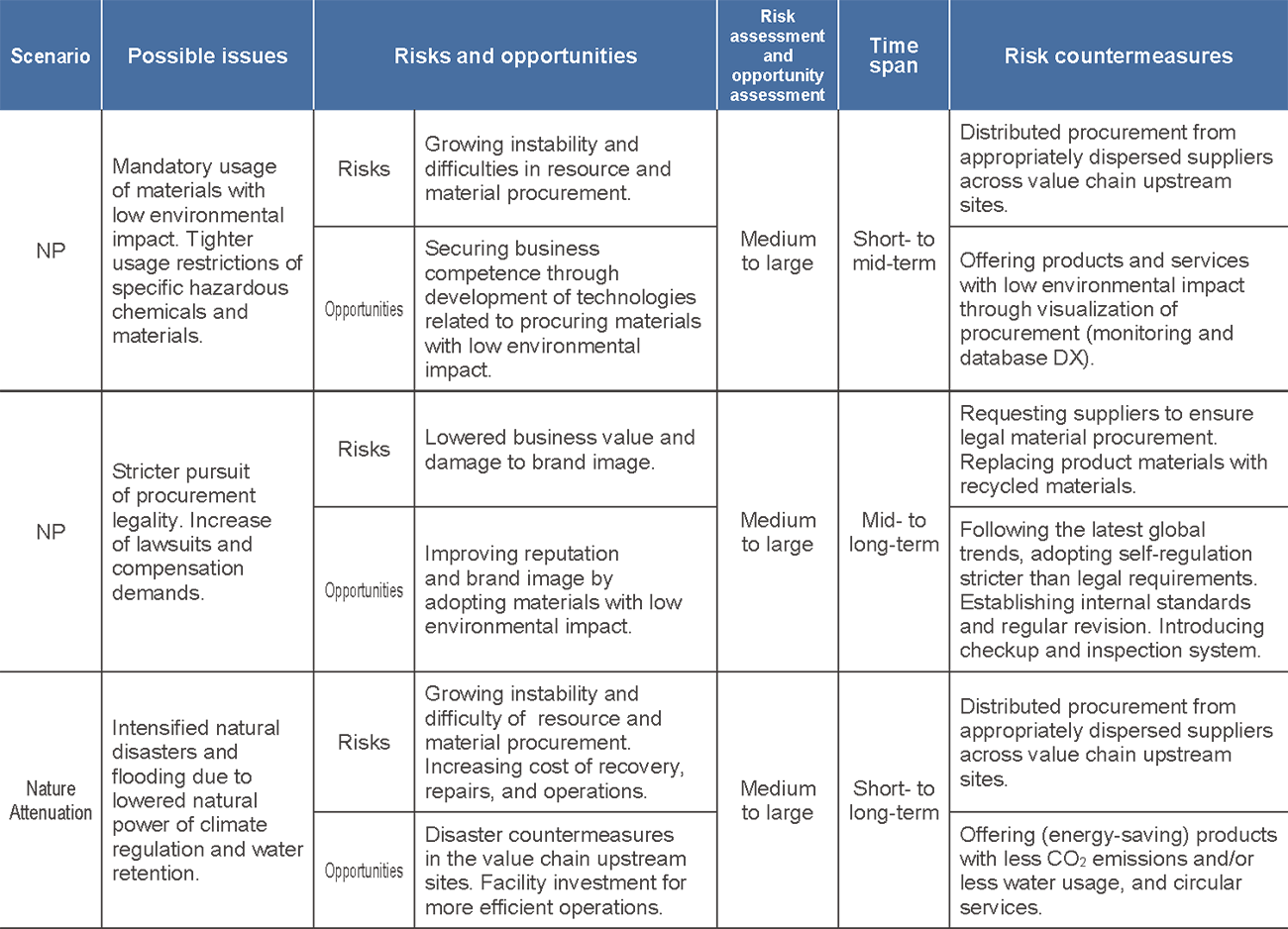
■Scenario Analysis on the Value Chain Upstream
Upstream analysis identified issues related to material procurement, which has a close relationship with nature. In the Nature Positive scenario, where nature protection and recovery progress vigorously, mandatory usage of materials with low environmental impact and tighter material usage restrictions may be enforced. These changes may cause instabilities in material procurement, stricter pursuit of illegal procurement, lowering of business value due to increase in lawsuit and compensation risks, and damage to our brand image. While in the Nature Attenuation scenario, where nature degradation and social indifference progress, we assume risks such as unstable material procurement due to intensified natural disasters and flooding arise with the lowering natural power of climate regulation and water retention. To respond to such risks, we would need to disperse the upstream sites over different areas, keeping pace with the latest regulation changes, and requiring closer cooperation with suppliers.
Risks, opportunities, and countermeasures (upstream)
■Scenario Analysis of Direct Operations in the Value Chain
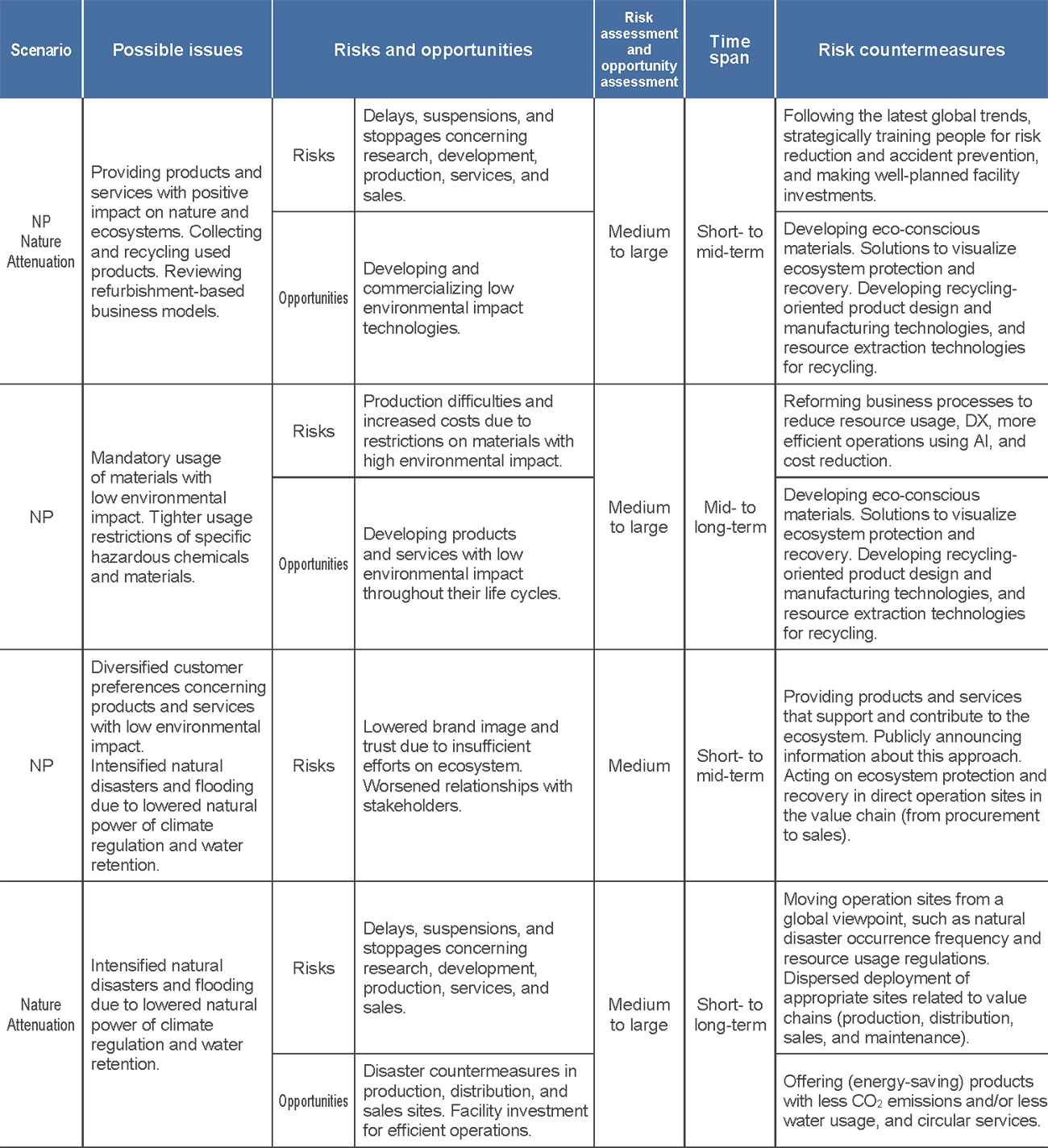
Direct operation analyses revealed that there are many issues in manufacturing, where natural materials are used. In the Nature Positive scenario, mandatory usage of materials with low environmental impact and tighter material usage restrictions may be enforced. These changes may cause risks, such as business stagnation and suspension. At the same time, increased demands for products and services with low environmental impact would require us to operate our business to suit such demands and publicly announce our contribution to ecosystems. Also, we would need to convert our business models to recycling-oriented, by creating products and services that provide a positive impact on nature and ecosystems, collecting and recycling used products, and expanding refurbished products. To realize this, we are aware of the necessity of strategic and well-planned resource deployment; facility investment; and development of eco-conscious product design and manufacturing technologies, as well as resource extraction technologies within the recycling process. In the Nature Attenuation scenario, we are concerned about the growing instability of material procurement and business operations due to the increase in natural disasters and flooding caused by deterioration in nature's capability with respect to climate regulation and water retention.
Risks, opportunities, and countermeasures (direct operations)
■Scenario Analysis in the Value Chain Downstream
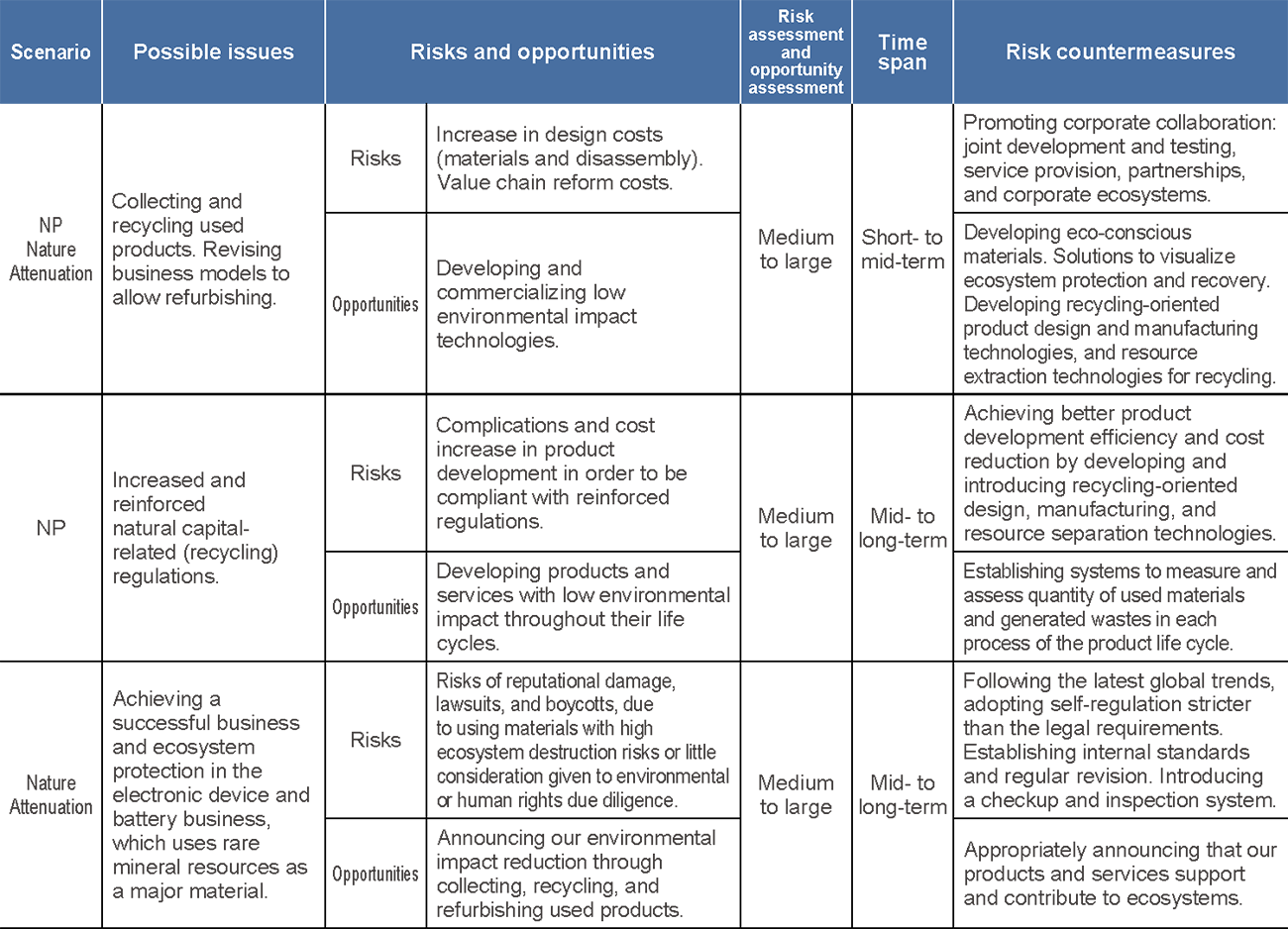
The downstream analysis identified a number of risks related to collection and recycling of used products, and refurbishing. In the Nature Positive scenario, we assumed that a circular economy and recycling-related regulations would be reinforced. We would need to develop and introduce recycling-oriented product design and manufacturing technologies, along with resource extraction technologies. We would also need to establish a system to measure and assess the quantity of used materials and generated wastes in each process of a product life cycle. It would also be necessary to build a closer relationship among partner corporations (joint development and testing, service provision, and forming new partnerships), as well as developing solution technologies to visualize ecosystem protection and recovery.
In the Nature Attenuation scenario, the electronic device and battery business, which uses rare mineral resources as a major material, would face challenges concerning how we can achieve ecosystem protection and a successful business at the same time. For this reason, it is essential to keep pace with the latest regulation trends, establish and maintain internal standards stricter than the legal requirements, and establish a system to carry out regular checkups and inspections.
Further, it is important to publicly announce such efforts and results in an appropriate manner.
Risks, opportunities, and countermeasures (downstream)
Risk and Impact Management
The Panasonic Group regards issues related to natural capital, including biodiversity, as a critical management issue, just as we do for climate change issues. We are working to alleviate impacts from identified risks and enhance opportunities by integrating them within the Groupwide risk management system, as we do for TCFD.
Metrics and Targets
Under Panasonic GREEN IMPACT, our long-term environmental vision, the Panasonic Group has set out targets that aim to reduce risks and expand opportunities related to natural capital protection (resource-related numerical targets and qualitative goals concerning biodiversity and water). We are working hard to achieve these targets and goals to reduce environmental impact across our value chain. We will continue our efforts leading to natural capital protection through our global environmental activities and by setting new indices and targets in our business activities.
Future actions
Under the Group's long-term environmental vision, Panasonic GREEN IMPACT, we began TNFD framework-aligned disclosures from a Panasonic Group perspective in the previous fiscal year to visualize our dependencies and impacts on natural capital, including biodiversity, and to accelerate the sustainable creation of corporate value. This fiscal year, we initiated an analysis of our nature-related risks and opportunities based on the LEAP approach, focusing on our lithium-ion battery business, one of our growth areas.
Going forward, we will use this analysis as a starting point to further refine our analysis and enhance our disclosures in a phased manner. We will also advance initiatives to mitigate future impacts and promote conservation and restoration, further deepen our TNFD disclosures, and enhance corporate value over the medium to long term.
