



The Panasonic Group upholds the management philosophy that a company is a public entity of society. We recognize that we have a responsibility to protect the rights of all people involved in our businesses, including our employees*1, customers, and employees of our business partners, and to contribute to their well-being and happiness. As a company operating globally, we comply with all applicable laws and regulations in our business activities while considering the human rights of all our stakeholders and respecting internationally recognized human rights as expressed in the International Bill of Human Rights and the International Labour Organization’s (ILO) Declaration on Fundamental Principles and Rights at Work.
The Group is committed to pursuing human rights due diligence to identify, prevent, mitigate, and address any adverse human rights impacts related to our business activities, products, services, and transactions. We also seek our suppliers and business partners to understand and implement our human rights and labor compliance policies.
Respect for human rights is one of the Group's key material issues. For more on materiality, click here.
*1 Panasonic employees: (1) all regular and contracted employees having employment relationships with any Panasonic Group company, all temporary staff and seconded employees working under the control and supervision of any Panasonic Group company, and (2) all directors, executive officers, executive counselors, fellows, corporate auditors, supervisory board members, and corporate advisors (collectively, “executives”) appointed by any Panasonic Group company. The definition also includes employees with employment relationships to any key companies, subject to certain Group HR and other systems.
Policy
The Group established the Panasonic Group Human Rights and Labour Policy (hereinafter, the Human Rights and Labour Policy), referencing the below international standards and incorporating external experts’ opinions. This policy states that, predicated on compliance with international standards and the laws and regulations of each country that apply to our business activities and transactions, we are committed to respecting internationally recognized human rights; identifying, preventing, mitigating, and remediating the adverse impact on human rights; promoting remedy and other measures for victims; creating a rewarding working environment; and engaging in dialogue on these issues with various stakeholders. Following this policy, we have established internal rules, developed a promotion system, and advanced specific initiatives for respecting human rights and creating a rewarding work environment.
Moreover, the Panasonic Group Code of Ethics and Compliance (hereinafter, Code of Ethics and Compliance) defines the commitments that all Group employees must fulfil and positions respect for human rights as our social responsibility. We strive to raise awareness of this responsibility.
[Main international standards used as reference]
- The United Nations Guiding Principles on Business and Human Rights
- The United Nations International Bill of Human Rights (Universal Declaration of Human Rights, International Covenant on Civil and Political Rights, and International Covenant on Economic, Social and Cultural Rights)
- ILO Declaration on Fundamental Principles and Rights at Work and ILO Fundamental Conventions (Core Labour Standards)
We regularly, and periodically as necessary, review these policies based on the opinions of external experts, relevant stakeholders, and their representatives. We revised our Human Rights and Labour Policy in August 2023 under the advisement of internal and external experts. This revision was meant to respond to the ILO’s adding occupational health and safety to its Core Labour Standards and to enhance and consolidate efforts to prevent forced labor in the supply chain. After reviewing the changes with the Group and its operating companies’ management and labor unions, the Group CEO approved and proclaimed the policy. The Group’s Human Rights and Labour Policy is available in Japanese and English on our website. We also demand that all our suppliers respect human rights by complying with the Panasonic Supply Chain CSR Promotion Guidelines.

Responsible Executive and Framework
The executive officer responsible for the Group’s initiatives on respecting human rights is the Group Chief Human Resources Officer (Group CHRO) (as of August 2026). The Group’s executive officers set sustainability-related indicators within their respective areas of responsibility as evaluation metrics reflected in their compensation, and the Group CHRO has designated initiatives on respect for human rights. Key human rights issues are discussed by the Sustainability Management Committee*2, chaired by the Group CEO, under the supervision of the Board of Directors of Panasonic Holdings Corporation (PHD), and are reported to the Group Management Meeting and the Board. In fiscal 2025, the Committee discussed challenges in advancing human rights due diligence and related action plans. In fiscal 2026, discussions focused on enhancing internal frameworks and developing implementation plan to meet the requirement of the EU Corporate Sustainability Due Diligence Directive (CSDDD). In addition, human rights and labor compliance has been identified as a Group Major Risk for fiscal 2027, and mitigation efforts are being made at each business site and mitigation efforts are being made at each business site. For more details, see the “Risk Management” chapter.
The Social Sustainability Department, under the Group CHRO, leads our day-to-day efforts to respect human rights. As the supervising organization for the Group's human rights and labor initiatives, it collaborates primarily with HR functions, and also with other related functions such as legal and procurement, to promote these initiatives at each operating company of the Group. At each operating company, human rights due diligence promotion leaders take the initiative in addressing human rights issues identified within the company.
Refer to “Responsible Supply Chain” for details on our initiatives within the supply chain.
*2 The Sustainability Management Committee was dissolved at the end of March 2026. Beginning in fiscal 2027, the Group Transformation Round Table (GTRT) and the PHD Executive Committee (PEC) will continue to discuss and set directions for policies, strategies, indicators, and targets related to sustainability. See “Sustainability Management Basic Philosophy & Structure” for more details.
Key Indicators
The Group operates across a diverse range of business domains and locations through its operating companies, and the nature and severity of the human rights risks also vary accordingly. It is therefore important for each operating company to take the initiative in conducting human rights due diligence based on its own value chain and business characteristics. To this end, it is essential not only to establish human rights due diligence frameworks within each operating company, but also to secure the personnel and organizational structure necessary for their effective implementation. Accordingly, our Group has identified as one of its key indicators the development of human rights promotion leaders who possess a deep understanding of Business and Human Rights and are capable of appropriately identifying human rights risks on the ground and driving improvements.
In addition, through its human rights due diligence efforts, the Group has identified the prevention and mitigation of forced labor risks as a priority issue. It has also established awareness-raising and capacity building for Group sites that employ migrant workers who are vulnerable to forced labor as another key indicator.
Through these indicators, we continuously evaluate the progress of building the foundation for human rights due diligence and addressing priority issues, and strive to enhance the effectiveness of our initiatives.
| Key Indicators | Targets | Progress |
|---|---|---|
| Level of understanding*3 of participants in Human Rights Due Diligence Promotion Training to develop the promotion leaders at each operating company | 80% | 88% (fiscal 2026) |
| Implementation rate of in-person training on forced labour prevention provided to Group sites in Japan and overseas that employ foreign migrant workers | 100% (three-year target for fiscal 2025–2027) | 81% completed (32 sites in total; implemented at 13 sites in fiscal 2025 and 13 sites in fiscal 2026) |
*3 In addition to the level of understanding of the content, the post-training questionnaire focuses on assessing the level of empathy toward Business and Human Rights and the level of awareness regarding its promotion.
Raising Awareness and Capacity Building
The Group places a strong emphasis on raising awareness and capacity building to ensure that all employees consistently put respect for human rights into practice. The Code of Ethics and Compliance, which includes respect for human rights, has been translated into 22 languages, and training opportunities are provided on regular basis, including at the time of hiring and promotion. In particular, for human rights promotion leaders appointed by each operating company, the Group conducts a two-day Human Rights Due Diligence Promotion Training every year (in fiscal 2026, the scope of participants was expanded beyond HR to include functions such as legal and procurement, with a total of 45 participants). The training focuses on practical, hands-on learning, including exercises on identifying and assessing human rights risks and developing mitigation measures. It also emphasized group work centered on discussions among participants. It also featured lectures provided by external experts on key international standards, a range of human rights risks surrounding business activities, and case studies from other companies.
In Japan, we conducted human rights seminars for supervisors (103 participants) in manufacturing divisions that employ foreign technical intern trainees and specified skilled foreign workers. Furthermore, training is provided to all newly seconded employees, including management personnel posted from Japan to overseas subsidiaries, with the aim of deepening their understanding of international standards on corporate responsibility to respect human rights, the laws and regulations of each country, and the Group’s initiatives, including the Human Rights and Labour Policy (489 participants in fiscal 2026). Training on Business and Human Rights was also conducted for HR personnel and others in Asian countries where most of our manufacturing operations are located (13 participants in fiscal 2026).
Human Rights Due Diligence
To respect the human rights of the stakeholders in its business activities, products and services, and transactions, the Group conducts human rights due diligence based on the UN Guiding Principles on Business and Human Rights and with reference to the OECD Due Diligence Guidance for Responsible Business Conduct. Furthermore, in light of legislative developments such as the EU Corporate Sustainability Due Diligence Directive (CSDDD), the Group launched a cross-functional project in fiscal 2025 to ensure a consistent level of reliability and effectiveness in human rights due diligence across the Group, and has been continuously strengthening related processes and tools. In the course of these efforts, we also engage in dialogue, consultation, and collaboration with external experts as well as internal and external stakeholders.
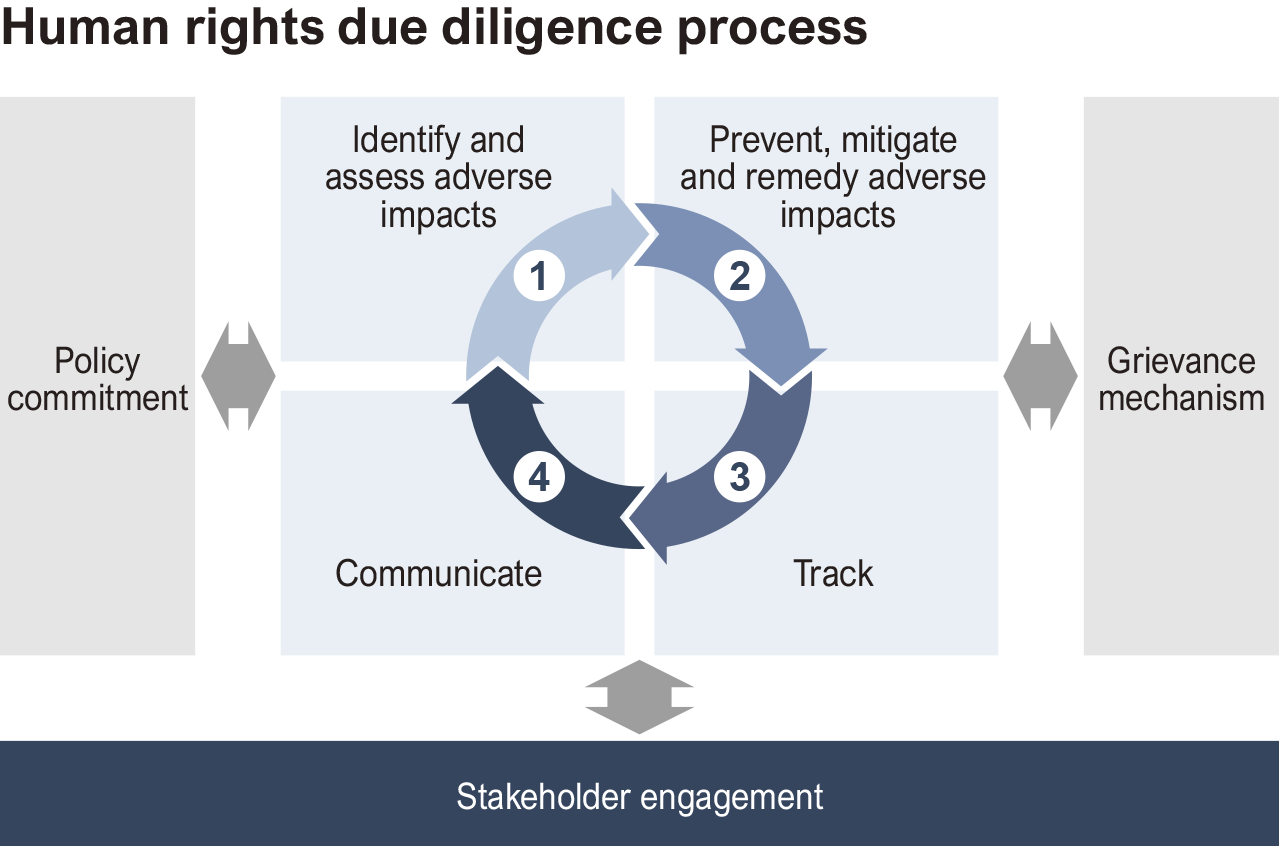
Additionally, given the complexity of supply chains associated with our operations, we strive to prevent and mitigate human rights risks in collaboration with each operating company and regional procurement departments with the support of the Global Procurement Division engaging in responsible supply chains. See “Responsible Supply Chain” for more details on our efforts.
▪Identifying and Assessing Adverse Impacts on Human Rights
The Group recognizes the need to identify human rights risks across all business activities, including the value chain. In fiscal 2025, we first identified the following 17 human rights issues for assessment, taking into account international human rights standards and guidelines, as well as dialogue and consultation with internal and external stakeholders and human rights experts, and reflecting the characteristics of our Group’s businesses and the countries and regions in which we operate.
- Non-discrimination and equality before the law
- Harassment and abuse
- Women’s rights
- Child labor
- Forced labor
- Occupational health and safety
- Working hours
- Freedom of expression
- Intellectual property rights
- Adequate working conditions
- Wages
- Freedom of association and the right to collective bargaining
- Inequality in training and education
- Freedom of thought, conscience and religion
- Infringement of privacy
- Freedom of movement and residence
- Anti-bribery and anti-corruption
Next, each operating company evaluated these human rights issues along two axes—severity and likelihood—taking into account its own value chain and business characteristics, the results of interviews with relevant departments and the status of its own risk mitigation efforts. Based on this evaluation, each operating company identified priority human rights issues. Furthermore, by aggregating the human rights issues identified by each operating company, the Group identified forced labor and occupational health and safety as particularly high-priority salient human rights issues for the Group.
We will continue to improve the process for identifying priority human rights issues and, especially in the event of imminent human rights issues, we strive to prevent, mitigate, and remedy them as promptly as possible.
▪Preventing, Mitigating, and Remediating Adverse Impacts on Human Rights
In fiscal 2026, in response to the priority human rights issues identified in fiscal 2025, each operating company conducted assessments to understand actual conditions and implemented corrective actions for identified issues as well as preventive measures. The status of these initiatives is regularly reviewed by the supervising organization of PHD, which provides advice and recommendations as necessary.
In particular, with respect to forced labor and occupational health and safety, which are high-priority human rights issues for the Group, each company is undertaking Groupwide initiatives (see Prohibition of Forced Labor below and Creating a Safe, Secure, and Healthy Workplace for more details). In addition, we are implementing a variety of initiatives to prevent, mitigate, and remediate other human rights issues identified through human rights due diligence.
Prohibition of Forced Labor
The Group’s Human Rights and Labour Policy clearly states the prohibition of any form of forced labor. We promote efforts to establish a recruitment and employment environment free from forced labor and unfair treatment, in accordance with all applicable laws and regulations and our internal rules, and with reference to international standards and guidelines established by the ILO and other organizations. In the event that any instance of forced labor, or practices indicative of forced labor including those that fall under or may be associated with the ILO’s 11 Indicators of Forced Labour*4, is identified within the Group or among our suppliers or business partners, our internal rules stipulate that such impacts must be addressed promptly. This includes cessation, remediation, mitigation, and the provision of remedy to affected individuals
Within the supply chain, the Group requires its suppliers to take measures to prevent forced labor in accordance with the Panasonic Supply Chain CSR Promotion Guidelines. For more details, see the “Responsible Supply Chain” chapter.
*4 The 11 ILO Indicators of Forced Labour: abuse of vulnerability, deception, restriction of movement, isolation, physical and sexual violence, intimidation and threats, retention of identity documents, withholding of wages, debt bondage, abusive working and living conditions, and excessive overtime
◇Responsible Recruitment and Employment
We recognize that migrant workers who cross national and regional borders to work at our manufacturing sites and in our supply chain are particularly vulnerable. Our Group companies in Malaysia, which employ the largest number of foreign migrant workers in the Group, launched the Responsible Employment Project in 2018 in collaboration with the International Organization for Migration (IOM), the UN Migrant Agency, which works globally to address persistent migration issues and has been engaged in identifying and correcting human rights issues as well as providing training on these issues in Malaysia and the wider region. In 2020, the Group companies in Malaysia formulated the Policy on Responsible Recruitment and Employment of Foreign Migrant Workers in April 2020 (revised in April 2025) and the corresponding standard operating procedures in September 2021 (revised in April 2025), under which Group companies have been promoting a range of related initiatives. In fiscal 2026, we developed the Panasonic Group Guidance on Responsible Recruitment and Employment based on the policy and standard operational procedures established in Malaysia, and from fiscal 2027, we will roll it out globally to Group companies that recruit and employ vulnerable foreign migrant workers. These Malaysian policies and the Group’s guidance clearly set out principles for protecting workers, including prohibiting foreign migrant workers from bearing recruitment fees and related costs, prohibiting companies from retaining personal documents such as passports, and transparently informing foreign migrant workers of basic employment terms and conditions in a language they understand before leaving their country of origin. In Malaysia, the Group companies also verify the implementation of the policy and standard operational procedures. In fiscal 2025, with the cooperation of the IOM, interviews were conducted with approximately 770 foreign migrant workers at manufacturing sites of four Group companies. These interviews identified insufficient awareness of internal rules and the operational-level grievance mechanism. Based on these findings, the policy and procedures were revised, and refresher training on workers’ rights and internal rules was provided to all foreign migrant workers (approximately 1,700) and supervisors at the four companies. In fiscal 2026, we conducted workshops for responsible managers and staff in related functions such as HR and legal to promote the dissemination of the policy and procedures (38 participants from eight Group companies).
In addition, from fiscal 2025, the Group companies have added requirements to respect for human rights to contracts with manufacturing contractors and various service providers in Malaysia, and have conducted training on international standards on forced labor, relevant national laws and regulations, and the Group’s Human Rights and Labour Policy (64 companies participated in fiscal 2025 and 52 companies in fiscal 2026).
In countries and regions with potential risks, we have been expanding initiatives implemented in Malaysia. In Taiwan, following a third-party audit conducted at a Group manufacturing company in fiscal 2025, we revised insufficient provisions in employment contracts, improved living conditions and hygiene, strengthened disaster preparedness in dormitories, and provided training to reinforce the operation of the company grievance mechanism. In Japan, we conducted awareness-raising, training and checks for potential risks at 13 sites employing foreign technical intern trainees and specified skilled foreign workers in fiscal 2026. In Thailand, we added human rights requirements to contracts with manufacturing contractors and various service providers (approximately 400 companies in total) in fiscal 2026. In addition, with the cooperation of IOM, we conducted training for 12 Group companies and 73 service providers on international human rights standards, risks of forced labor, and measures to mitigate such risks.
Based on the recognition that collaboration among governments, relevant organizations, companies, suppliers and business partners is essential to address the root causes of forced labor, the Group has participated, since fiscal 2026, in a working group of the Responsible Labor Initiative, a Responsible Business Alliance (RBA) initiative involving more than 190 companies, and is working to promote ethical recruitment. At the Group’s business sites in Malaysia, we have been working with recruitment agencies that meet ethical recruitment standards and have been certified by On the Level*5 program since fiscal 2026. In high-risk countries such as Malaysia and Thailand, the Group is also working to build relationships with government authorities, United Nations-affiliated organizations, and NGOs, and to promote key information and exchanging views.
*5 On The Level by the Fair Hiring Initiative is a certification program for recruitment agencies and labor suppliers, with the objective of promoting and ensuring the implementation of internationally recognized ethical recruitment standards.
Prohibiting Child Labor and Protecting Young Workers
Our Human Rights and Labour Policy clearly state our commitment to the effective eradication of child labor.
We comply with applicable laws and regulations in the countries where we recruit employees, and we require that our recruitment agencies and other business partners do the same. We also do not permit workers under the age of 18 to engage in hazardous or harmful work. In the supply chain, we request our suppliers to take the same approach in the supply chain as outlined in the Panasonic Supply Chain CSR Promotion Guidelines. For more details, see the “Responsible Supply Chain” chapter.
Prohibition of Discrimination and Harassment
Our Human Rights and Labour Policy clearly seeks to eliminate discrimination in the field of employment and occupation. Moreover, in our Code of Ethics and Compliance, the Group prohibits discrimination, behavior that leads to discrimination, and harassment on the basis of age, gender, race, skin color, beliefs, religion, social status, citizenship, ethnicity, marital status, sexual orientation, gender identity and expression, pregnancy, medical history, viral infection status, genetic information, disability status, political affiliation or orientation, labor union affiliation, veteran status, or any similar status or characteristic. We also strive to raise awareness of this prohibition. By doing so, we aim to foster an inclusive and supportive workplace where diverse talents respect one another as valued partners and can thrive. For more details, see the “Maximizing the Potential of Diverse Talent and Organizations” chapter.
◇Recruitment Selection
We ensure that recruitment and selection processes are conducted in accordance with applicable laws and guidelines of each country and are strictly based on candidates’ qualifications, abilities, and motivation. If any human rights violations, including the abovementioned forms of discrimination, or issues that may lead to such violations are identified during the selection process, we will not only take prompt corrective action but also strive to prevent recurrence through awareness-raising and education.
Respect for the Freedom of Association and the Right to Collective Bargaining
Our Human Rights and Labour Policy clearly expresses our support for freedom of association and the effective recognition of the rights to collective bargaining. In each country and region, we make efforts to establish healthy relations with employees and to solve their issues by active dialogue with them. In addition, based on our Human Rights and Labour Policy, we pursue ways to respect internationally recognized human rights principles at our locations in countries that do not legally permit the formation of labor unions.
◇In Japan
The Group recognizes the rights of labor unions, including the right to organize, the right to collective bargaining, and the right to strike, as stipulated in the labor agreements concluded with each labor union with which the Group and its subsidiaries engage. We also prohibit discrimination against union members and any disadvantageous treatment based on union activities. Managers and employees are members of the labor union at a rate of 74.6%, while the rate is 97.2% when excluding managers (as of March 31, 2026).
Based on a common understanding that the Company’s sound development, improvements in labor and welfare conditions for employees, and social development are inseparable, the Company and the Union have established a system of Union participation in management based on equality and robust trust between labor and management. The Company and the Union discuss essential management matters in Labor-Management Council.
◇In Europe
Following an EU directive*7 adopted in 1994, we have set up a voluntary labor agreement to provide a venue for healthy discussion between labor and management. We have also established the Panasonic European Employee Congress (PEEC). Employee representatives and company representatives also meet to exchange opinions and discuss business issues including management strategies and living support for employees.
*7 EU directive: A directive that obliges all companies employing 1,000 or more employees in two or more European Union countries to establish a pan-European labor-management consultation committee.
◇In China
Nearly all Group-affiliated companies in China have labor unions (gōnghuì). We hold regular opinion exchanges and discussions surrounding compensation, welfare and benefits, training, and the like through initiatives including periodic labor-management dialogues, proactive joint labor-management recreational events, and advance briefings to unions concerning critical management decisions, with a focus on building good relations between labor and management.
Occupational Health and Safety
The Human Rights and Labour Policy sets out its commitment to providing a safe and healthy work environment. This has been identified as one of the Group’s most salient human rights issues and is being addressed as a priority. For more details, see Creating Safe, Secure, and Healthy Workplaces in the Maximizing the Potential of Diverse Talent and Organizations chapter.
Managing Working Hours
We have established provisions in our work regulations related to proper management of working hours, break times, overtime work, holidays, leave, and other matters in accordance with applicable labor laws in each country and labor-management agreements (e.g. collective bargaining agreements). Our internal rules also prohibit forcing workers to work overtime without their agreement as this constitutes a practice indicative of forced labor or may be considered forced labor.
In Japan, the standard working day is set at 7.75 hours per day, and any extra hours worked are eligible for extra pay, going beyond the minimum required by law. We have also established internal working hour management standards that are even stricter than legal requirements as part of our efforts to prevent excessive working hours.
We also provide more annual paid leave than legally required, and employees may accumulate up to 50 days of unused leave. We have made the system more flexible to accommodate individual needs, such as allowing leave to be taken on an hourly or half-day leave available.
In addition to those measures, we support employees’ physical and mental health by ensuring appropriate workforce allocation to prevent overtime from being concentrated among specific employees, and by providing additional medical examinations for employees who have worked long hours.
Wage Management
We have established guidelines for the design of compensation systems, aiming to achieve market-competitive levels of remuneration. In accordance with applicable laws and regulations in each country, as well as labor-management agreements including collective agreements, we also set out in our work regulations appropriate wages, allowances, bonuses, and other types of occasional compensation or retirement benefits.
In addition, we establish rules in each country in compliance with all applicable wage-related laws and regulations, including those governing minimum wages, statutory benefits, and overtime pay. Wages are managed and paid in accordance with these rules, and employees are provided with the necessary information through payslips and electronic records. Payments are made directly to employees in accordance with the prescribed pay cycle and on designated payment dates.
Grievance Mechanism
The Group accepts human rights related grievances through various channels to ensure that they are addressed promptly and lead to corrective action and the provision of remedy. In addition, where human rights violations are confirmed, we work to provide remedy to the affected individuals.
As one of its whistleblowing channels, we have established the Global Hotline EARS (available in 32 languages), which is accessible to employees as well as external stakeholders, including suppliers and business partners. This allows individuals to report when they have been affected by or become aware of compliance violations, including human rights and labor issues. Reports may be made anonymously, and all information of the reporter and the reported content is kept confidential. In addition, our internal rules stipulate that neither internal nor external reporters shall be subject to retaliation or any disadvantageous treatment as a result of making a report. For more details, see the “Whistleblowing System” in the “Compliance” chapter.
Furthermore, in order to more broadly accept human rights related reports from outside out Group, we have joined as a regular member of the Japan Center for Engagement and Remedy on Business and Human Rights (JaCER), an industry-wide grievance platform established through the integration of initiatives led by the Business and Human Rights Lawyers Network, the Global Compact Network Japan, and the CSR Committee of the Japan Electronics and Information Technology Industries Association (JEITA). We utilize such third-party mechanisms to address human rights issues, ensuring fairness and transparency, as well as promoting dialogue.
Participation in International and Industrial Partnerships
The Group has been a participant in the United Nations Global Compact since January 2022. We have declared our support for the ten principles in four areas, including human rights and labor, and uphold our accountability by reporting the progress and outcomes of our human rights and labor initiatives in accordance with international standards.
In addition, since October 2021, the Group has been a member of the Responsible Business Alliance (RBA), an international CSR organization in the electronics, ICT, and automotive industries, and also participates in the Responsible Minerals Initiative (RMI) under the RBA. In March 2026, the Group was involved from the planning stage in a dialogue hosted by the RBA between Malaysian government ministries and RBA member companies, and requested that Malaysian government agencies provide support to companies in their efforts to respect the rights of foreign migrant workers.
In February 2024, the Group entered into a strategic global partnership with IOM, a specialized UN agency, with a proven track record of assisting in the responsible recruitment and employment of foreign migrant workers in Malaysia—to improve the rights of foreign migrant workers in the supply chain.
In April 2025, we joined the Global Business Initiative on Human Rights (GBI), an international organization that supports corporate efforts to respect human rights. Through collaboration with GBI, we are deepening our understanding of the human rights challenges that companies face and leveraging this to continuously enhance our human rights due diligence.
The Group continues to strengthen its management system through these initiatives.
The Group also actively provides practical input on human rights from a corporate perspective to domestic and international organizations, as well as government agencies. In fiscal 2026, PHD personnel continued to participate in OECD's Sustainable Business Expert Group, Business at OECD (BIAC) and took a leading role as vice-chair of the Corporate Sustainability Committee of the Japanese Business Council in Europe (JBCE) consistently contributing to government policies related to human rights and due diligence in Europe. In 2025, the Group made proactive contributions to the drafting process of the Omnibus I Simplification Package, including the CSDDD. In Japan, through participation in the Sustainability Due Diligence Working Group under the CSR Committee of JEITA, the Group has been working to address common challenges faced by the electronics industry, including by submitting position papers to European policymakers regarding legislation on human rights due diligence. In Malaysia, the Group also continues dialogue with the Human Rights Commission of Malaysia (SUHAKAM) on human rights issues in the country. In January 2026, following the previous year, the Group hosted the Japan training program under the Training Course on Promoting Responsible Business Conduct in Vietnam organized by Japan’s Ministry of Economy, Trade and Industry. The Group introduced its initiatives related to Business and Human Rights and exchanged views with executives from the Vietnam Chamber of Commerce and Industry and Vietnamese companies in the electrical and electronics sector that have business relationships with Japanese companies.
-
United Nations Global Compact

-
Responsible Business Alliance (RBA)
-
Business at OECD (BIAC)
-
Japan Business Council in Europe (JBCE)
-
CSR Committee, Japan Electronics and Information Technology Industries Association (JEITA) (Japanese only)
-
The Human Rights Commission of Malaysia (SUHAKAM)
-
GBI (Global Business Initiative on Human Rights)
