



As the Panasonic Group’s business activities continue to expand globally, we believe that preventing violations of laws and regulations and misconduct before they occur and maintaining the trust of our stakeholders are essential prerequisites for the sustainable creation of corporate value. To this end, every director and employee must always have accurate knowledge and high ethical standards. At the same time, the Group must clarify its policies and establish rules and mechanisms based on risks arising from the external environment, business characteristics, and regional characteristics, thereby ensuring that business activities are conducted under a sound corporate culture.
As a “public entity of society,” the Panasonic Group believes it is important not only to comply with laws and social norms, but also to consistently act with integrity and in the spirit of fair play, free from self-interest, while always considering “what is right for society.” We believe that the continued practice of such conduct will earn and maintain the trust of society, our industry, and our customers, thereby contributing to our long-term development.
On the other hand, if a compliance violation occurs within the Panasonic Group’s global operations, in addition to criminal penalties and disciplinary actions imposed on the individual responsible, the company involved may also be subject to fines, administrative sanctions, or criminal penalties. Such consequences may not only result in economic losses, but also undermine the trust of society and stakeholders and damage our reputation.
With a full understanding of these positive and negative impacts, the Panasonic Group has established the Panasonic Group Code of Ethics & Compliance to embody its Basic Business Philosophy and practice compliance in its business activities. In addition, we have established various internal rules and regulations, including those designed to ensure respect for fair and free competition and to prevent bribery and corruption, and we are implementing the necessary measures to ensure that every director and employee can perform their duties based on high ethical standards and appropriate judgment.
Policy
The Panasonic Group has established the Panasonic Group Code of Ethics & Compliance (the “Code of Ethics & Compliance”) as the basic policy governing compliance in its business activities. The Code sets out the commitments that each Group company and every employee must fulfill, and it has been translated into 22 languages to ensure that it is understood by employees around the world and thoroughly communicated across the Group.
The Code of Ethics & Compliance goes beyond simply complying with laws and internal rules. It explains the positive impact that putting the Code into practice can have on society and stakeholders in connection with the Basic Business Philosophy, while also clearly indicating the negative consequences that violations may bring to both the Group and individuals.
The Code is established and revised by the Board of Directors of Panasonic Holdings Corporation (“PHD”) and, after being communicated to all Panasonic Group companies, takes effect through resolutions of each company’s Board of Directors or other appropriate internal procedures.
The Panasonic Group not only establishes the Code of Ethics & Compliance and related internal rules, but also continually verifies whether they are being put into practice across its business activities. Through these efforts, we aim to ensure that compliance is not treated as a mere formality, but is firmly embedded in day-to-day operations as the basis for each individual’s judgment and actions.
Responsible Executive and Framework
The Group General Counsel (Group GC), a Director and Executive Officer, is responsible for and oversees the Panasonic Group’s compliance initiatives, including efforts to prevent bribery and corruption (as of August 2026). Roles and responsibilities related to compliance in the Panasonic Group have been clearly defined on a Groupwide basis.
As shown below, under the Group management system based on the operating company system, Panasonic Holdings Corporation (“PHD”) is responsible for establishing and overseeing the Groupwide compliance system. Under the Group CEO’s leadership, the Group GC and the PHD Legal Division play central roles in advancing these initiatives.
At each operating company, based on the principles of autonomous responsible management, the Chief Legal Officer (CLO) and legal department are responsible for establishing and fully implementing a compliance system for the relevant business area under the leadership of the operating company CEO. Outside Japan, the CLOs and legal departments at each regional location address matters in consideration of regional characteristics.
These CLOs work together under the Group GC as a single legal team to promote compliance across the Group.
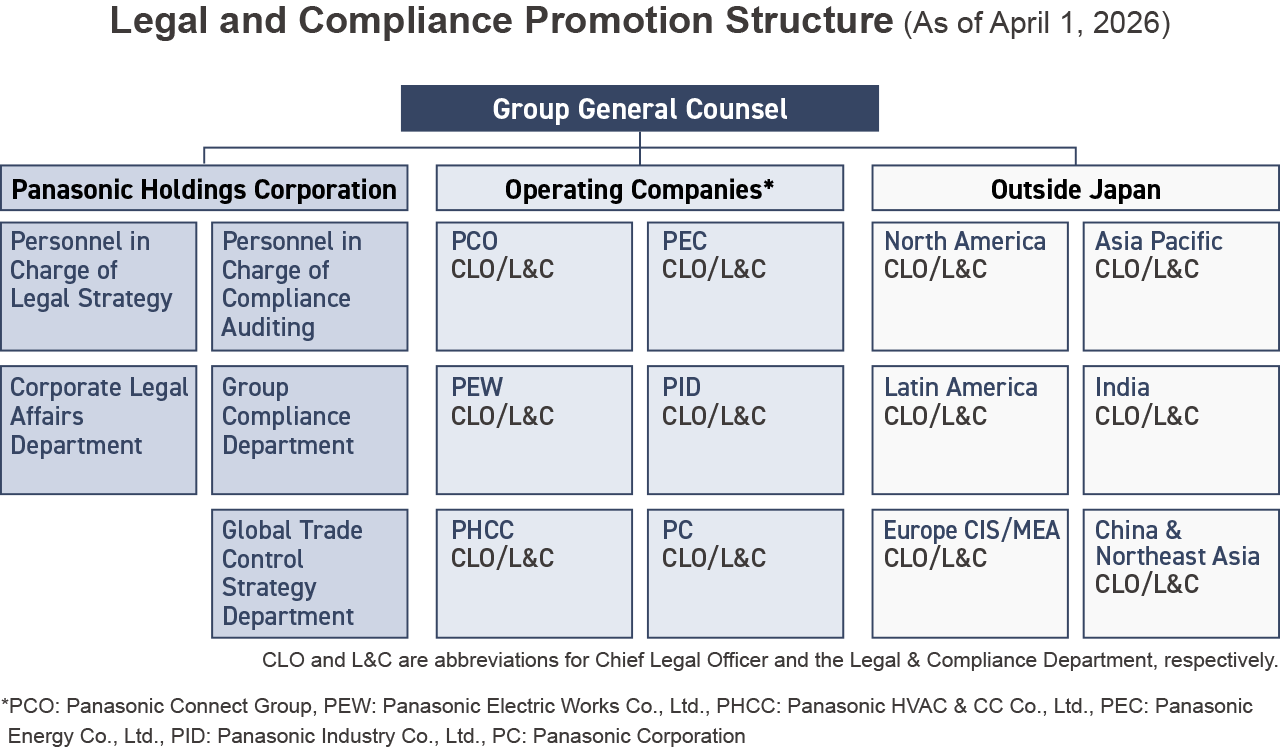
In addition, the Group GC and the CLOs of each company regularly report on compliance initiatives and other important matters to the Board of Directors and other relevant management bodies. Through this framework, management provides timely and appropriate instructions and oversight, while issues and risks at the operational level are reflected in management decision-making.
In evaluating compensation for PHD executive officers and operating company CEOs, compliance-related initiatives are included as one of the non-financial indicators. Furthermore, starting in fiscal 2026, malus and clawback provisions*1 have been introduced to promote appropriate conduct by executive officers and to help prevent, detect, and address serious compliance issues (applicable to performance-based compensation).
*1 If a serious compliance issue arises (i.e., one that may materially affect the financial condition, reputation, or brand value of the entire Panasonic Group) or if the financial statements for the entire Panasonic Group need to be amended in any material respect, these provisions allow PHD to claim a refund of previously paid compensation (clawback provisions) or reduce the compensation to be paid (malus provisions).
Key Indicators
The Panasonic Group has identified Business integrity as one of its material issues and is advancing initiatives with “zero serious compliance violations” as a key performance indicator (KPI). Potential serious compliance violations may span multiple areas. This chapter focuses in particular on the core areas of business integrity that directly affect overall business activities—such as ensuring fair competition, preventing bribery and corruption, and compliance with global trade regulations—and describes the initiatives implemented by the Group in these areas. For other areas, see the relevant chapters below.
Main incidents that could constitute serious compliance violations | Relevant sections and chapters in the Sustainability |
|---|---|
| Cartels and other violations of the antitrust law and the competition law | “Initiatives to Address Significant Compliance Risks” in “Ethics and Compliance” chapter |
| Corruption, including bribery | |
| Violations of export control laws and laws/regulations on economic sanctions or UN sanctions | |
| Violations of the act on the protection of personal information | “Data Protection” in “Cyber Security and Data Protection” chapter |
| Quality-related fraud or legal violations relating to products and services, and violations of regulations related to chemical substances and waste disposal | “Serious Violations and Corrective Measures” in “Ethics and Compliance” chapter “Raising Product Quality Levels and Ensuring Product Safety” chapter “Environmental Risk Management” in “Environment” chapter |
| Human rights issues such as child labor and forced labor | “Respect for Human Rights” chapter |
Internal Communication and Training
▪Internal Communication
The Panasonic Group positions compliance as one of the most important foundations of management, and the Group CEO, the CEOs of each operating company, and the heads of each business site continually communicate the importance of sincere and ethical conduct and of a compliance-first mindset through internal messages and opportunities for dialogue. The Group also engages in two-way communication by reporting opinions and concerns raised at the frontline to management and reflecting them in policies and measures as necessary.
Moreover, through the CLOs and legal departments assigned to operating companies and overseas regions, as well as through officers responsible for compliance and export control and the heads of each functional department, specific compliance initiatives are implemented across business sites.
Within the legal departments, which play a leading role in these efforts, legal staff from around the world participate in meetings, and the CLOs of the operating companies, overseas regions, and the PHD Legal Division attend meetings led by the Group GC. Through these meetings, they share the annual compliance policy and promote a variety of compliance initiatives.
Furthermore, changes to laws and regulations, as well as other legal developments relevant to the Group’s businesses are promptly communicated to business sites and related departments in a timely manner, and a quarterly compliance newsletter is distributed globally to management.
▪Training
In the Panasonic Group, we are strengthening our efforts to accurately identify changes in risks in specific business fields, divisions, and countries and regions, as well as early signs of legal violations and misconduct, in response to changes in the business environment and the Group’s business. Through these efforts, we carry out initiatives on an ongoing basis throughout the year to establish Groupwide awareness of ethical and legal compliance and enhance our risk response capabilities.
With regard to the Panasonic Group Code of Ethics & Compliance that all employees are required to follow, together with basic compliance education and awareness-raising, we conduct education and training on an ongoing basis throughout the year through e-Learning and a variety of educational materials, in addition to training provided at the time of hire and upon promotion.
Furthermore, to ensure the observance and implementation of the Code of Ethics & Compliance, we promote education and awareness-raising activities at each business site under the supervision of Officer responsible for observance of the Code, who are appointed at each operating company, business site, and subsidiary.
In addition, in areas where violations could have a significant impact, such as bribery and corruption and violations of competition laws, we provide field-specific compliance e-Learning programs, and ensure that directors and employees engaged in high-risk duties receive these courses on a regular basis. We also confirm participants’ understanding and monitor the course completion status.
Moreover, at operating companies and in overseas regions, we provide compliance training to the relevant personnel based on risks that reflect the characteristics of each business and region.
The Panasonic Group continuously implements these educational initiatives, while also evaluating participants’ understanding and the extent to which awareness has taken root, and uses the results to enhance the programs. Through these efforts, we aim to embed compliance not only as “rules to be followed,” but also as a foundation that enables each individual to make fair judgments and put them into practice in their daily work.
Whistleblowing System
▪Establishment of the Global Hotline
The Panasonic Group has introduced the “Global Hotline EARS,” a Groupwide, integrated whistleblowing system available to employees at both domestic and overseas sites, as well as to business partners and other external stakeholders, to prevent misconduct and enable its early detection and correction. The system enables anonymous reporting and accepts reports on a wide range of compliance-related issues, including ethical concerns, bribery and corruption, and harassment. It is available in 32 languages, 24 hours a day, 365 days a year. The Global Hotline is clearly set out in the Code of Ethics & Compliance, and awareness of the system is promoted through various compliance training programs and the posting of posters at domestic and overseas sites. In addition, to ensure transparency in the operation of the reporting system, statistical data on reports, case studies demonstrating how reports have led to issue resolution, and instructions on how to use the system are posted on the Company intranet to encourage employees to use the system. We also promote awareness and use of the system among our business partners through the CSR Promotion Guidelines for Suppliers and other initiatives.
On the Global Hotline website, we clearly indicate the procedures for making a report, the types of personal data collected, how such information is managed, and where responsibility lies. In addition, whistleblowers can check the status of their reports at any time using a reporting key and password assigned to their submission.
▪Ensuring the Effectiveness of the Whistleblowing System
The Panasonic Group clearly states in its Code of Ethics & Compliance that “Panasonic does not tolerate any retaliation or other action that discriminates against or disadvantages anyone who acts in good faith to raise a compliance concern.” Retaliation against whistleblowers is strictly forbidden, and their confidentiality is assured. Anonymous reporting is also available. To clarify this stance, we have established the rules which prohibit retaliation against whistleblowers, individuals who cooperate in investigations, and employees involved in such investigations, thereby ensuring the proper operation of the whistleblowing system.
In addition, we have established internal rules to ensure the appropriate reporting, receipt, investigation, corrective action, and reporting to management on compliance issues. These rules clearly define the types of cases subject to reporting and the methods of investigation. In accordance with these rules, each operating company has established a whistleblowing response framework and designated responsible personnel, primarily within the legal and human resources functions. When potential violations are identified through reports, audits, or other channels, we promptly conduct internal investigations. If a violation is confirmed, we take corrective action, implement measures to prevent recurrence, and, where necessary, take disciplinary action against the persons concerned. The results of our response are shared with relevant departments and management and, where appropriate, used to review internal rules and training content, thereby contributing to improvements across the Group.
Furthermore, to maintain and enhance, and to standardize the investigative capabilities of employees engaged in whistleblowing investigations, we continuously provide training programs for those engaged in such investigation activities.
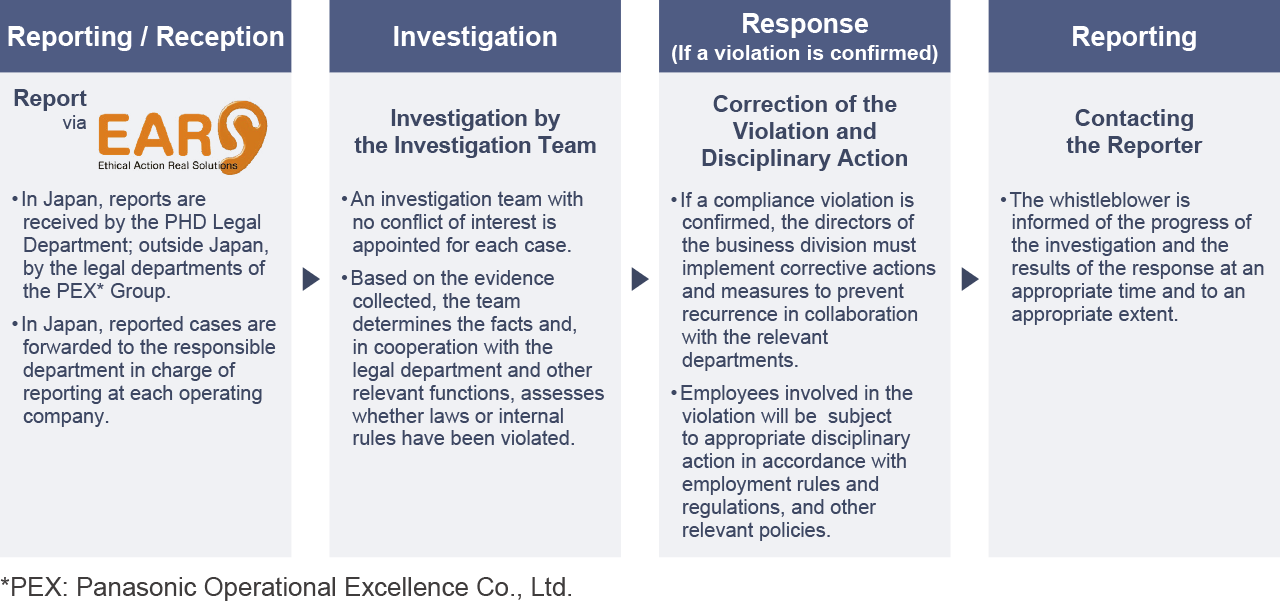
The Panasonic Group places great importance on fostering a “Speak up” culture in which each employee feels safe to raise concerns or seek advice, thereby helping to prevent serious compliance violations and enabling their early detection and correction. In addition to ongoing awareness-raising and education on the whistleblowing system, we are working to improve its effectiveness through prompt and fair investigations, implementation of corrective measures, and appropriate feedback following reports.
As a result, the number of reports and consultations has increased year on year. In fiscal 2026, we received 1,592 reports and consultations. Of these, approximately 79% were submitted through the Global Hotline, and approximately 70% related to workplace issues (see graph on the right). Approximately 26% of all reports and consultations were substantiated, and all cases are investigated in accordance with the internal rules. For substantiated cases, corrective actions and recurrence prevention measures are implemented, and feedback is provided to the reporters (the reporting period for these statistics is from March 16, 2025 to March 15, 2026).

Based on changes in the internal and external environment and emerging issues, the Group will continue to verify the status of the whistleblowing system’s operation and make appropriate improvements as necessary.
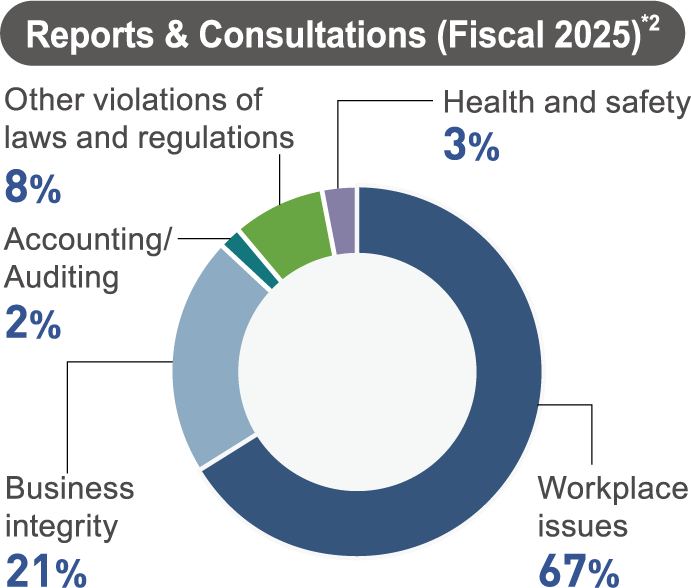
*2 The definition of "Workplace issues" includes harassment, sexual harassment, bullying, discrimination, unfair treatment, complaints, and others. The definition of "Business integrity" includes bribery, conflicts of interest or receiving any improper benefits, fraud and theft, competition law and antitrust, product quality, data privacy and information security, and others. The figures in the graph are rounded to the nearest whole number.
Performance Evaluation
The Panasonic Group monitors not only outcome indicators such as the number of serious compliance violations, but also process indicators, including the use of consultation and whistleblowing systems, the status of compliance with internal rules, and the implementation of education and training. Through these efforts, the Group works continuously to enhance its compliance framework and corporate culture.
With regard to compliance with and implementation of the Code of Ethics & Compliance, the PHD Legal Division conducts an annual review of matters such as the appointment of officers responsible for observance of the Code at each Group company, the implementation of education and training, and the obtaining of written pledges. As part of Groupwide control audits, these review results are also subject to external audits by an auditing firm, and their effectiveness is regularly verified from an independent perspective. We also continue to monitor the whistleblowing system to ensure that it operates properly.
Additionally, we conduct a survey targeting all employees worldwide, asking questions on compliance awareness and its reach within our corporate culture. We measure these metrics over time across the entire Group, regions, and organizations, using the results to improve compliance culture within each organization. We received responses from approximately 147,000 employees in fiscal 2026.
▪Serious Violations and Corrective Measures
If the Panasonic Group identifies any serious violation of laws, internal rules, or similar requirements, we immediately cease the misconduct and conduct appropriate investigation into the facts and underlying causes before determining the necessary corrective actions. Depending on the significance of the matter, we also report it to the Board of Directors and consider prompt, Groupwide responses.
In response to the irregularities related to UL certification and other quality irregularities identified at Panasonic Industry Co., Ltd. (“PID”) in 2024, the Group conducted thorough self-assessments targeting inappropriate actions related to quality compliance from January 2024 to August 2025, with the aim of thoroughly identifying and correcting quality irregularities and preventing their recurrence.
As part of this investigation, we conducted a survey of all Group employees in Japan. For all quality compliance issues reported through the survey, an external law firm interviewed the reporters and other relevant parties and conducted detailed reviews of related business records to identify and clarify the facts. For the matters identified, we took appropriate corrective measures based on advice from the external law firm and are promoting Groupwide efforts to prevent recurrence. None of the cases identified through this investigation were subject to administrative sanctions or resulted in revocation of certifications.
For details of the matters identified at PID, please refer to the link below

▪Audit
The Panasonic Group has established Compliance Auditing Division and conducts annual audits focusing on significant compliance risks, including bribery and corruption and competition law violations. In these audits, we assess country- and region-specific risks at all business sites based on objective indicators such as the Corruption Perceptions Index (CPI) published by Transparency International, and select approximately five sites with relatively high risk for audit each year. At the selected sites, we review the development and operation of Groupwide compliance rules and regulations. For deficiencies identified through the audits, the business sites take the lead in formulating improvement plans, and the Compliance Auditing divisions follow up on their implementation to ensure that corrective measures are effectively implemented.
Initiatives to Address Significant Compliance Risks
The Panasonic Group places particular importance on compliance with competition laws including the prevention of cartels, the prevention of bribery and corruption, and compliance with trade and transaction regulations. In light of the significant impact these areas can have on the Group’s overall business activities, we are driving focused initiatives in each of them.
▪Compliance with Competition Laws
The Panasonic Group takes extremely seriously the fact that it has been implicated in cartel incidents in the past and is working to ensure compliance with competition laws, including the prevention of cartels. If the Group were ever involved in a cartel, it would not only lose the trust of customers and society, but could also be required to pay substantial fines and damages, be suspended from participating in public procurement, and face other consequences that could significantly affect its business activities. Accordingly, we rigorously implement measures to prevent cartels and other competition law violations before they occur.
In fiscal 2026, enforcement authorities took no legal action against the Group for anticompetitive behavior. We will continue to pursue strict compliance with competition laws.
Basic Policies
We have established the following basic policies to prevent cartels, collusive bidding, and other such violations:
- Contact with competitors is allowed only in cases in which it is absolutely necessary, and it is subject to prior approval.
- Agreements and exchanges of information with competitors regarding prices, quantities, and other competition-related matters are strictly prohibited.
- Anyone who encounters behaviors that may give rise to suspicions of cartels must make an objection, leave the room, and file an internal report.
- We have established a whistleblowing system and an internal leniency system to improve our ability to self-regulate and conduct appropriate monitoring based on risk assessment, thereby maintaining an effective anti-cartel system.
Fair Competition Compliance Policy
The Group established and implemented rules in 2008 to prevent actual or suspected cartel and bid-rigging activities in all activities with competitors. In light of enforcement trends among competition authorities in various countries, those rules were revised as the Fair Competition Compliance Policy in January 2025. The Policy has applied to all Group employees since April 2025 and sets out the rules and procedures necessary to ensure fair and free competition. It includes the following:
- The basic principle that we must not engage in anticompetitive conduct, such as cartels and bid-rigging, resale price maintenance, abuse of a dominant market position or other unfair trade practices.
- Definition of prohibited information exchanges and agreements with competitors not only in markets related to product sales, production, development, and research, but also in material procurement and labor markets. It also requires prior approval before initiating contact with any competitor.
- Specification of the matters regarding periodic education and auditing, etc. to ensure compliance with the Policy
- Obligations to report any suspected violations of the Policy and dawn raids or any other investigations by law enforcement authorities
- Internal leniency system for cartels and bid rigging
▪Preventing Bribery and Corruption
Basic Policy
In addition to preventing the bribery of government officials, the Panasonic Group prohibits offering undue benefits—whether in the form of entertainment, gifts, or otherwise—in violation of laws or social ethics, as well as receiving personal benefits. Based on these principles, to strengthen the global prevention of bribery and corruption, the Panasonic Group adopted the following Groupwide regulations on July 1, 2019, which apply globally to all directors and employees. These regulations provide a systematic framework for preventing, detecting, and correcting bribery and corruption.
In the past three years, there were no cases of sanctions by the authorities for bribery or corruption.
Regulations
◇Global Anti-Bribery / Anti-Corruption Policy
The Policy was adopted to effectively prevent, detect, investigate, and correct corruption, including the bribery involving government officials and corruption in relationships with business partners.
It defines and prohibits facilitation payments and acts considered to be bribery or corruption in connection with political contributions, donations, sponsorships, lobbying, hiring and recruitment, mergers, acquisitions, and joint ventures. It also establishes procedures for due diligence, approval requirements, and the accurate recording and retention of expenditure records for at least five years.
◇Rules on Third-Party Intermediary Risk Management for Anti-Bribery / Anti-Corruption
These rules are designed to prevent, detect, investigate, and remediate acts of bribery or corruption involving third parties, including sales intermediaries and administrative service providers. They stipulate the procedures for assessing, reviewing, and monitoring risks and risk mitigation measures for these business partners.
◇Rules on Gift and Hospitality for Anti-Bribery / Anti-Corruption
These rules outline prohibited conduct and specific procedures to prevent the risks of bribery and corruption. These risks involve the provision or receipt of gifts or entertainment, including meals, hospitality, and travel costs, in relation to government officials or business partners.
Directors and employees must obtain prior approval from their superior or the head of the business unit when providing gifts, meals, hospitality, or travel invitations to others. These rules establish specific implementation procedures, including the matters that must be included in the prior approval, documenting approvals, investigating and verifying evidential documents of payment and expense reimbursement requests by the accounting officer, and maintaining payment and expense reimbursement documents at least for a period of five years.
◇Rules on Conflict of Interest
Any situation in which directors’ or employees’ personal interests or outside activities interfere or appear to interfere, directly or indirectly, with the interests of Panasonic Group, or influence or appear to influence, in any way, the directors’ or employees’ business decisions, actions, objectivity, loyalty, or ability to perform their jobs are defined as “conflicts of interest” in these rules. In addition to the rules regarding prevention, identification, management, and correction, the rules also offer specific examples of actual or potential conduct that may create conflicts of interest.
Additionally, directors and employees must disclose any actual or potential conflicts of interest in writing to their supervisor or the head of the business unit. Upon receiving such a disclosure, the supervisor or head of the business unit must consult with the legal officer to evaluate the disclosed information and determine the appropriate measures.
Promotion Efforts
Under its Global Anti-Bribery / Anti-Corruption Policy, the Panasonic Group provides training for directors, employees, and others whose duties involve a high risk of bribery and corruption. Those designated by business divisions and consolidated subsidiaries as eligible for this training*3 are required to complete it periodically, generally at least once every two to three years.
To reduce the risk of indirect bribery and corruption through third parties, the Group conducts risk due diligence and operates a risk review process for transactions with sales intermediaries and administrative service providers in accordance with its Rules on Third-Party Intermediary Risk Management for Anti-Bribery / Anti-Corruption. Specifically, the Group conducts risk reviews and implements risk mitigation measures not only for new transactions, but also periodically after transactions commence, at intervals determined by the level of risk, and reviews those measures as necessary. In conducting these reviews, the Group assesses corruption risk by country/region and transaction type, taking into account the Corruption Perceptions Index (CPI) score published by Transparency International, the type of business partner, and the details of the transaction, and implements risk mitigation measures accordingly.
*3 Directors and employees who have contact with government officials in the course of their duties
▪Trade Compliance
The Group has also stipulated global trade compliance rules in the Code of Ethics & Compliance. We also have Rules on Global Trade Restrictions & Sanction Law Compliance to ensure compliance with each country’s trade-related regulations, including security export controls and sanctions laws. Moreover, in Japan, we set standards meant to help us maintain and improve corporate value through the fulfillment of our social responsibility by respecting and following not only laws but also business ethics in our execution of logistics work in the Logistics Operating Standards and Customs Law Compliance Standards. Through these efforts, we ensure trade compliance, including adherence to import/export regulations and trade-related laws and regulations in all countries.
In Japan, the Authorized Economic Operator (AEO) system provides simplified and expedited customs procedures for business operators that have established frameworks for cargo security management and legal compliance. Under this system, Panasonic Operational Excellence Co., Ltd. has been certified by customs as both an Authorized Exporter (AEO) and an Authorized Importer (AEO). We strive to ensure the safety of our international logistics by selecting companies that provide physical, personnel, and information security, not only for our own operations but also for those of our contractors.
At a global level, we promote our participation in AEO frameworks in all regions. For instance, our US subsidiary Panasonic North America participates in the Customs-Trade Partnership Against Terrorism (C-TPAT). At the same time, we actively promote participation in the AEO framework in other countries, including China.
Ensuring Transparency of Political Contribution Funds
Panasonic Group makes political donations as a part of its corporate social responsibilities. It abides by the Japan Business Federation’s policy which states that: “Costs commensurate with the task are essential to properly maintaining democratic politics. Political donations by companies are a crucial part of companies’ social responsibilities.” When making donations, we comply with the Political Funds Control Act and all other relevant legislation, as well as strict internal rules including the abovementioned global Groupwide rules for preventing bribery and corruption and prohibits any conduct that could lead to suspicion of bribery on the part of public employees or that amount to corrupt practices. We also have regulations in place concerning political contributions, including the reporting and confirming by multiple responsible executives, such as the executive officers in charge of Government and External Relations, Accounting (CFO), and HR & GA (CHRO) of PHD, and obtaining agreement and approval.
Political donations in FY2025: JPY 28.5 million (one donation in Japan)
* The amount of the one FY2026 political donation in Japan will be disclosed by the Ministry of Internal Affairs and Communications (Japan) in November 2026.
As a general rule, we encourage the development of public policy through industry associations. For lobbying in connection with policy recommendations, our Global Anti-Bribery / Anti-Corruption Policy defines lobbying and requires compliance with relevant laws and regulations, and ensures fairness and transparency by requiring that specific lobbying activities must not be reasonably perceived as inappropriate, unethical, or corrupt.
Tax Policy
The Group contributes to the development of society and the resolution of issues through its business activities by paying its fair share of taxes in communities where it operates and in accordance with the tax laws of each country and other tax guidelines published by international organizations such as the OECD. See below for details.
