


Value Creation Process and Materiality

Value Creation Process
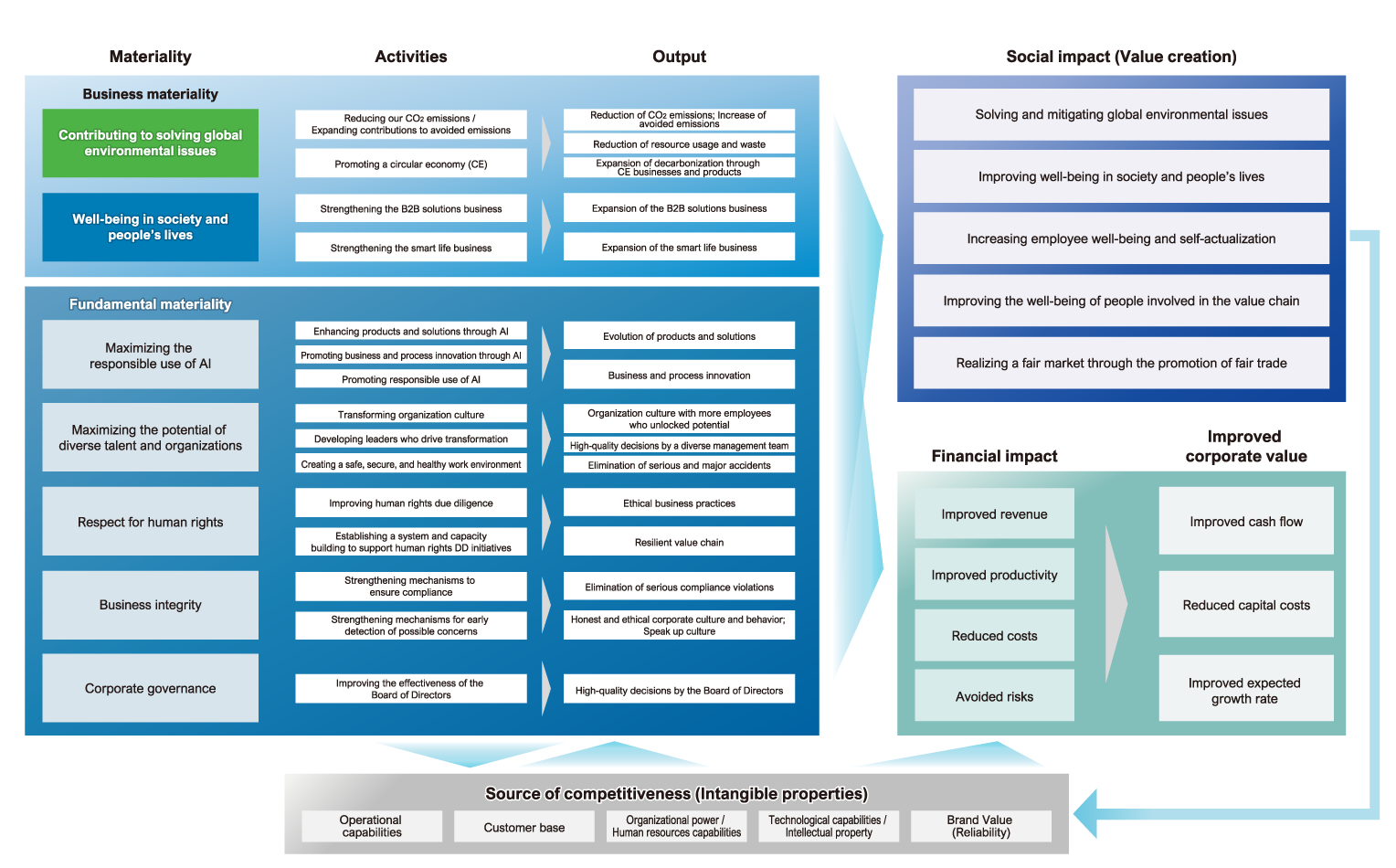
The Value Creation Process details the kinds of value that we are generating in order to sustainably contribute to society and enhance our corporate value, and describes how this is being achieved. In essence, the process is as shown in the conceptual diagram below:

Toward its mission of achieving “an ideal society with affluence both in matter and mind,” the Panasonic Group will continue to create value through its business activities in the form of “contributing to solving global environmental issues” and “well-being in society and people’s lives” (= business materiality). To achieve this, we will optimize our business portfolio and strengthen our focus areas while also working to continually strengthen intangible properties, which are a source of competitiveness common to the Group. By combining these initiatives, we will maximize value creation.
At the same time, we will also focus on building and strengthening a management foundation that will enable sustainable value creation (= fundamental materiality). In addition to initiatives such as “corporate governance,” “business integrity,” “respect for human rights,” and “maximizing the potential of diverse talent and organizations,” we will enhance our business through the evolution of products and solutions and strengthen our source of competitiveness through operational and process innovation by “maximizing the responsible use of AI.”
The basis for all of these initiatives is our Basic Business Philosophy. As a public entity of society, we will engage in dialogue, cooperation, and co-creation with all relevant stakeholders, aiming to achieve the ideal society we envision together.
Materiality
▪Materiality (from FY2026)
At Panasonic we regard materiality as “priority issues for creating value for society”, and, to support this value creation, we have opted for business materiality, which involves the creation of value through business activities, and fundamental materiality, which involves the building and strengthening of a management foundation. These are important elements in the aforementioned value creation process.
We set and continually try to improve KPIs for each materiality, with a view to creating even greater value.
As outlined in the Group growth strategy, toward 2032, the Group will focus on the efficient use of energy and the alleviation of frontline labor shortages, and will further enhance its contributions by supporting AI infrastructure and social operations. At the same time, in Smart Life area, the Group will work to further enhance comfort and convenience in people's lives by providing products and services underpinned by quality and reliability, and by strengthening core technologies that deliver clearly differentiated value to customers. By promoting these initiatives in an integrated manner, the Group aims to realize "well-being in society and people’s lives” from both societal and individual perspectives. The indicators for "well-being in society and people's lives” will continue to be examined.
Regarding "maximizing the responsible use of AI," our Group views the introduction of responsible AI as "a promise to the rest of the world to apply AI in ways that are human-centered and that respect human rights," and is promoting the development and operation of appropriate AI products and services, as well as the utilization of AI. In fiscal 2026, we established the position of Group CAIO (Chief AI Officer) effective April 1, 2026, to lead the acceleration of AI utilization across the Group for solving customer issues and optimizing internal operations. Furthermore, we support the implementation of responsible AI by leveraging a system that assists with self-assessment of AI ethics risks at AI development and utilization sites. In fiscal 2027, under the Group CAIO, we will accelerate the transformation of “Business model,” “Operational processes,” and “Organization culture” in the realm of AI utilization, as part of our Group's Digital Transformation (DX) initiative, Panasonic Transformation (PX). Indicators for "maximizing the responsible use of AI" will continue to be reviewed as these initiatives progress.
In addition, regarding productivity indicators, each operating company sets indicators tailored to its specific business characteristics, and Panasonic Holdings Corporation ("PHD") monitors their progress.
Materiality List
| Materiality | Indicators | FY2026 Results | FY2026 Targets | Targets | Report on related items | ||
|---|---|---|---|---|---|---|---|---|
Business Materiality*1 | Contributing to solving environmental issues | Contributing to decarbonization | CO2 reduction impact | 300 million tons (by 2050) | ||||
CO2 emissions reductions in the Group’s value chain *3 | - 40.12 million tons | 16.00 million tons (FY2029) | ||||||
Avoided emissions*5 | 47.50 million tons | 71.00 million tons (FY2029) | ||||||
Net zero CO2 sites*6 | A total of 60 sites*6 | A total of 49 sites | A total of 86 sites | |||||
Promoting a circular economy | Amount of recycled materials used | Recycled resins | 17,100 tons | 25,000 tons | 22,000 tons | |||
Recycled steel (electric arc furnace-based steel) | ー (Newly established from FY2027) | 2,500 tons | ||||||
Number of circular economy business models/products created | A total of 15 businesses | A total of 16 businesses | A total of 17 businesses | |||||
Well-being in society and people’s lives | Well-being in society | Further review will continue in line with the new Group Growth Strategy | ― | |||||
Well-being in people’s lives | ||||||||
Fundamental Materiality*2 | Maximizing the responsible use of AI | Evolving products and solutions through the use of AI | Further review will continue in line with the new Group Growth Strategy | |||||
Promoting operational and process innovation through the use of AI | ||||||||
Maximizing the potential of diverse talent and organizations | Organization culture transformation | UNLOCK indicator*7 | 43% | ― | 60% | |||
Develop & appoint transformational leaders | Diversity ratio in management team (PHD Executive Officers)*9 | 55% | More than half | More than half | ||||
Ratio of female managers (in Japan)*10 | 8.3% | ― | 12% | |||||
Safe, secure and healthy work environment | The number of serious or major accidents | 8 | 0 | 0 | ||||
| Productivity indicator | Each operating company sets its own indicators, and monitoring is conducted accordingly | ||||||
Respect for human right | Implementation rate of in-person training on forced labour prevention provided to Group sites in Japan and overseas that employ foreign migrant workers | 81% | ― | 100% | ||||
Level of understanding of participants in "Human Rights Due Diligence Promotion Training" to develop the promotion leaders at each operating company*11 | 88% | 80% | 80% | |||||
Business integrity | Occurrence of serious compliance violations | 0 | 0 | 0 | ||||
Corporate governance | Enhancing constructive dialogue with shareholders | Implemented | Implemented | Implemented | Corporate information website | |||
Ratio of outside directors in the PHD Board of Directors | More than half | More than half | More than half | |||||
Chairperson of the Board of Directors to be Outside Director who is Independent Director | Implemented | Implemented | Implemented | |||||
Adoption of nonfinancial indicators in compensation for directors | Implemented | Implemented | Implemented | |||||

*1 Priority issues for value creation through business activities
*2 Priority issues for building and strengthening a management foundation that will enable sustainable value creation
*3 The amount of reductions in total CO2 emissions (Scope 1, 2, and 3) in the business activities of the company, from procurement of raw materials to manufacturing, distribution, sale, use, after-sale services, and disposal.
*4 Minus sign (-) indicates an increase in emissions. The figures in parentheses represent the amount of CO2 emissions reductions from fiscal 2021 (the baseline year) in the target businesses for fiscal 2026, including those for which calculations became available after 2021.
*5 An indicator representing the amount of CO2 emissions reductions contributed to society and customers through business activities, calculated as the difference in CO2 emissions before and after the introduction of the company’s products or services.
*6 Sites that achieved net zero CO2 emissions through the combined promotion of energy saving activities, the introduction of renewable energy, and the utilization of energy certificates and carbon credits.
*7 Favorable response rate for both questions in the Employee Opinion Survey, "Motivation from the company or supervisors to do more than is required" and "No significant barriers at work to doing job well" (Target: Group employees globally)
*8 Based on the Group management reform implemented in fiscal 2026, the target achievement years have been postponed by one year respectively.
*9 Diversity of PHD Executive Officers (Total ratios of female, non-Japanese citizens and mid-career hires. excluding US region)
*10 Japan region (PHD, PEX, PCO and operating companies)
PEX: Panasonic Operational Excellence Co., Ltd.
PCO: Panasonic Connect Co., Ltd.
*11 The post-training questionnaire focuses on assessing the level of empathy towards "business and human rights" and the level of awareness regarding its promotion, in addition to the level of understanding of the content.
▪Materiality identification process
In FY2024, the Group identified important opportunities and risks as materialities from the two perspectives of financial effects on the Group and impact on society. The identification process is as follows:
- List issues that could represent opportunities and risks based on demands from society and foreseeable future challenges
- Assess the importance of these issues from the perspective of the Group and its stakeholders and extract materialities
- Confirm the validity of this process and the extracted materialities through dialogue with multiple external experts
- Identify materialities after deliberation at the meetings of the Group’s Sustainability Management Committee and the Group Management Meeting and with the Board of Directors.
Furthermore, starting from FY2026, we have narrowed down our materialities to “priority issues for creating value for society” and are reviewing them to ensure they are consistent with our future business direction and strategies.
▪Relationship of materiality to value creation
When redefining materiality as a key issue for value creation, we examined how the activities related with each materiality are linked to social impact and increased corporate value, and organized those relationships accordingly.
For details on our efforts to visualize social impact in circular-economy (CE) businesses on a trial basis, please see here.