


Maximizing the Potential of Diverse Talent and Organizations*1
(Policy/Responsible Executive and Framework)

Panasonic Group is committed to realizing well-being and job satisfaction by creating a work environment where every Panasonic employee*2 can work in a safe, secure, and healthy state with their individuality respected and eliminating the risk of infringement on their rights and opportunities through unfair treatment, discrimination, or prejudice.
- *1 The information provided regarding DEI and diversity set forth policies, initiatives, and indicators is applicable to PHD, PEX, operating companies and affiliated companies in the Japan region, as well as certain other regions, and does not intend to refer to the United States. Employment practices in the United States are administered in accordance with applicable laws and regulations and other relevant requirements.
- *2 Within this section, the following list of stakeholders are collectively referred to as “Employees”: (1) all employees having employment relationships with any Panasonic Group company including those working under contracts with the Group, as well as external contractors and seconded employees working under the control and supervision of any Panasonic Group company; and (2) all board directors, executive officers, executive counselors, fellows, corporate auditors, supervisory board, and corporate advisors or persons in equivalent positions appointed by any Panasonic Group company. It also includes employees of key companies subject to some Group HR and other systems.
Policy
Panasonic Group Founder Konosuke Matsushita pursued management that emphasized nurturing and developing people so that they can thrive based on his philosophy of “develop people before making products.” At its foundation lies the philosophy that human beings are like rough diamonds—depending on how they are polished, they can shine in different ways. This idea is closely aligned with the concept of a growth mindset, which holds that people’s abilities are not fixed but can continue to develop through experience and challenges.
We carry forward this philosophy and, with our unwavering Basic Business Philosophy as our foundation, practice human capital management to maximize the value of the human capital entrusted to us by society.
Responsible Executive and Framework
The executive officer responsible for creating and promoting the HR strategy of Panasonic Holdings Corporation (“PHD”) and the entire Group is the Group Chief Human Resources Officer (“Group CHRO”). The PHD Strategic Human Resources Department is responsible for planning and formulating strategies across the Group. At the same time, the HR departments at the operating companies and their affiliated divisions have the same responsibilities at the organizational level and manage day-to-day operations.
Under the holding company structure, effective April 2022, each operating company must establish an optimal business structure tailored to its industry, customers, and competitors, in strict compliance with the concept of autonomous responsible management. Each operating company is responsible for planning and executing human resource strategies, including acquiring and developing human resources, building compensation and evaluation systems, and promoting organizational development. Meanwhile, PHD is responsible for supporting the operating companies from the perspective of corporate governance and stakeholder engagement. Panasonic Operational Excellence (“PEX”) also assists the operating companies by providing solutions to enhance competitiveness.
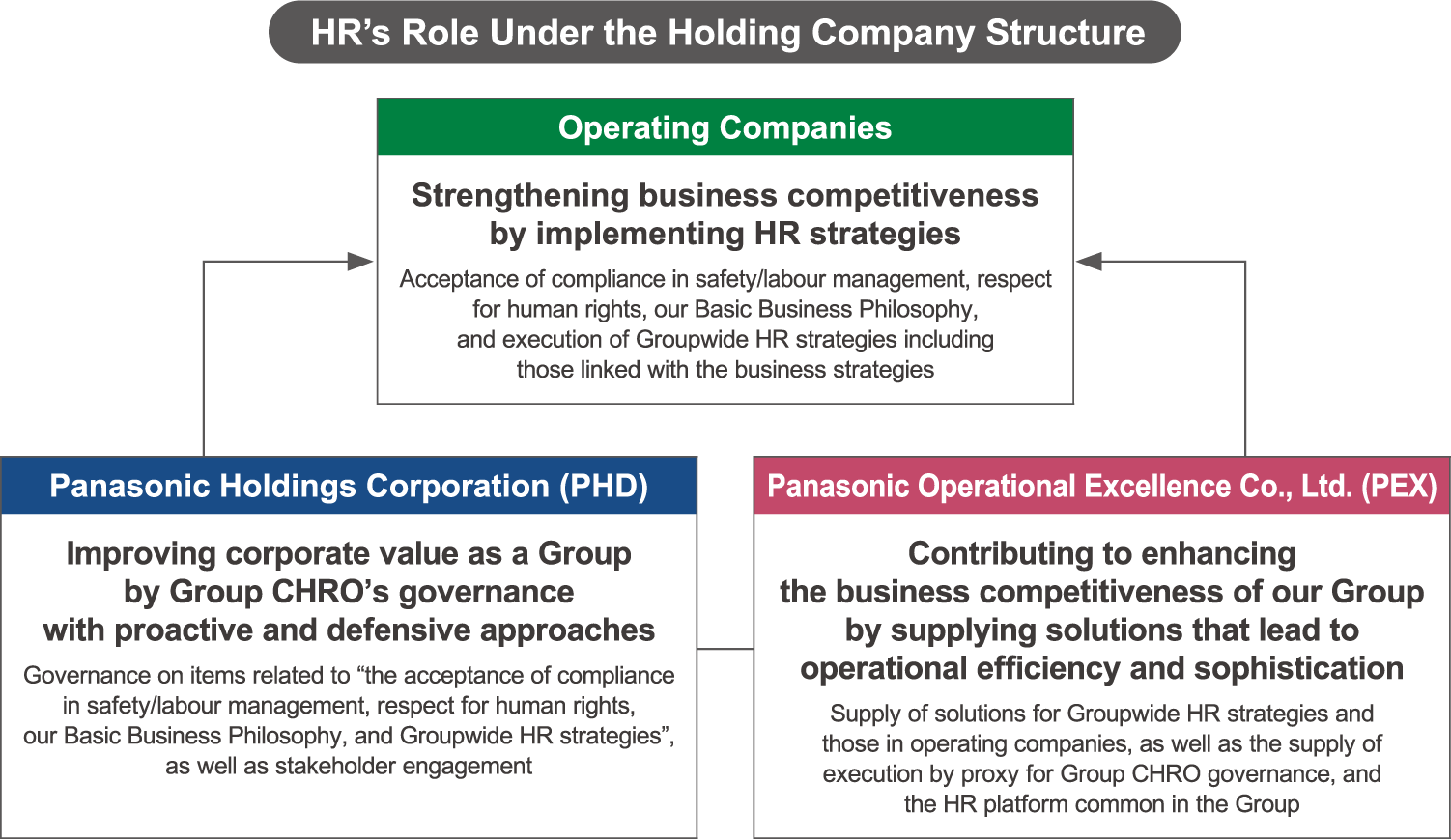
The Group CHRO oversees corporate governance through our compliance with safety/labor regulations, respect for human rights, dissemination of the Basic Business Philosophy, and groupwide HR strategies. To this end, the Group CHRO holds one-on-one meetings with the CHROs of each operating company and reviews their HR strategies, which are then submitted to their respective boards of directors. Moreover, the Group CHRO actively discusses new initiatives in groupwide HR strategies through reports to the PHD Board of Directors.
Our Vision for Human Capital Management
The Panasonic Group has consistently addressed a wide range of social challenges throughout its history as it strives to fulfill its mission of achieving “an ideal society with affluence both in matter and mind.” Under our Group growth strategy through 2032, we will focus on addressing key societal issues such as the efficient use of energy and the alleviation of frontline labor shortages. By fiscal 2029, we aim to achieve adjusted operating profit of at least 750 billion yen, driven by businesses that support AI infrastructure. From fiscal 2030 onward, we will pursue further growth by expanding businesses that underpin societal operations.
To execute this growth strategy, we aim to become a company where every employee can UNLOCK their full potential, fully realize that potential, and continue to grow. Achieving this state represents the realization of our Basic Business Philosophy at a high level. To measure progress toward this goal, we have established our own “UNLOCK Indicators,” with a target of reaching 60% globally by fiscal 2029.
Human Resources and Organizational Challenges
▪Achieving a highly competitive and resilient talent portfolio
In fiscal 2026, we positioned the reform of our fixed cost structure—previously higher than that of our peers—as a major management priority to drive the Group’s growth. While we have strengthened our management foundation through measures such as workforce optimization described below, we must continue to maintain and further strengthen a lean management structure amid a rapidly changing business environment. At the same time, to execute our growth strategy, we must also transform our talent portfolio as follows.
Solutions Area | To meet the need to create sustainable value for business customers facing challenges such as labor shortages and energy issues in businesses that support social operations, it is essential to secure talent capable of providing solutions. |
|---|---|
Devices Area | To meet the need to contribute to clients related to AI infrastructure by proposals that anticipate industry evolution, it is essential to secure talent with advanced materials and process technologies. |
▪Realizing an Organization Where Each Individual Can Unlock and Fully Demonstrate Their Potential
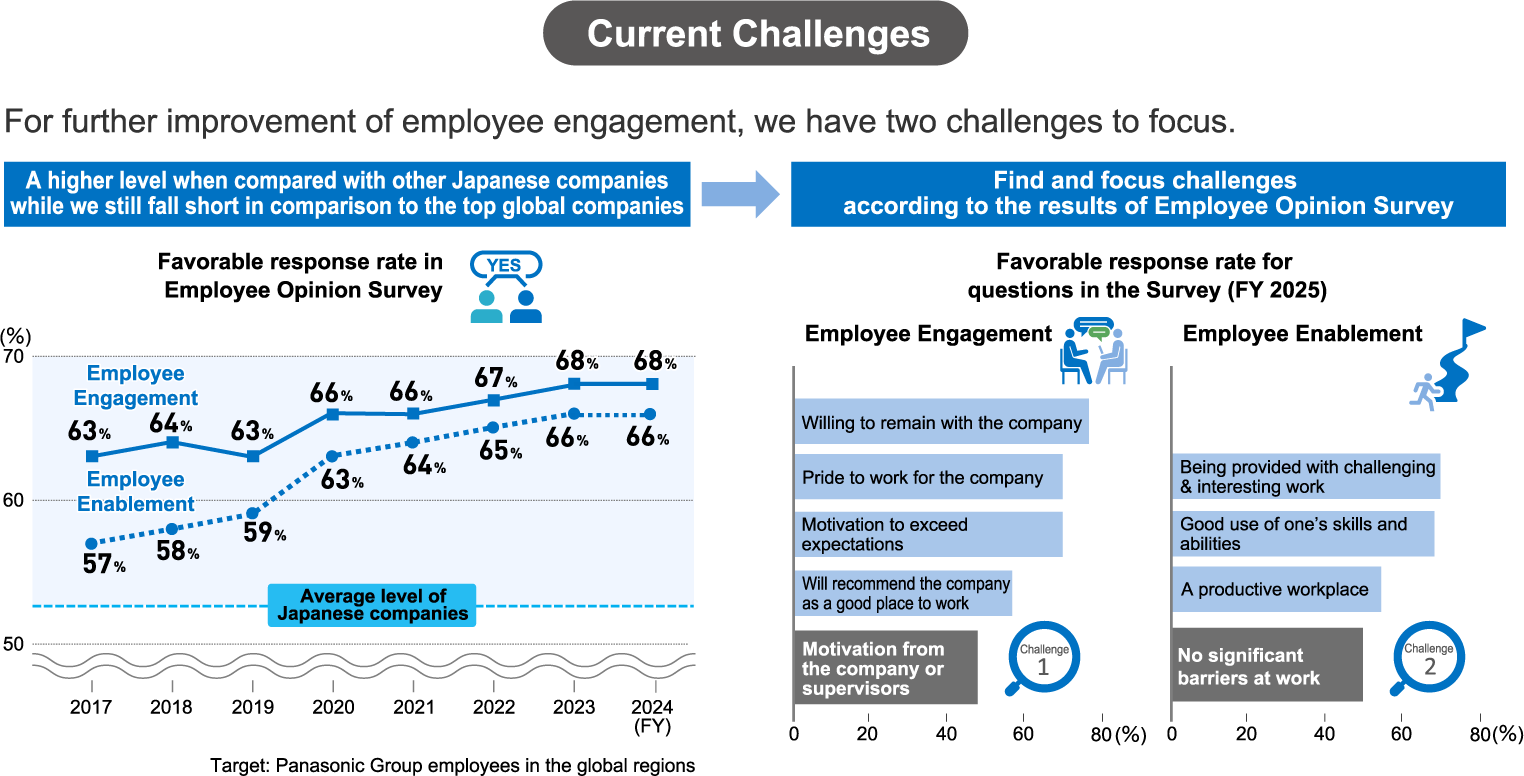
Even if we secure talent with the necessary potential, we cannot leverage it for business growth unless we provide an environment that enables individuals to fully demonstrate their potential. At the Panasonic Group, we conduct an annual employee survey covering approximately 150,000 employees worldwide. Through fiscal 2025, we have placed particular emphasis on “employee engagement” (employees’ willingness to contribute proactively) and “employee enablement” (placing the right people in the right roles and providing a supportive working environment). While the favorable response rate has shown a continuous upward trend, scores for two items— “Motivation from the company or supervisors to do more than is required” and “No significant barriers at work to doing job well”—remained low among the nine questions.
This represents a critical issue for our goal of becoming a company in which each employee can “UNLOCK” their potential, fully demonstrate their capabilities, and grow. Accordingly, we have defined the positive response rates to these two questions as the UNLOCK indicators, and we are working to improve them while monitoring these indicators together with five related survey questions.
Key Indicators
The Panasonic Group has established as key indicators for its human capital initiatives metrics aligned with the Group’s materiality of “Maximizing the Potential of Diverse Talent and Organizations.” These include UNLOCK indicators, the diversity ratio of management teams, the ratio of female managers, serious and major occupational accidents, and productivity indicators.
Using these indicators, the Group continuously monitors the progress of its human capital strategy through forums such as the Group Talent Management Committee and the Group DEI Promotion Council. The Board of Directors and other relevant bodies provide appropriate oversight.
Materiality and Indicators Regarding “Maximizing the Potential of Diverse Talent and Organizations”
Materiality | Our vision | Indicators | Current situation | Targets | |
|---|---|---|---|---|---|
Organization culture transformation | Employees taking bold and positive challenges and maximizing their skills and abilities | UNLOCK indicator*3 | Favorable response rate for both questions in the Employee Opinion Survey, "Motivation from the company or supervisors" and "No significant barriers at work" (Target: Group employees globally) | 43% | 60% (FY2029) |
Develop & appoint transformational leaders | Transformational leaders making high-quality decisions | Diversity ratio in management team (PHD Executive Officers)*5 | Diversity of PHD Executive Officers (Total ratios of female, non-Japanese citizens and mid-career hires) | 55% | More than half |
Ratio of female managers (in Japan)*6 | Female ratio in management positions (in Japan) | 8.3% | 12% (April 2028) | ||
Safe, secure and healthy work environment | Operating with a safe, secure, and healthy environment as a prerequisite | The number of serious or major accidents | Number of fatal accidents or accidents resulting in long-lasting physical disabilities, Number of accidents affecting at least three people | 8 | 0 |
- *3 Favorable response rate for both questions in the Employee Opinion Survey, "Motivation from the company or supervisors to do more than is required" and "No significant barriers at work to doing job well" (Target: Group employees globally)
- *4 Based on the Group management reform implemented in fiscal 2026, the target achievement years have been postponed by one year respectively.
- *5 Diversity of PHD Executive Officers (Total ratios of female, non-Japanese citizens and mid-career hires. excluding US region)
- *6 Japan region (PHD, PEX, PCO and operating companies)
PEX: Panasonic Operational Excellence Co., Ltd.
PCO: Panasonic Connect Co., Ltd.
Human Resource Portfolio Transformation
In fiscal 2026, as part of groupwide management reform, we implemented workforce optimization affecting approximately 12,000 employees. We will leverage this initiative to enhance our long-term competitiveness by reallocating talent to growth areas and acquiring the capabilities required for our growth strategy. To maintain and further strengthen a lean management structure, we will build highly productive business processes by leveraging data and technologies such as generative AI. At the same time, we will ensure rigorous management by monitoring workforce levels, personnel expenses, and productivity indicators—set for each operating company in line with its business characteristics—at the Group Transformation Round Table, a management forum attended by Business CEOs.
Furthermore, recognizing the need to transform our human resource portfolio, we are defining the capabilities required for our growth strategy while advancing the visualization of employees’ skills and experience. Through these initiatives, we will identify gaps between our target human resource portfolio and the current state, and systematically address them by combining measures such as recruitment, development (reskilling), internal reassignment, and external collaboration.
Solutions area | We will build the aforementioned pool of solution-related talent by implementing initiatives such as solution delivery skill development programs. |
|---|---|
Devices area | In addition to strengthening the skills of talent with advanced materials and process technologies, we will focus on building a more resilient production system through flexible resource allocation. |
