


Growth that Advances Society and Industry by Addressing Evolving Societal Challenges
As Panasonic looks ahead to 2032, marking 100 years since founder Konosuke Matsushita's realization of the company's mission to create “an ideal society with affluence both in matter and mind” the Group is focused on addressing two critical challenges: improving energy efficiency and easing frontline labor shortages. By focusing on businesses that support AI infrastructure and social operations, Panasonic will help address these challenges while contributing to the continued advancement of society and industry.


The Devices Area Will Drive Groupwide Growth by Supporting AI Infrastructure, While the Solutions Area Will Become a Core Source of Future Profit Growth by Supporting Social Operations
Accelerating value creation across three areas to address evolving social challenges
Looking toward 2032, the Panasonic Group is creating value across the three areas: Devices, Solutions, and Smart Life.
Businesses in the Devices area that support AI infrastructure—including rapidly growing generative AI data centers—will drive the Group's growth through fiscal year 2029.
The Solutions area is positioned as a core source of future growth: It will continue to transform its business model by moving beyond hardware-centric value delivery, strengthening services and engineering that support the evolution of customers’ operations.
The Smart Life area will enhance brand value through customer touchpoints closely connected to everyday life, particularly consumer electronics, and play a vital role in strengthening the Panasonic Group brand.
Through its technologies and devices, Panasonic supports both the “brain” that powers AI computing and the “heart” that delivers energy to data center servers. By helping meet the rapidly growing demands of AI infrastructure, Panasonic is contributing to the development of the social infrastructure that powers modern society.

By shifting from hardware to services and engineering, Panasonic will help customers keep social operations running more efficiently through solutions that are always on, energy efficient, and labor saving.

By offering products and services closely connected to people’s lives, Panasonic will broaden customer touchpoints and strengthen awareness of and trust in the Panasonic brand.

Group's Profit Growth Roadmap Through 2032
Phase 1 runs through fiscal year 2029. During this period, Panasonic expects businesses supporting AI infrastructure within the Devices area to drive significant growth in sales and profit, helping the Group achieve adjusted operating profit of at least 750 billion yen. At the same time, the Solutions area will expand its services and engineering capabilities to help customers operate more efficiently while continuing to transform its business model.
These efforts are intended to position the Solutions area as a major growth driver beginning in Phase 2, which starts in fiscal year 2030.
Meanwhile, the Smart Life area will focus on improving efficiency, reducing costs, and strengthening its competitive advantage through proprietary technologies to support sustainable growth.
*Fiscal years (FY) refer to the years ending March 31 of the stated year.
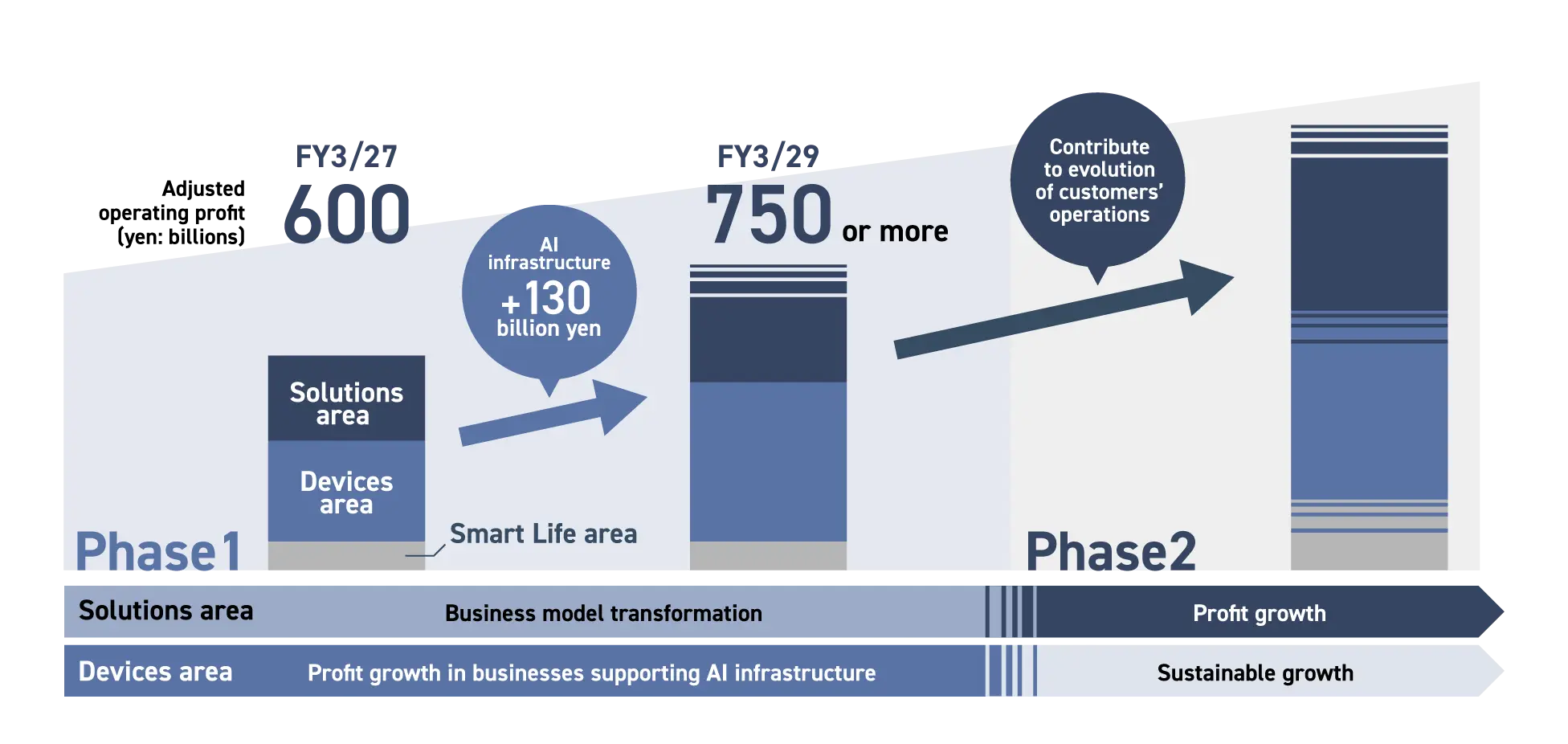
Note: The chart reflects information as of May 12, 2026. On July 30, 2026, the forecast for adjusted operating profit in fiscal year 2027 was revised upward to 650 billion yen.FY27 First-Quarter Financial Results
Capital Allocation for Sustainable Growth
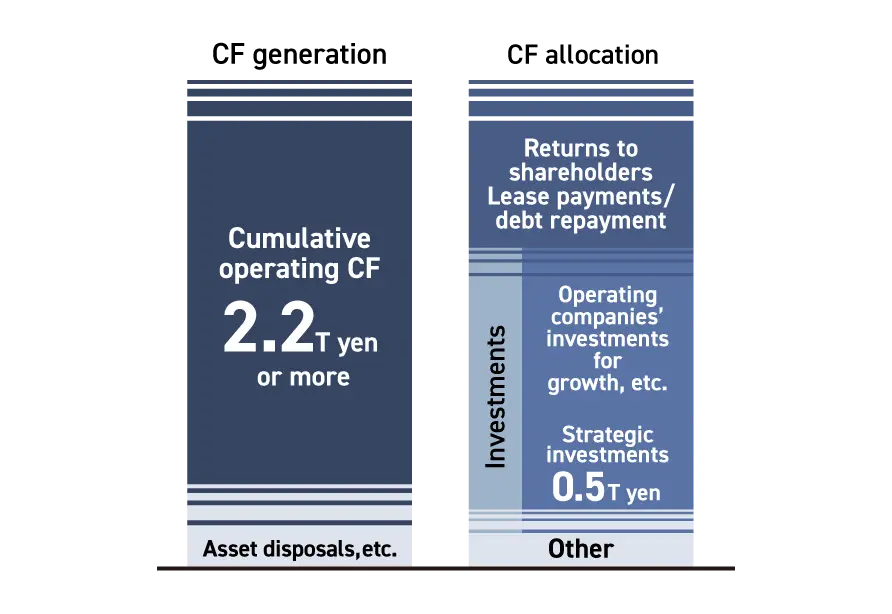
The Panasonic Group expects to generate at least 2.2 trillion yen in operating cash flow over the three years from fiscal year 2027 through fiscal year 2029. The cash generated by its businesses will fund growth investments and shareholder returns. In addition to 500 billion yen in strategic investments in businesses supporting AI infrastructure, the Group will invest for growth in the Solutions area and other businesses. It will also seek to provide stable and sustained dividends, targeting a consolidated dividend payout ratio of 30%.
To maintain financial discipline, the Group will target a net debt/EBITDA ratio of approximately 1.0 times, while balancing growth investment, shareholder returns, and financial soundness.
Investment Policy
500 billion yen for businesses supporting AI infrastructure, plus growth investments in the Solutions area and other businesses
Shareholder Returns
Target a consolidated dividend payout ratio of 30%, while maintaining stable and sustained dividends
Financial Discipline
Target a net debt/EBITDA ratio of approximately 1.0 times, keeping debt broadly in line with cash-generating capacity
Priority Initiatives Supporting Group Growth



With digital transformation (DX) at its core, PX is an initiative to transform information systems, the operating model, and corporate culture as an integrated whole, strengthening business competitiveness and accelerating management decision-making.
Since its launch in 2021, PX has evolved beyond the renewal of IT systems into a broader effort to strengthen the management foundation needed to execute the Group Growth Strategy.
Starting with the use of AI, the Group will transform its business models, business processes, and organizational culture. By advancing operations, maximizing efficiency, and enhancing management decision-making, it aims to build a stronger foundation for competitiveness across the Group and establish a management system capable of delivering results consistently.

The Panasonic Group has long believed in “Developing people before products,” with the understanding that “A business is people.” Our employees are our greatest asset, and realizing the Group Growth Strategy requires an environment in which every employee is empowered to fulfill their potential.
Organization Culture Transformation is an initiative to shape and evolve the culture needed to execute business strategies effectively, deliver strong performance, and continue contributing to society in a constantly changing environment.
Group CHRO Tatsuo Kinoshita Shares Panasonic’s Approach to Human Capital Management: “Turning Human Potential into Business Strength”

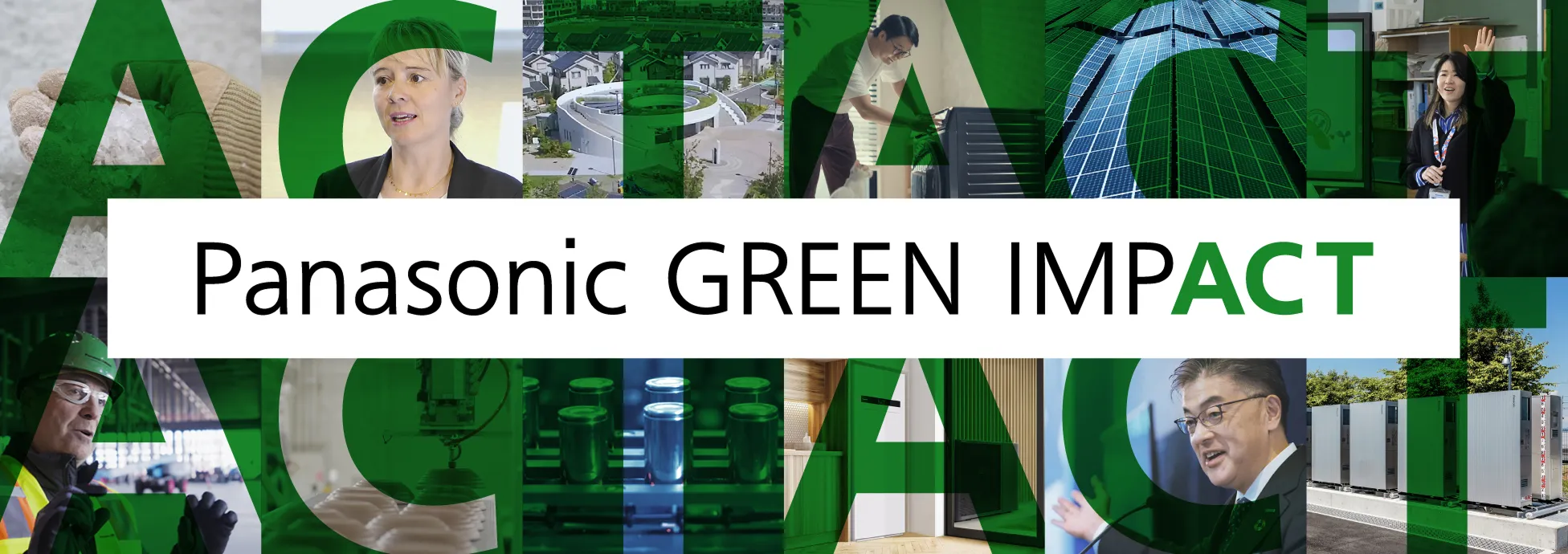
The Panasonic Group established its long-term environmental vision, Panasonic GREEN IMPACT, to help achieve both better lives and a sustainable global environment. By 2030, the Group aims to achieve net-zero CO₂ emissions at all facilities operated by its operating companies.1 By 2050, it aims to deliver an annual CO₂ reduction impact of at least 300 million tons—equivalent to approximately 1% of total global emissions2—and advance a circular economy in which greater resource efficiency supports decarbonization and reduces reliance on finite natural resources.
1 The Group defines a CO₂-zero factory as one that effectively reduces CO₂ emissions to zero through a combination of energy-saving technologies, productivity improvements, expanded use of renewable energy, and credits that offset CO₂ emissions from fossil fuels.
2 Based on global energy-related CO₂ emissions in 2020, the baseline year for PGI (source: IEA). The emissions factor used to calculate contributions to CO₂ reduction is also based on 2020.
Related Links