


Attempt at visualizing social impact – CE businesses
The Panasonic Group is aiming to strengthen dialogue with stakeholders by translating the social impact of its businesses into monetary value, and to thereby gain an objective view of the significance and outcomes of our initiatives. In a new effort this year, we are attempting to value the environmental impact of our circular-economy (CE) businesses (in which the causal relationships are highly complex) in monetary terms. This section outlines our approach and the progress that we have achieved in this pioneering impact-accounting exercise.
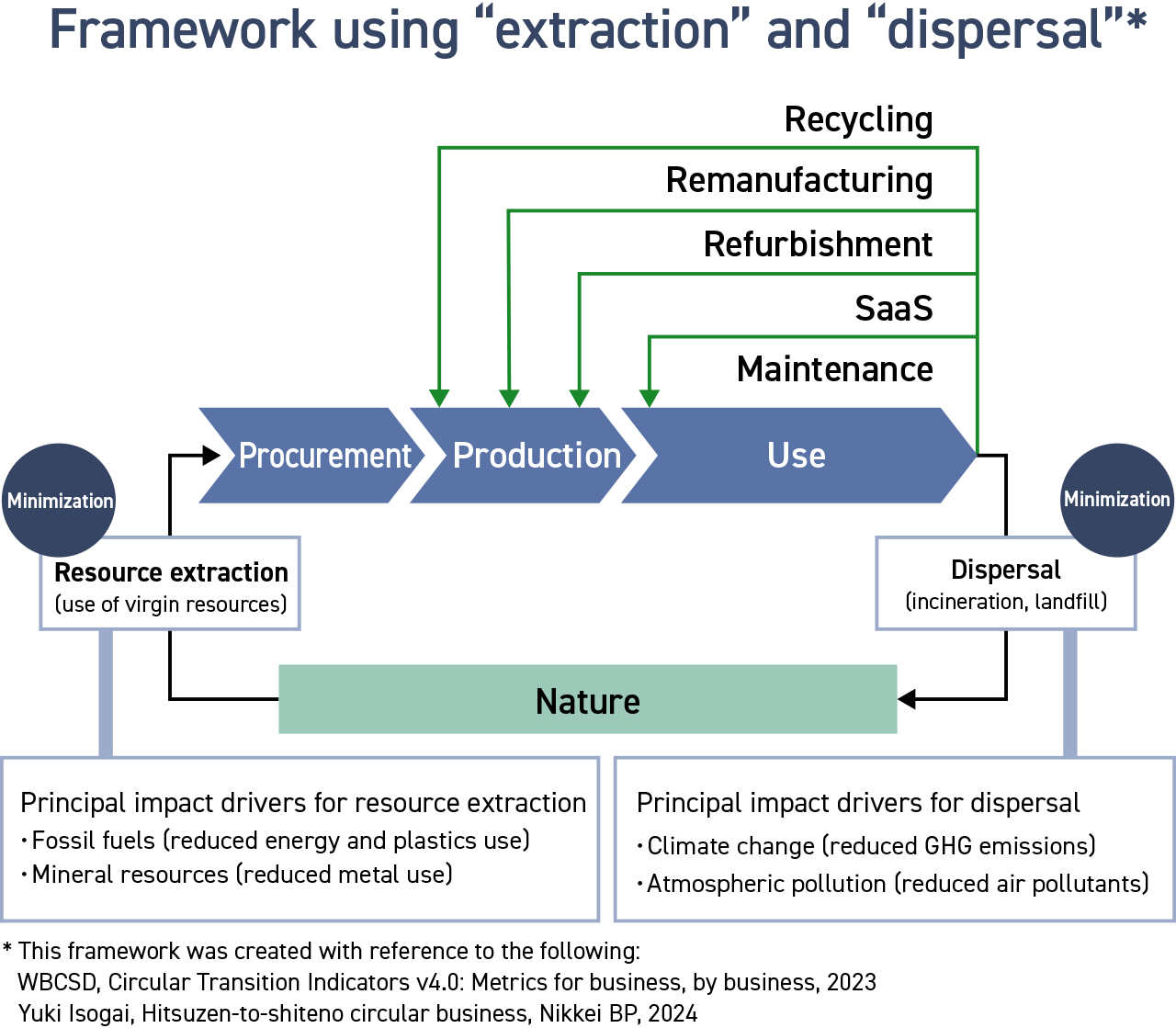
The environmental contribution made by our CE businesses extends beyond simple physical indicators like product recycling ratios and CO2 reductions and can be perceived as the “environmental value” provided to society. We believe it is important to carry out an integrated and objective assessment of this value and communicate the result to our stakeholders in an easy-to-understand way. With this in mind, the Panasonic Group has started using the common yardstick of currency to visualize the social benefits created when environmental burdens are eased and resources are recycled. In concrete terms, CE businesses help ease these burdens by minimizing both the extraction of natural resources for economic activity and the dispersal of waste, such that nature can still cope. These activities form the core of our definition of “environmental value” and impact accounting plays a key role in fulfilling our corporate social responsibility.
The environmental impact of our CE businesses is defined as the difference they can deliver compared to conventional linear models. This difference includes both positive impacts, such as reduced waste, and negative impacts, such as the energy consumed for recycling. Impact accounting is applied using a monetization factor for each impact driver based on indicators and methodologies such as the International Foundation for Valuing Impacts (IFVI) and Life Cycle Impact Assessment (LCIA).
Principal environmental impacts
Impact driver | Description of the impact | Principal impact(s) |
|---|---|---|
Mineral resources | Impact on the loss of future supply due to the present removal of the resource (impact on the extinction of the resource stocks/expense and profits from future exploitation) | Reduced mineral use due to material recycling |
Land use | Impact on the ecosystem services lost when land is converted and occupied for mineral mining | Area of land altered by mineral mining /area of land prevented from alteration |
Fossil fuels | Impact on the loss of future supply due to the present removal of the resource (impact on the extinction of the resource stocks/expense and profits from future exploitation) | Energy used for the company and VC business activities |
Fossil fuels | Reduced plastic use for the company and VC business activities | |
Water consumption | Impact on human health (water-related infections and malnutrition) due to water consumption, impact on human lifestyle (loss of cultural assets, communities, etc.) due to droughts caused by water shortages, impact on access to water. | Water consumed for business activities |
Climate change | Impact on socio-economic aspects by the effects of CO2 emission on human health (increased mortality), biodiversity (reduced area for plant cultivation, increased extinction risk), labor productivity, income from energy consumption and production, etc. | CO2 emitted by the company and VC businessd activities |
Air pollution | Impact of other atmospheric emissions (SOx, NOx, PM2.5) on human health (mortality and disease rates, chronic bronchitis, restricted activity), visibility (especially for shipping, aviation, recreation, etc.), and on agriculture | Pollutants emitted to the atmosphere by the company and VC business activities |
Waste | Impact on socio-economic aspects by the effects of CO2 emission on human health (increased mortality rates), biodiversity (reduced area for plant cultivation, increased extinction risk), labor productivity, income from energy consumption and production, etc. | Reduced CO2 emitted during product disposal |
In 2024, we quantified in monetary value the environmental impact of some CE businesses in the Panasonic Group. Here we highlight the results for our consumer electronics recycling and refurbishing businesses.
Consumer electronics recycling business (Panasonic Eco Technology Center: PETEC)
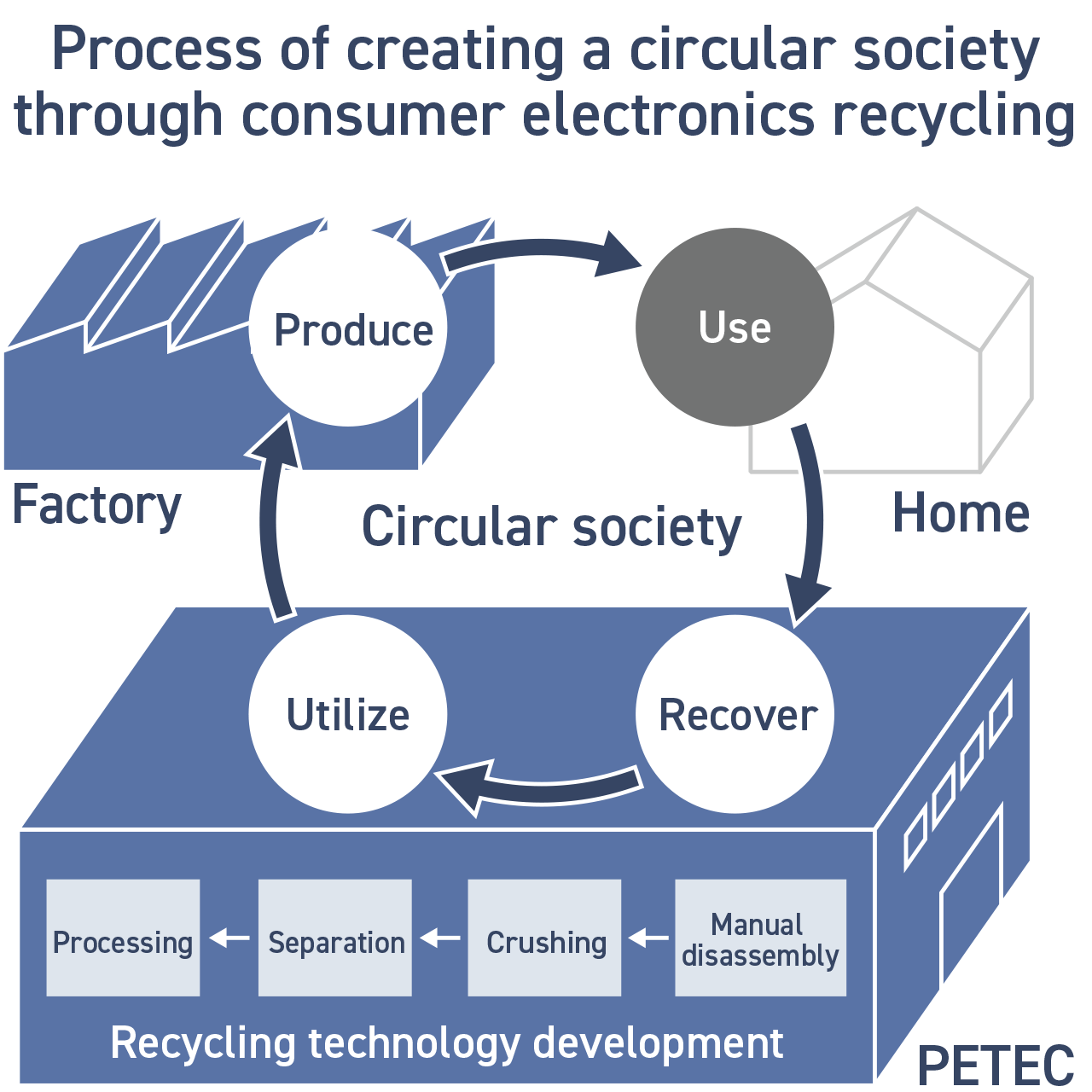
PETEC collects the four appliance types covered by the 2001 Home Appliance Recycling Law—TVs, air conditioners, refrigerators/freezers, and washing machines—from designated pick-up points, dismantles them, and recycles the materials. Useful materials such as iron, copper, and aluminum are recovered from the used appliances, helping to promote the efficient use of resources. Although material recycling plays a particularly significant role in alleviating climate change and promoting the sustainable use of resources, it also has some downsides, such as the generation of CO2 emissions during transportation. All the corresponding impacts are evaluated to calculate the environmental value in numerical terms.
Consumer electronics refurbishing business (Panasonic Factory Refresh)
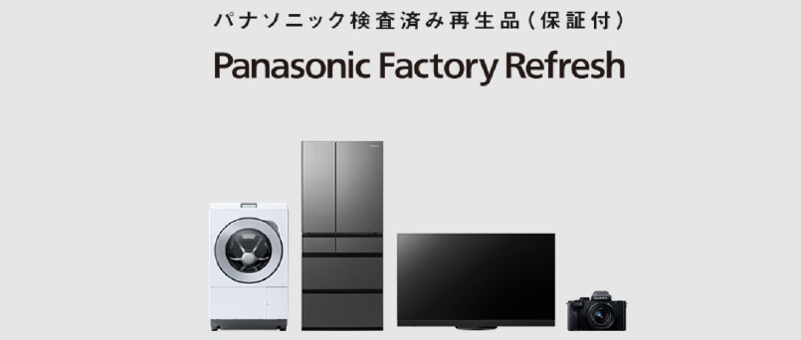
Panasonic Factory Refresh refurbishes consumer electronics slated for disposal and returns them to the market as refurbished products. Focusing on TVs and dishwashers in 2024, the company analyzed the effect on the environment of restoring initially faulty appliances and extending the service life of subscription products. Although the positive impacts (such as reduced waste, and the avoidance of high CO2 emissions from manufacturing and disposal) were partially offset by the additional energy usage, water consumption, and CO2 emissions resulting from the restoration process, the numerical data showed an overall positive effect.
The positive environmental impact delivered by the two businesses in 2024 was assessed as 1.71 billion yen and is expected to reach 1.75 billion yen in 2025. This type of quantitative assessment highlights the areas on which each CE business should focus. It could also be used in future as an analysis tool to assist business decision-making.
Environmental impact delivered by the consumer electronics recycling and refurbishing businesses
Unit: million yen
| Mineral resources | Land use | Fossil fuels | Fossil fuels | Water consumption | Climate change | Air pollution | Waste | Total |
|---|---|---|---|---|---|---|---|---|---|
2024 | 472 | 17 | 358 | 32 | -3 | 799 | 24 | 11 | 1,709 |
2025 | 613 | 22 | 369 | 35 | -2 | 783 | 23 | 31 | 1,875 |
| 2024 | 2025 |
|---|---|---|
Mineral resources | 472 | 613 |
Land use | 17 | 22 |
Fossil fuels | 358 | 369 |
Fossil fuels | 32 | 35 |
Water consumption | -3 | -2 |
Climate change | 799 | 783 |
Air pollution | 24 | 23 |
Waste | 11 | 31 |
Total | 1,709 | 1,875 |