

Here are our diverse research activities that aim to achieve empathy-driven manufacturing, centered on ergonomics, that we have been pioneering ahead of the industry. Through standardization within and outside the company, as well as commercialization, these research achievements have contributed to enhancing the ease of living for users in society.
Research on changes in vision with aging|Cataract Simulation Goggles
Company-wide criteria development
Cataracts are a condition that can make a person’s eyesight blurry or make everything seem yellowish. It is said that roughly 70% of people aged 60 and older contract this condition. To find out how things appear to elderly people with cataracts, Panasonic partnered with ophthalmologists on joint research to develop goggles that simulate the experience of cataracts. Using this tool, Panasonic tested and improved its product displays, catalogs, packaging, user’s manuals and other materials, making them more legible to people with cataracts. In 2000 the changes were adopted as an in-house standard.
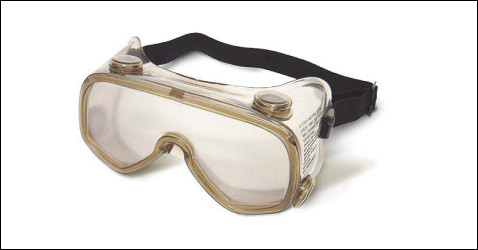
Product photo of Cataract Simulation Goggles
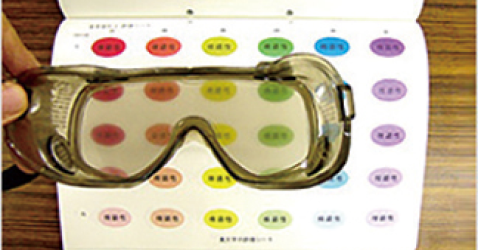
Research image
Research on 'ease of hearing'|Voice Guidance Standards
Company-wide criteria development
Voice guidance is an effective method of conveying information to the widest possible range of people. To deliver voice guidance that is easy both to hear and understand, Panasonic is conducting research on acoustic quality, volume, speaking speed, content, expressions, sentence length and other factors, and is developing indicators for each. Since 2003, Panasonic has adopted these features as in-house standards.
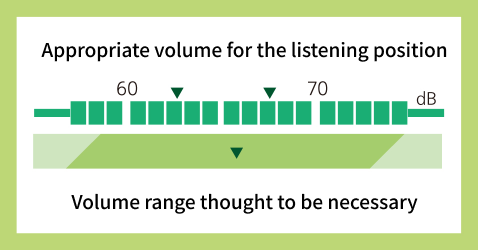
Voice Guidance Standards
Research on legible letters|Panasonic Universal Design Font Development
First in the world*
Company-wide criteria development
For optimal legibility of letters, we not only researched size and contrast of the letters, but the fonts themselves. Through global research, validation by senior users, and expert interviews, we identified four elements that constitute a good font: visibility, recognizability, legibility, and good design. We collaborated with a type foundry, Iwata Co., Ltd., and developed the world's first Universal Design font in 2006. This font is used for all operation panels on Panasonic products.
In 2008, the font was used as the brand logo for Panasonic Group.
* On June 12, 2006, the Panasonic Universal Design font was established for use in Panasonic Group products (researched by Panasonic).
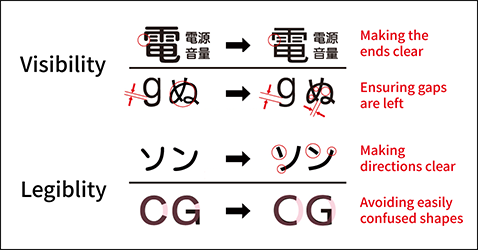
Example of Panasonic Universal Design Font
Research on 'ease of distinguishing between color schemes'|Color Universal Design
External certifications
In a collaboration with non-profit organization, CUDO (Color Universal Design Organization), we analyzed colors that can easily be distingueished by those with difficulties differentiating between red and green hues. The results are used on VIERA and DIGA’s remote control color buttons and on program guides. We acquired the CUDO’s Color Universal Design Certification, which is only given to products that have met their standards.
Color Universal Design was implemented in 2007.
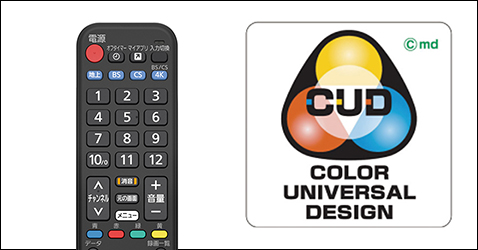
Remote Control Color Keys
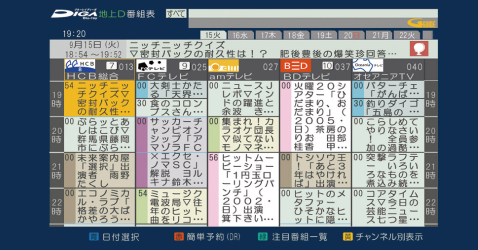
Electronic Program Guide with Color Coded Categories
Research on preventing household accidents|Safety Consideration: Artificial Fingers
Implementation of verification process
Award-winning (Kids Design Award)
Accidents in the house involving children, such as fingers getting caught in folding doors or when closing ordinary doors, are common. To address this issue, Panasonic has developed artificial fingers modeled after children's fingers to assess the safety of various scenarios, including whether the fingers can fit in a gap, be cut, or be fractured. Based on the results, we established internal criteria by quantifying risk levels and establishing guidelines, which were then adopted in the verification process.
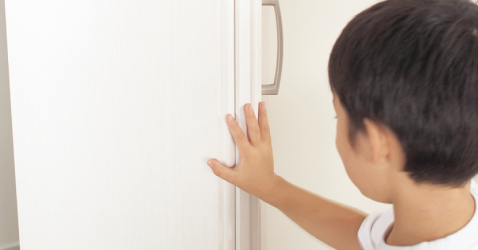
Safety Consideration
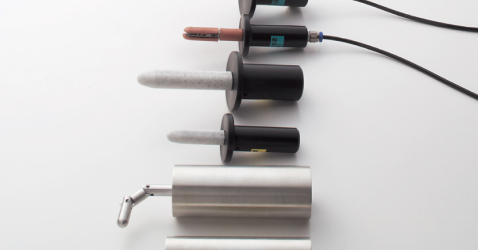
Various artificial finger models
Research on easy-to-understand displays|UD pictogram
Global compatibility
Company-wide criteria development
How does each product serve the needs of the elderly, the disabled, caregivers and assistants by providing the gentleness and ease of use they need? To inform consumers of these qualities through simple visual cues, Panasonic proposed the UD pictogram. In 2001 the pictogram was adopted as an in-house standard. To respond to globalization and technological advances, in 2016 other pictograms were added. Surveys were conducted in seven countries: Canada, China, Japan, Malaysia, Thailand and the United States. Based on the results of those surveys, Panasonic refined the pictograms to make them more intuitive.
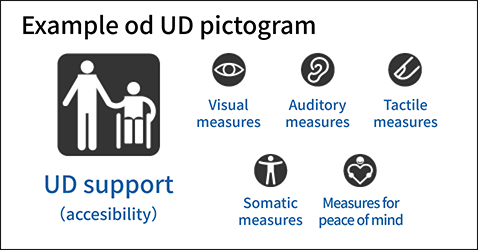

Reserch on Motion, Burden, and Mobility|Scientifically evaluate the 'ease of use'
Proprietary development database
Panasonic is continuing to develop products that visualize and quantify the vague sensation that is “user friendly”, using various scientific analysis such as the load on muscles and changes in the center of gravity. We have conducted digital human simulations to visualize physical strain, employing a database of body types acquired by approximately 40,000 Japanese individuals of all ages and genders. Further, based on our proprietary physical strain database measured under the supervision of the National Institute of Technology and Evaluation, we can quantitatively assess the strain a person experiences through certain postures and movements.
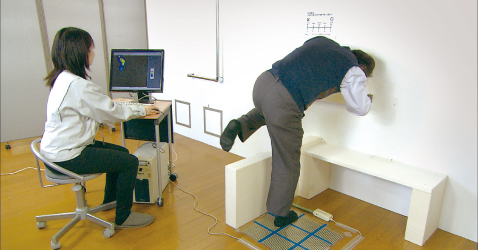
Reserch on Motion, Burden, and Mobility
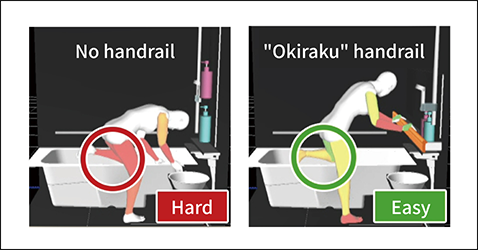
Digital human simulation
Reserch on a society kind to both people and robots|Robotics Accessibility Project
Pioneer
Since 2015, Panasonic has been conducting demonstrations utilizing ICT equipment and robotics to create a society in which everyone, including foreigners and people with disabilities, can go places safely without getting lost. In 2016, we received the IAUD Gold Award for creating a practical solution that seamlessly integrates hardware and software. Building on this achievement, we launched the Robotics Accessibility Project. We are developing a range of services by adding the essence of accessibility, which indicates ease of access and convenience, and the perspective of universal design (UD), which aims to create products, towns, and systems that are easy for more people to use and live in, to its development of cutting-edge technologies such as robotics and mobility.
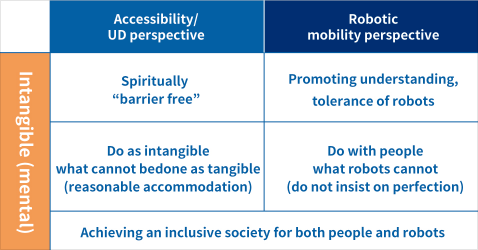
There are similarities between UD, which represents ease of use for people, accessibility, which represents ease of access, and the concept of service through robotic mobility.
The accessibility/UD perspective looks at the environment, rather than the person, in the tangible, physical aspect. In the intangible, mental aspect, it looks to cover those parts where the tangible cannot through helping each other (spiritually “barrier free”).In reality, and like with robotic mobility, we are moving ahead from preparing environments to ensure that the robots can move easily. However, there are times when robots cannot exert 100% of their capabilities by preparing the tangible aspects alone. However, there are times when robots cannot exert 100% of their capabilities by preparing the tangible aspects alone. We therefore deepen our understanding of robotics and propose the idea of exploring further possibilities through the collaboration of humans and robots.
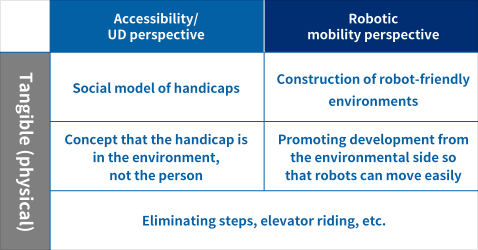
Ideas about accessibility/UD and robotic mobility