


At Panasonic, we have developed tools to support expanding empathy through Inclusive Design. These tools are already being put into practice within the company, and here we share some of them publicly with the aim of deepening understanding of Inclusive Design and inviting more partners inside and outside the company to join us. We hope these tools will serve as a catalyst to shift perspectives and actions and help spread greater kindness across society.
Persona Spectrum Tool
■ About the Tool
This tool is designed to support one of “Five Principles for Expanding Empathy” —Overarching: starting from ideas for one individual and extending them to create a better life for all.
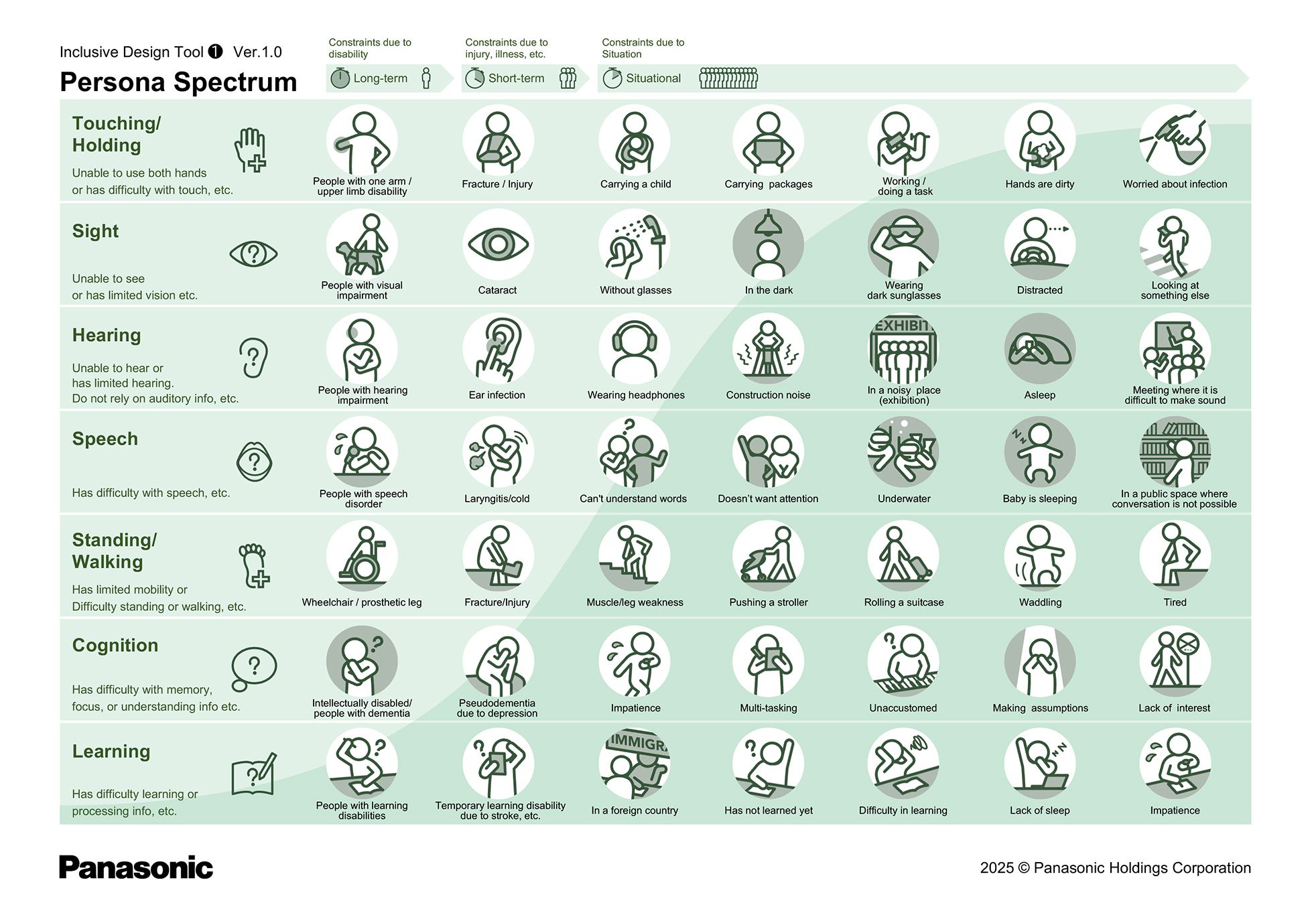
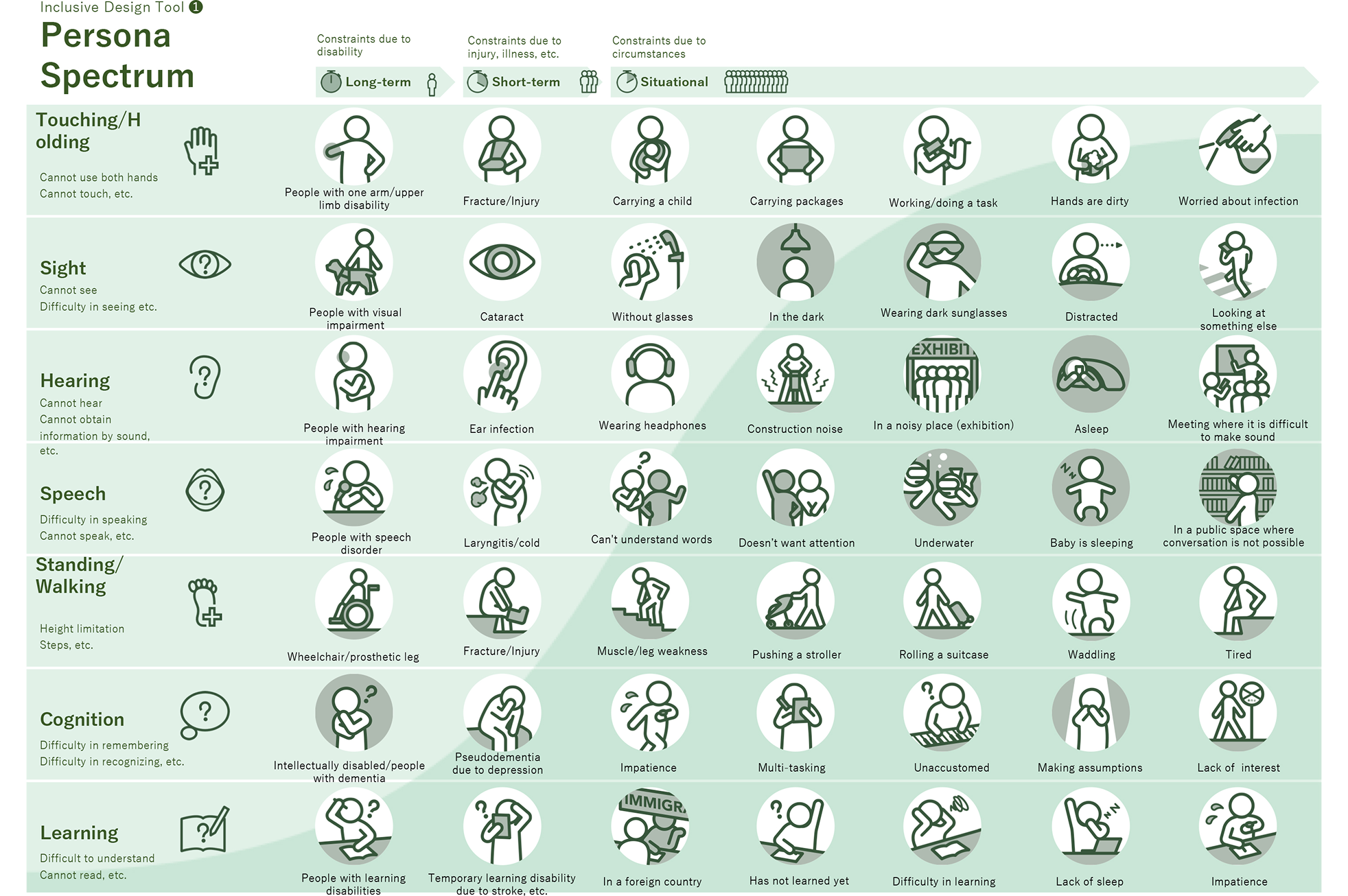
The Persona Spectrum helps teams imagine diverse situations by grouping experiences of constraint according to:
Shared interactions (such as touching, seeing, or hearing), and Types of circumstances (for example, long-term conditions or temporary situations).
By doing so, insights gained from dialogue with one person can be translated into ideas that benefit many. Including not only long-term conditions but also temporary situations that anyone may encounter makes it easier for creators and developers to relate personally and generate inclusive ideas.
■ How to Use
1. Identify the person you engaged with as the starting point for your idea and circle their situation.
2. Consider whether the idea is also effective for people in short-term or temporary situations shown on the right-hand side. If yes, circle them as well.
3. Next, consider whether the idea may also be effective for people with different long-term conditions. If yes, circle them.
4. Finally, review the spread of impact by looking at how broadly the circled areas extend.
(PDF available for download)

Inclusive Design Worksheet
■ About the Worksheet
This worksheet supports another of “Five Principles for Expanding Empathy” —Insight: always recognizing that there are perspectives and voices we may have overlooked.
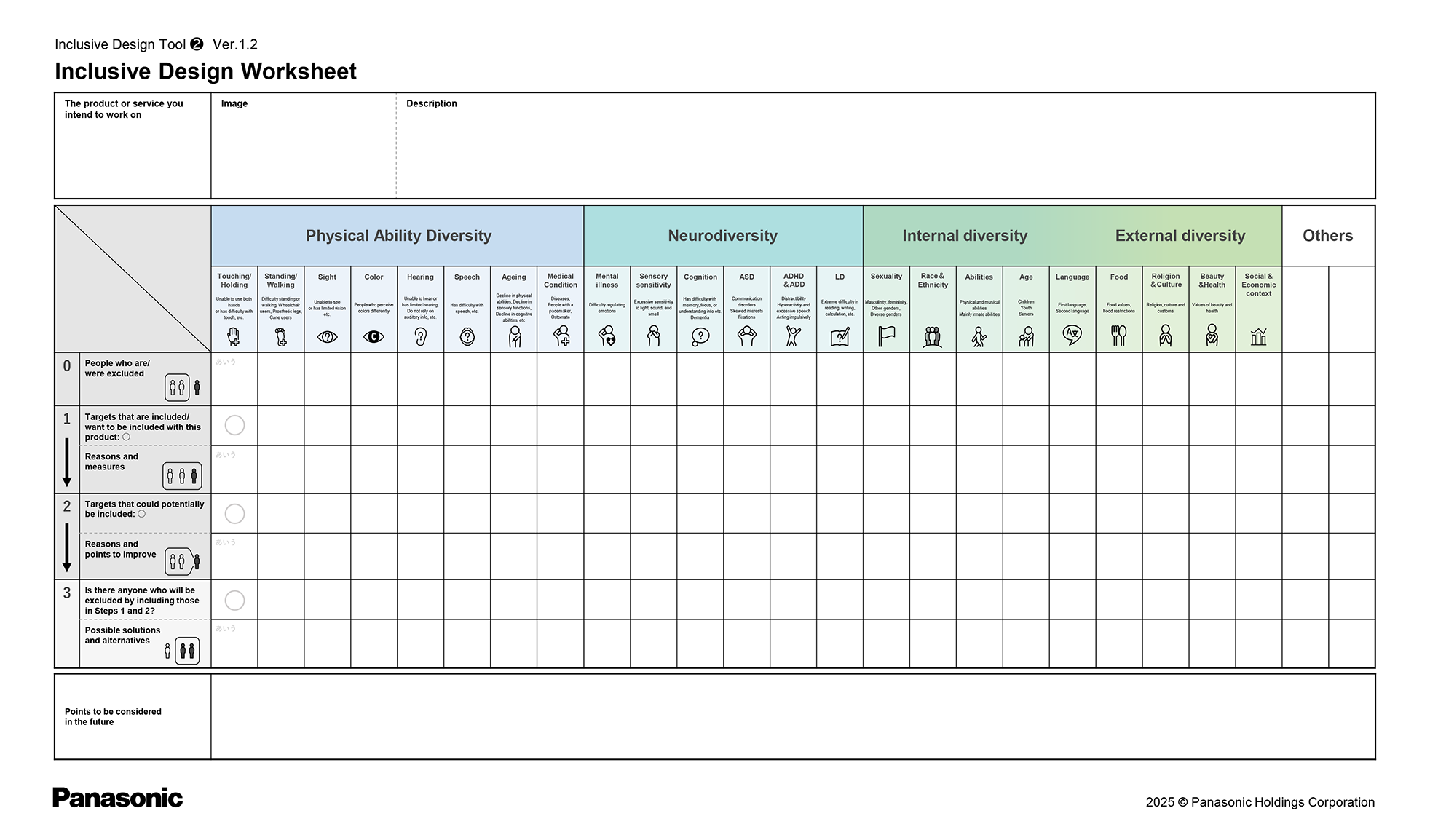
It is designed to help teams expand the range of people considered in product and service development, ensuring that overlooked needs and perspectives are consciously included.
- Horizontal axis: Different aspects of diversity (physical, neurodiversity, internal factors, external factors)
- Vertical axis: Current inclusion efforts, new ideas and hypotheses, and considerations for unintended exclusions that may emerge.
■ How to Use
Begin by writing the product or service you are working on in the top box.
Then proceed through the following steps:
0. Identify who may have been excluded
Reflect on whether there are people who have been excluded by the product/service noted in the top box. If so, describe how.
1. Current state / existing ideas
Mark user groups that are already included—or those you would like to include—with a circle in the upper row, and write down the specific measures or ideas in the lower row.
2. Explore possibilities for expansion
Consider whether the ideas in Step 1 could be extended to other user groups. If so, mark them in the upper row and note hypotheses for consideration below.
3. Check for new exclusions
Review whether any new exclusions may arise as a result of Steps 1 and 2. If so, circle them in the upper row and describe countermeasures or alternatives in the lower row.
Finally, summarize the key points for further consideration at the bottom of the sheet.
This worksheet is intended as a starting point for reflection. The next step is to engage in dialogue with those you have identified as potentially excluded, or with those you aim to include.
(PDF available for download)
At Panasonic, we have developed tools to support expanding empathy through Inclusive Design. These tools are already being put into practice within the company, and here we share some of them publicly with the aim of deepening understanding of Inclusive Design and inviting more partners inside and outside the company to join us. We hope these tools will serve as a catalyst to shift perspectives and actions and help spread greater kindness across society.
Persona Spectrum Tool
■ About the Tool
This tool is designed to support one of “Five Principles for Expanding Empathy” —Overarching: starting from ideas for one individual and extending them to create a better life for all.
The Persona Spectrum helps teams imagine diverse situations by grouping experiences of constraint according to:
Shared interactions (such as touching, seeing, or hearing), and Types of circumstances (for example, long-term conditions or temporary situations).
By doing so, insights gained from dialogue with one person can be translated into ideas that benefit many. Including not only long-term conditions but also temporary situations that anyone may encounter makes it easier for creators and developers to relate personally and generate inclusive ideas.
■ How to Use
1. Identify the person you engaged with as the starting point for your idea and circle their situation.
2. Consider whether the idea is also effective for people in short-term or temporary situations shown on the right-hand side. If yes, circle them as well.
3. Next, consider whether the idea may also be effective for people with different long-term conditions. If yes, circle them.
4. Finally, review the spread of impact by looking at how broadly the circled areas extend.
(PDF available for download)
Inclusive Design Worksheet
■ About the Worksheet
This worksheet supports another of “Five Principles for Expanding Empathy” —Insight: always recognizing that there are perspectives and voices we may have overlooked.
It is designed to help teams expand the range of people considered in product and service development, ensuring that overlooked needs and perspectives are consciously included.
- Horizontal axis: Different aspects of diversity (physical, neurodiversity, internal factors, external factors)
- Vertical axis: Current inclusion efforts, new ideas and hypotheses, and considerations for unintended exclusions that may emerge.
■ How to Use
Begin by writing the product or service you are working on in the top box.
Then proceed through the following steps:
0. Identify who may have been excluded
Reflect on whether there are people who have been excluded by the product/service noted in the top box. If so, describe how.
1. Current state / existing ideas
Mark user groups that are already included—or those you would like to include—with a circle in the upper row, and write down the specific measures or ideas in the lower row.
2. Explore possibilities for expansion
Consider whether the ideas in Step 1 could be extended to other user groups. If so, mark them in the upper row and note hypotheses for consideration below.
3. Check for new exclusions
Review whether any new exclusions may arise as a result of Steps 1 and 2. If so, circle them in the upper row and describe countermeasures or alternatives in the lower row.
Finally, summarize the key points for further consideration at the bottom of the sheet.
This worksheet is intended as a starting point for reflection. The next step is to engage in dialogue with those you have identified as potentially excluded, or with those you aim to include.
(PDF available for download)