


Outline
Accessibility maps are tools that provide the information necessary for all employees and visitors—regardless of disability—to reach their destination efficiently. While traditional barrier-free maps often indicate only the presence of steps or facilities, accessibility maps visualize potential barriers and conditions along the route to the destination (e.g., slopes, sidewalk width, congested points, etc.). This enables users to select the most suitable route based on their physical characteristics, abilities, and mobility needs.
To incorporate diverse perspectives, we adopted an inclusive design process in which not only wheelchair users but also coworkers from the same workplace participated. Together, we observed the site and exchanged insights while mapping the environment. This approach goes beyond simply organizing information and also contributes to fostering an inclusive organizational culture.


Gain insights from dialogue at conceptualization stage
The idea for the Accessibility maps was inspired by a session at the 2022 Panasonic Group DEI Forum. During the session, an employee who uses a wheelchair shared:
“I want to travel to other sites for business, but I want to know in advance where the meeting room is located within the building, which side the ramp is on along the route, and whether there is an elevator. However, that information is not available.”
The employee also expressed:
“I have a disability, but I want to challenge myself for management roles just like anyone else, so I am honing my expertise. Of course, I want to go on business trips too, but if the necessary information isn’t provided, I start to wonder whether the company expects someone like me to be able to perform and succeed.”
Hearing this, a project was launched to organize information for each Panasonic Group site, create accessibility maps, and publish them on the Group’s intranet site.


Refining the solution method through repeated dialogue
The Accessibility map project was driven by volunteer members within the company who resonated with its purpose and gathered primary information through on-site surveys. To create:
- a site map that clearly indicates accessible routes within the workplace, and
- an access map from the nearest station to the workplace,
the team worked together with employees who use wheelchairs. They navigated the workplace together, experiencing mobility within the environment from different perspectives, and filled in base maps as they progressed.
In addition, through chats on the company’s internal social networking platform, they shared observations such as “This route feels safe to take” and “This area is difficult to pass through.”
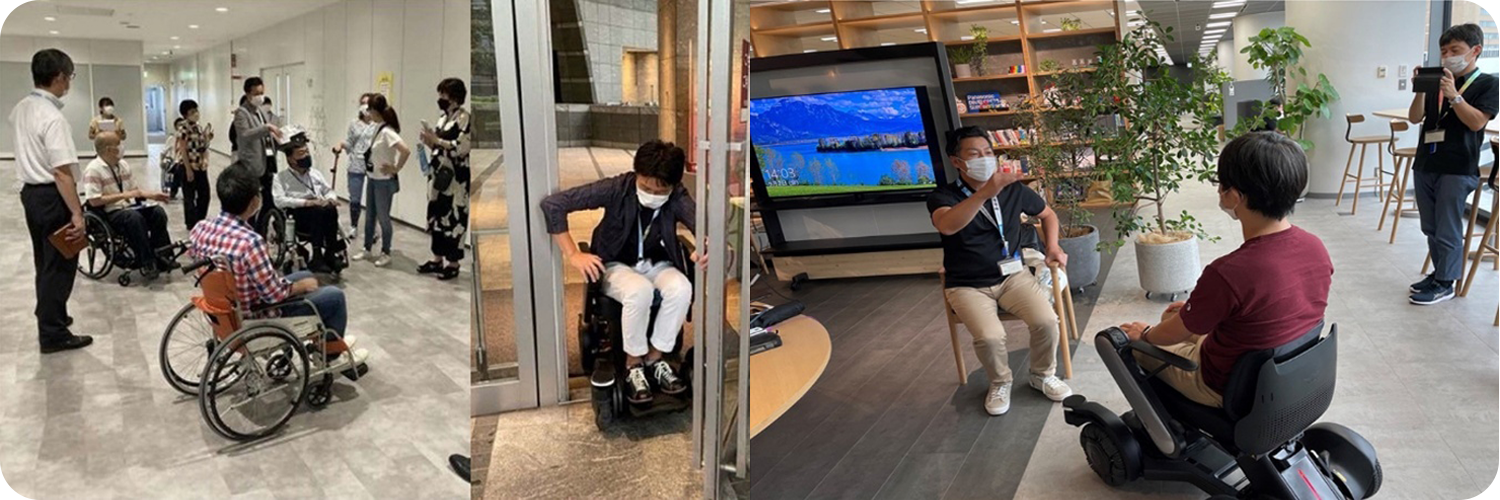
Left photo: Employees experiencing wheelchair mobility. Right photo: Employees exchanging business cards with a wheelchair user.


Verification to see if the problem has been solved
After Accessibility maps had been created at multiple sites, the employee who originally inspired the initiative traveled from Kansai to the Tokyo site to verify the maps in practice.
The Tokyo site’s “Access Map from Station to Workplace” included not only information such as the presence of steps and hazardous areas, but also detailed considerations—for example: “This crosswalk is long, so it may be difficult to cross within a single green-light cycle.” Such details enabled the employee to move around safely and with confidence.
After successfully completing the business trip, the employee shared the experience in an internal intranet article. Along with the joy of meeting people and expanding their network through the trip, they emphasized:
“Please don’t think, ‘Let’s stop asking wheelchair users to travel for work.’”
This initiative later expanded to other sites, and today, Accessibility maps have been created at 20 locations within the Panasonic Group.
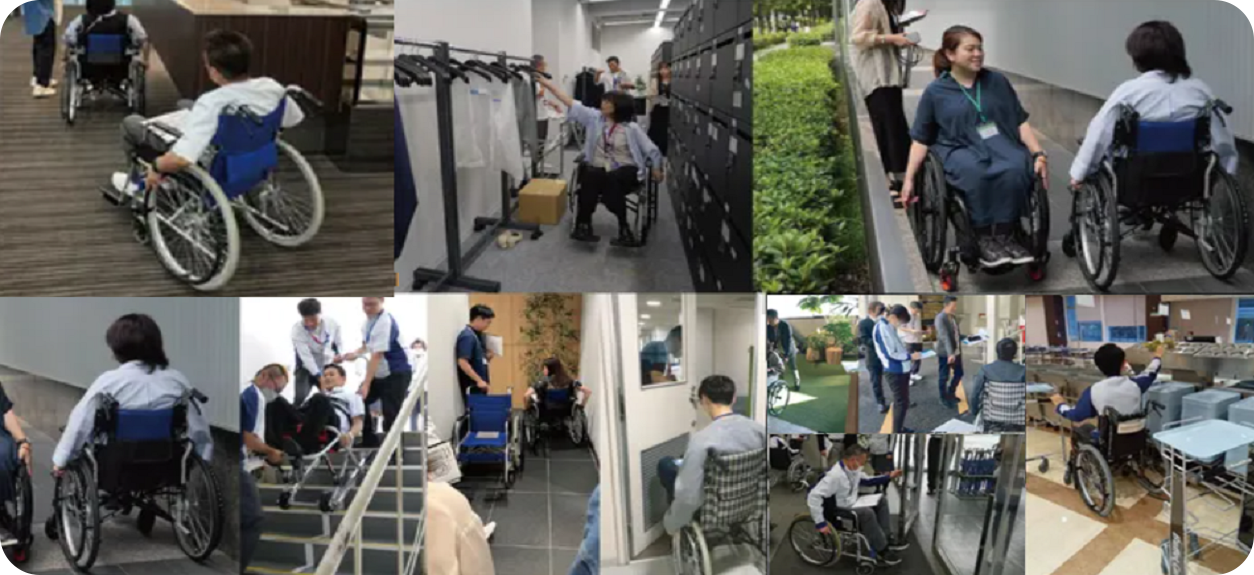
Photos showing wheelchair testing conducted at various locations

Gain insights from dialogue at conceptualization stage
The idea for the Accessibility maps was inspired by a session at the 2022 Panasonic Group DEI Forum. During the session, an employee who uses a wheelchair shared:
“I want to travel to other sites for business, but I want to know in advance where the meeting room is located within the building, which side the ramp is on along the route, and whether there is an elevator. However, that information is not available.”
The employee also expressed:
“I have a disability, but I want to challenge myself for management roles just like anyone else, so I am honing my expertise. Of course, I want to go on business trips too, but if the necessary information isn’t provided, I start to wonder whether the company expects someone like me to be able to perform and succeed.”
Hearing this, a project was launched to organize information for each Panasonic Group site, create accessibility maps, and publish them on the Group’s intranet site.
Refining the solution method through repeated dialogue
The Accessibility map project was driven by volunteer members within the company who resonated with its purpose and gathered primary information through on-site surveys. To create:
- a site map that clearly indicates accessible routes within the workplace, and
- an access map from the nearest station to the workplace,
the team worked together with employees who use wheelchairs. They navigated the workplace together, experiencing mobility within the environment from different perspectives, and filled in base maps as they progressed.
In addition, through chats on the company’s internal social networking platform, they shared observations such as “This route feels safe to take” and “This area is difficult to pass through.”
Left photo: Employees experiencing wheelchair mobility. Right photo: Employees exchanging business cards with a wheelchair user.
Verification to see if the problem has been solved
After Accessibility maps had been created at multiple sites, the employee who originally inspired the initiative traveled from Kansai to the Tokyo site to verify the maps in practice.
The Tokyo site’s “Access Map from Station to Workplace” included not only information such as the presence of steps and hazardous areas, but also detailed considerations—for example: “This crosswalk is long, so it may be difficult to cross within a single green-light cycle.” Such details enabled the employee to move around safely and with confidence.
After successfully completing the business trip, the employee shared the experience in an internal intranet article. Along with the joy of meeting people and expanding their network through the trip, they emphasized:
“Please don’t think, ‘Let’s stop asking wheelchair users to travel for work.’”
This initiative later expanded to other sites, and today, Accessibility maps have been created at 20 locations within the Panasonic Group.
Photos showing wheelchair testing conducted at various locations
