


Outline
Communication Support Cards are a tool that makes workplace concerns and requests for support visible—things that are often difficult to voice directly—in the form of cards, creating opportunities for dialogue. These cards were developed by visualizing insights gathered through surveys of Panasonic Group employees and actual workplace interviews, focusing on questions like “What kinds of feelings or situations are difficult?” and “What kinds of responses or adjustments would be helpful?”.
However, these cards are not intended for individuals facing difficulties to unilaterally request consideration. They were developed as a communication tool to help people understand each other's perspectives and backgrounds through the cards, and to consider “how we can create a more comfortable environment to work together.”
Use of the cards is voluntary, and we handle feedback and examples with appropriate care for privacy and consent.
*This project is not currently commercialized. Content may be subject to change in the future.


Gain insights from dialogue at conceptualization stage
It started with a small comment from one employee. An employee shared a “Communication Cards” they had created for a friend's child with developmental disabilities via the company chat. This prompted numerous requests for similar cards to be created for employees and the workplace.
We then solicited ideas on what types of cards would be helpful, gathering over 100 suggestions. Many specific requests came from individuals with hearing impairments, such as “Please remove your mask” or “Please speak slowly with your mouth open wide.” Even among those with hearing impairments, communication preferences vary greatly: some find sign language easier, others are skilled at reading lips, and some prefer writing. A clear need emerged: “We want to be able to tell others what we need!”
However, many employees had not disclosed their disabilities, raising concerns that the cards might become skewed toward the voices of those who feel safe enough to speak up.
Therefore, we collaborated with employees who had led inclusive design efforts and, with company support, decided to launch this as an official project to gather opinions more broadly across the entire company. We specifically listened to detailed requests from employees with hearing impairments, developmental disabilities, mental health conditions, and those concerned about their health, who had high expectations for the cards. Based on these results, we prototyped the cards.
We also considered how the cards could be used without requiring individuals to disclose personal information, while still enabling practical, workplace-specific dialogue.
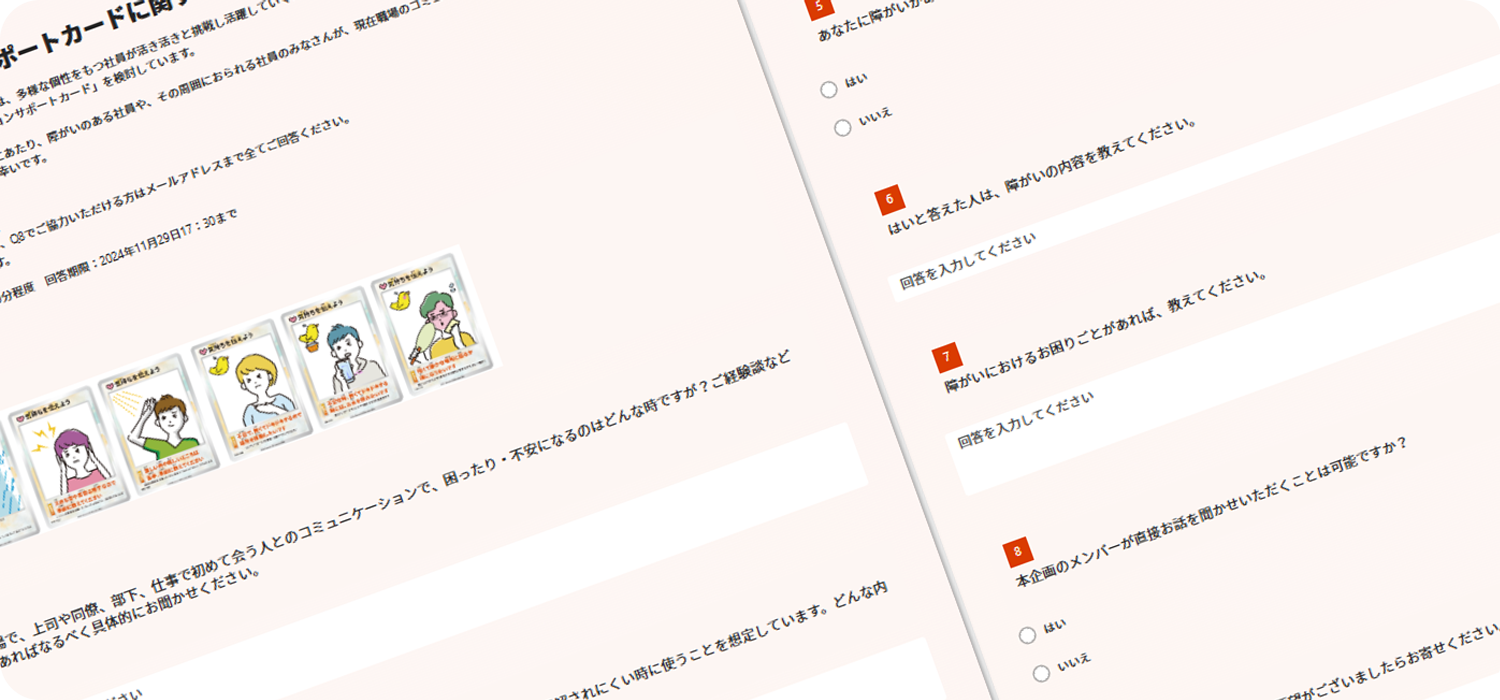
Survey on Communication Support Cards Conducted for All Employees


Refining the solution method through repeated dialogue
We conducted a one-week trial of the prototype cards, primarily with the employees who contributed the ideas, using them in the workplace. Before and after the trial, we interviewed both the employees and their supervisors. Both parties gave positive feedback, such as, “It was good to be able to understand the situation!” On the other hand, we also heard the following concerns:
- The words and illustrations on the cards felt a bit harsh, making them difficult to present
- Even when mustering the courage to present them, they were sometimes declined / perceived as asking for preferential treatment
- Some requests left supervisors unsure how to accommodate them appropriately Furthermore, when we conducted broad interviews with the ERG for employees with disabilities, we also heard:
- We want an equal relationship, not one where we have to ask for favors like “Please do XX for us.”
While we were able to adjust the tone of the expressions, a key challenge emerged: it's not about “just handing out the cards and calling it done.” What matters most is using the cards as a starting point to deepen dialogue.
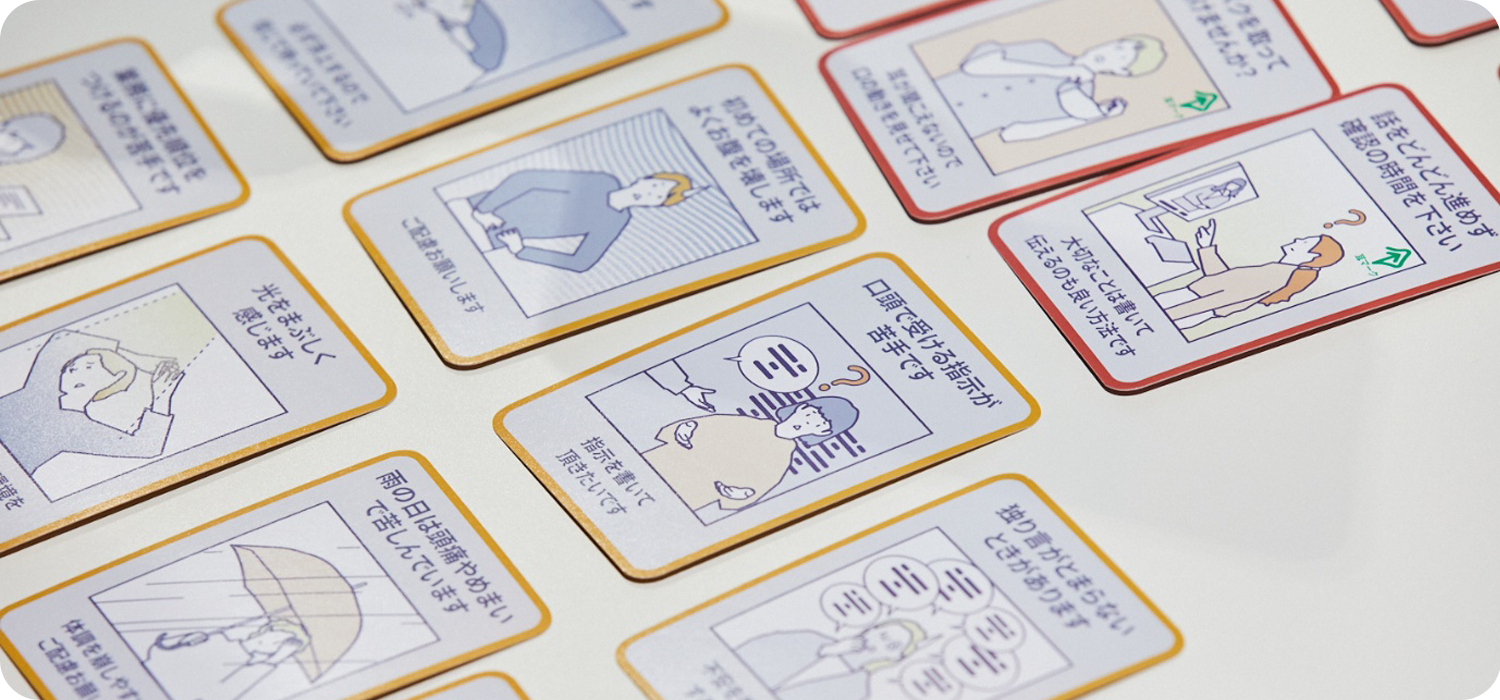
Communication Support Cards Improved Through Verification


Verification to see if the problem has been solved
The cards, improved based on feedback from workplace trials and ERG interviews, are now being used in the workplaces of employees who helped create them, as well as in workplaces that contacted us expressing interest in using them.
Furthermore, based on advice from expert instructors, we conducted workshops in several workplaces with the cooperation of managers and team members. These workshops focused on sharing feelings when “giving” and “receiving” the cards. Participants evaluated the workshops as opportunities to recognize differences in each other's perspectives and deepen mutual understanding.
We also emphasized that both employees and managers share responsibility for building a workable approach, rather than placing the burden solely on the person presenting a card.
The Communication Support Cards reflect current challenges within the company, so we plan to continue updating them based on ongoing feedback from various workplaces. We also recognize that, given the diversity of workplaces, the cards alone cannot solve every issue.
Therefore, we will combine them with other initiatives to foster a culture that deepens mutual understanding and maximizes individual potential.
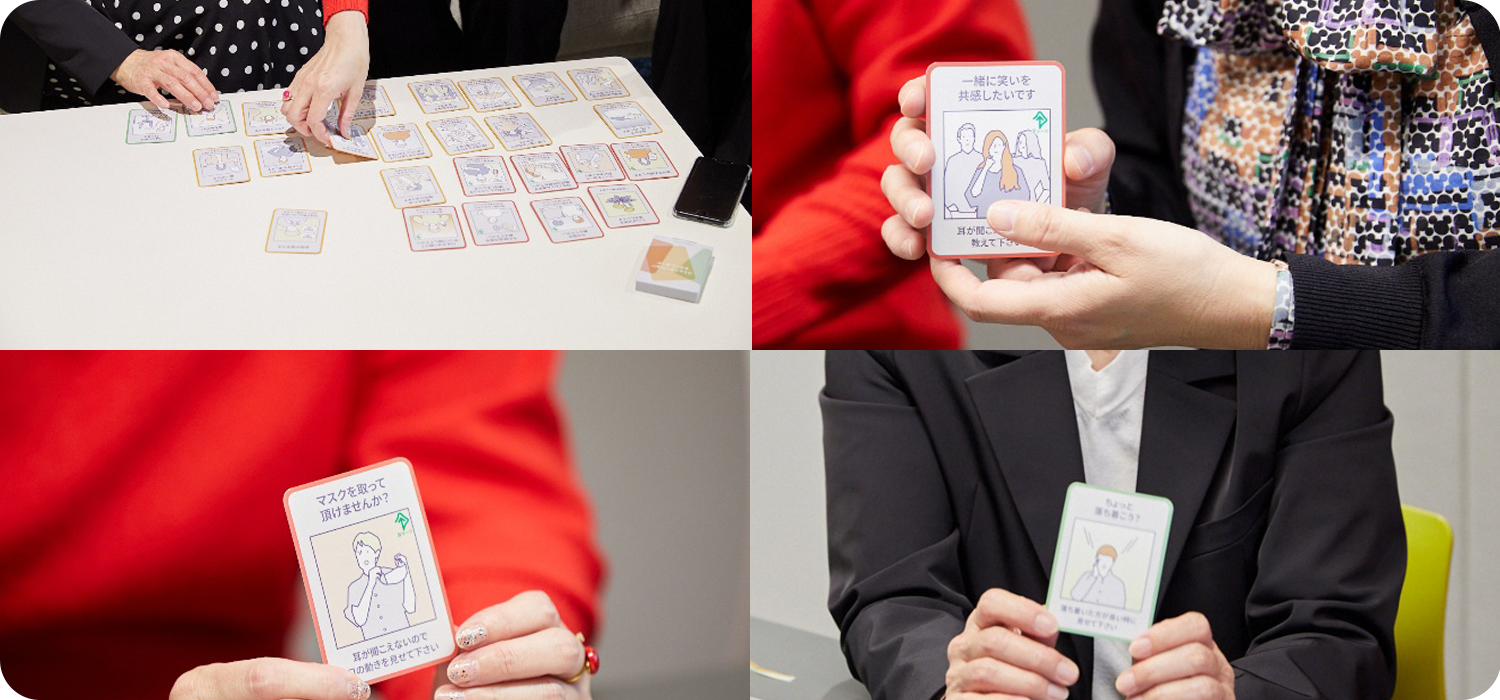
Employees involved in card production selecting their favorite cards.
Gain insights from dialogue at conceptualization stage
It started with a small comment from one employee. An employee shared a “Communication Cards” they had created for a friend's child with developmental disabilities via the company chat. This prompted numerous requests for similar cards to be created for employees and the workplace.
We then solicited ideas on what types of cards would be helpful, gathering over 100 suggestions. Many specific requests came from individuals with hearing impairments, such as “Please remove your mask” or “Please speak slowly with your mouth open wide.” Even among those with hearing impairments, communication preferences vary greatly: some find sign language easier, others are skilled at reading lips, and some prefer writing. A clear need emerged: “We want to be able to tell others what we need!”
However, many employees had not disclosed their disabilities, raising concerns that the cards might become skewed toward the voices of those who feel safe enough to speak up.
Therefore, we collaborated with employees who had led inclusive design efforts and, with company support, decided to launch this as an official project to gather opinions more broadly across the entire company. We specifically listened to detailed requests from employees with hearing impairments, developmental disabilities, mental health conditions, and those concerned about their health, who had high expectations for the cards. Based on these results, we prototyped the cards.
We also considered how the cards could be used without requiring individuals to disclose personal information, while still enabling practical, workplace-specific dialogue.
Survey on Communication Support Cards Conducted for All Employees
Refining the solution method through repeated dialogue
We conducted a one-week trial of the prototype cards, primarily with the employees who contributed the ideas, using them in the workplace. Before and after the trial, we interviewed both the employees and their supervisors. Both parties gave positive feedback, such as, “It was good to be able to understand the situation!” On the other hand, we also heard the following concerns:
- The words and illustrations on the cards felt a bit harsh, making them difficult to present
- Even when mustering the courage to present them, they were sometimes declined / perceived as asking for preferential treatment
- Some requests left supervisors unsure how to accommodate them appropriately Furthermore, when we conducted broad interviews with the ERG for employees with disabilities, we also heard:
- We want an equal relationship, not one where we have to ask for favors like “Please do XX for us.”
While we were able to adjust the tone of the expressions, a key challenge emerged: it's not about “just handing out the cards and calling it done.” What matters most is using the cards as a starting point to deepen dialogue.
Communication Support Cards Improved Through Verification
Verification to see if the problem has been solved
The cards, improved based on feedback from workplace trials and ERG interviews, are now being used in the workplaces of employees who helped create them, as well as in workplaces that contacted us expressing interest in using them.
Furthermore, based on advice from expert instructors, we conducted workshops in several workplaces with the cooperation of managers and team members. These workshops focused on sharing feelings when “giving” and “receiving” the cards. Participants evaluated the workshops as opportunities to recognize differences in each other's perspectives and deepen mutual understanding.
We also emphasized that both employees and managers share responsibility for building a workable approach, rather than placing the burden solely on the person presenting a card.
The Communication Support Cards reflect current challenges within the company, so we plan to continue updating them based on ongoing feedback from various workplaces. We also recognize that, given the diversity of workplaces, the cards alone cannot solve every issue.
Therefore, we will combine them with other initiatives to foster a culture that deepens mutual understanding and maximizes individual potential.
Employees involved in card production selecting their favorite cards.
