


Environmental Support for the Entire Factory
Business of Factory Support Service
Panasonic launched its Factory Support Service Business in April 2010, by making use of actual results in reducing CO2 emissions in production activities in the three years of fiscal 2008-2010. This service provides all-round support in energy-saving activities at factories, from visualization of energy use and energy efficiency diagnoses to execution of concrete energy efficiency measures, covering the aspects of technology, facility and equipment, human resources, and finance.
As part of this service, we have analyzed data which are managed by respective our customers, and understood the level of energy consumption efficiency with basic energies such as electricity and gas used in respective factories, physical data such as energy flow, pressure, temperature, and humidity that directly reflects the operation status of the facility and equipment. With the analysis results, we have supported the customers in swiftly formulating energy efficiency measures, making trial calculations, and improving accuracy of the verification.
At the beginning when the business started, we worked to clearly understand deterioration of equipment and necessity of its maintenance, through indicating variations of energy efficiency in long term in graphic displays with power equipment such as compressors, boilers, and freezers, and reduced their wasted energy consumption. Then, we accelerated energy efficiency activities, through paying attention to the production volume per basic unit calculated from the production volume and energy consumption, and utilizing the production volume per basic unit to "CO2 ITAKONA method" which timely extracts issues of production lines, and of facilities and equipment.
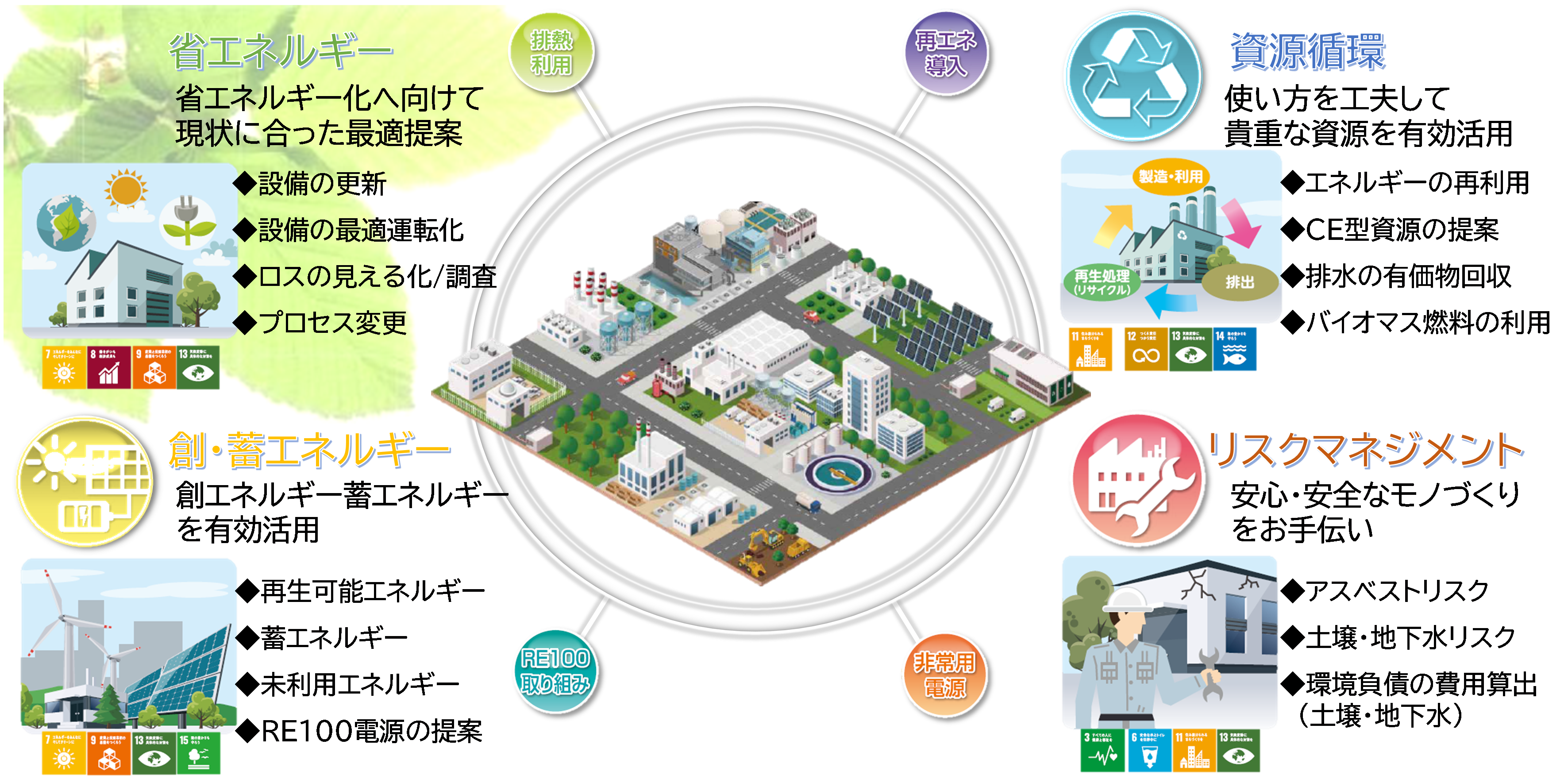
From fiscal 2020, we have further updated our activities; we have started the "Factory support service business" that formulates activities and plans for improvement in all of the areas related to the customer’s environmental sustainability management, including "energy-saving", "new energy and energy creation", "resource circulation" and "risk management."
In a contribution outside the company, in the 13 years from 2010 to 2023, we conducted diagnosis for approximately 789 cases, and provided energy-saving and factory support in the automotive-related, food, pharmaceutical, machinery, and electronic components industries in Japan. Moreover, we registered as a diagnostic service body dedicated to corporate energy efficiency diagnosis for 'Support for High-efficiency Installations for Facilities with Targets' led by the Ministry of the Environment, which provides information on the use of effective facilities and equipment, operational improvements, and the like, in order to reduce CO2 emission. We continue these energy efficiency activities.
By making full use of environmental technologies, know-hows, and experience which have been developed and established in Panasonic group, the service of the Total Environmental Package Solutions for Entire Factory, which provides a total solution that covers not only energy efficiency measures, but also environmental and energy technologies in wastewater treatment and drainage and water recycling, exhaust gas treatment, resources recycling, soil and groundwater purification, and photovoltaic power generation, has been developed. By enhancing the package service, we will further contribute to the comprehensive environmental solutions for Panasonic customers.

Image of Business of Factory Support
Examples of carbon neutral factories
Introduction of an EMS (Energy Management System) at Panasonic Energy Co., Ltd.’s Nishikinohama Factory
In fiscal 2025, PESENG introduced pure hydrogen fuel cell generators (30 kW) at Panasonic Energy Co., Ltd.’s Nishikinohama Factory, contributing to an increase in the ratio of renewable energy. In fiscal 2026, we will be installing one hydrogen holder (150 m3) as a fuel supply facility for the pure hydrogen fuel cell generators. We also plan to launch an EMS facility that combines pure hydrogen fuel cells with existing solar cells (approx. 2 MW) and storage batteries (approx. 2 MWh) in order to reduce peak energy consumption in business activities.
The newly introduced EMS is equipped with a “prediction function” not implemented in conventional systems. It automatically predicts energy consumption in business activities and the amount of power generated by solar cells, and performs peak shaving based on accurate thresholds in real time.
By introducing this EMS, we aim to reduce the amount of electricity used during the summer, when energy consumption is the highest, and to reduce contracted power consumption. We will analyze data throughout the year and aim to build a system that optimally controls the three types of batteries (fuel cells, solar cells, and storage batteries) according to the factory’s operating conditions and load fluctuations.
PESENG will contribute to reducing CO2 emissions throughout the Panasonic Group by deploying these technologies and initiatives at other sites.
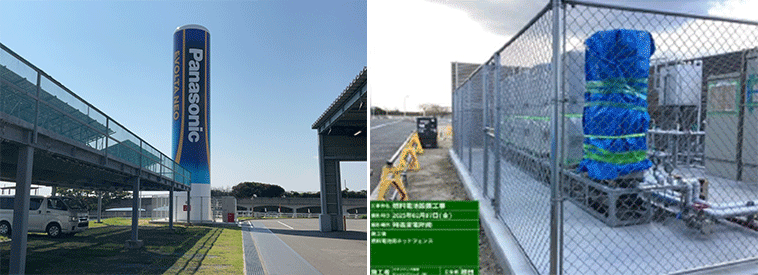
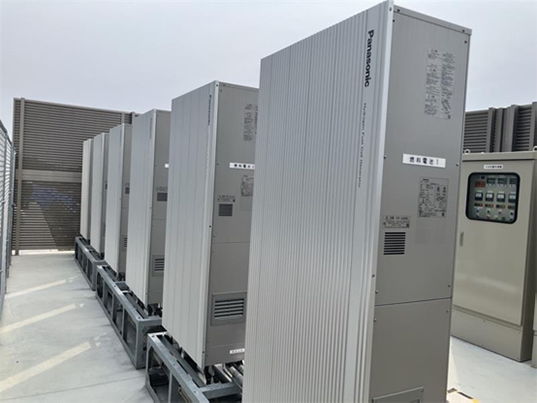
Introduction of pure hydrogen fuel cell generators (Nishikinohama Factory, Panasonic Energy Co., Ltd.)
Installation of Glass-Based Perovskite Solar Cells at "Technology CUBE" of the Technology Sector at Panasonic Holdings Corporation
In fiscal 2026, Panasonic Environmental Systems & Engineering Co., Ltd. (PESENG) contributed to the installation of glass-based perovskite solar cells for demonstration purposes at Technology CUBE*1 , a facility of the Technology Sector at Panasonic Holdings Corporation.
This demonstration project was positioned as a pilot initiative conducted before Technology CUBE began full operations.
The project aimed to evaluate the ease of retrofitting additional window frames and methods for routing the wiring. Specifically, only the glass panes were removed while the existing window frames were left in place. New frames capable of accommodating wiring were then retrofitted, and the glass-based perovskite solar cells were installed within them.
With a view to expanding into new business domains, PESENG will continue to advance this initiative in collaboration with Panasonic Holdings Corporation.
*1 Technology CUBE
An ever-evolving experimental facility that aims to remain a cutting-edge laboratory for the next 100 years. Based on the three concepts of Well-Being, Sustainability, and Flexibility, it explores and develops both workplaces and ways of working for the next century, helping shape the future.
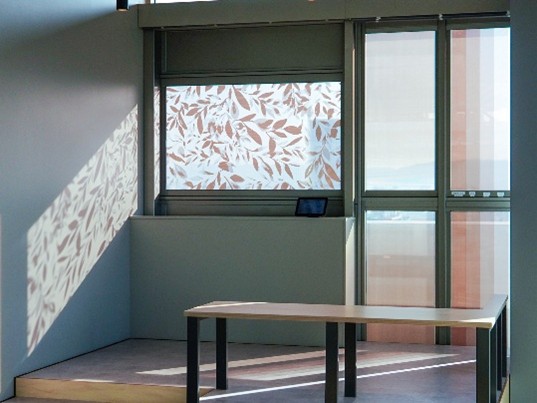

Glass-Based Perovskite Solar Cells (Overall and Close-Up Views)
